Home
» Technology
»
Where to Study Cross-Border Digital Supply Chain Management: 7 Programs to Compare
Where to Study Cross-Border Digital Supply Chain Management: 7 Programs to Compare
The first question is not “Which university is best?” It is “What part of a cross-border digital supply chain do you actually want to manage?” A procurement analyst working with global suppliers needs a different skill mix from a logistics planner managing ports and warehouses, a digital-transformation consultant implementing analytics and enterprise systems, or a trade specialist focused on customs and compliance.
There is also an important naming issue. Few leading degrees are literally called “Cross-Border Digital Supply Chain Management.” Instead, the strongest fits usually sit under Supply Chain Management, Global Logistics, Global Operations, or Digital Supply Chain Management. The practical task is to compare the curriculum for four things: global network design, digital and analytical tools, cross-border trade exposure, and real-world application.
As of September 2026, several programs stand out because their official curricula or program descriptions make those elements unusually clear. The list below is not a universal ranking; it is a decision guide for different career goals.
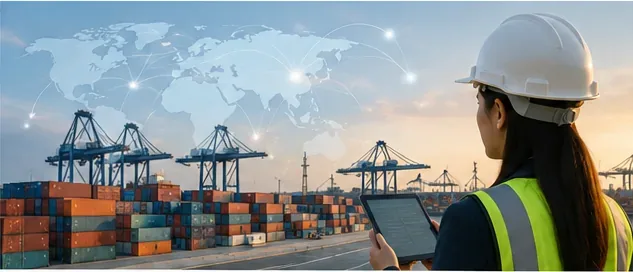
A logistics professional reviews operations at a container terminal, reflecting the mix of global trade, digital visibility, analytics, and physical logistics that defines cross-border supply chain management.
What should you decide before choosing a program?
Start by choosing your target role. “Supply chain” covers planning, sourcing, manufacturing, transportation, warehousing, trade compliance, technology implementation, risk, sustainability, and analytics. A good program for one path can be too broad or too technical for another.
If your target is...
Look for...
Be cautious if...
Digital supply chain transformation
Analytics, enterprise systems, AI/data courses, process redesign, digitalization projects
The program is mostly traditional logistics with little technology content
Cross-border logistics
Global logistics, distribution networks, ports, transport, international business, network design
The curriculum focuses almost entirely on domestic operations
Customs, trade compliance, regulation, documentation, tariff and border processes
You assume a general SCM degree covers detailed customs practice when it may not
Supply chain analytics
Optimization, forecasting, simulation, statistics, data analysis, decision modeling
You want quantitative work but the course is mainly managerial
Which programs are the strongest overall fits?
1. MIT Supply Chain Management Master’s — best for deep analytics and systems thinking
The MIT Supply Chain Management Master’s Program is a strong fit if you want rigorous analytical training, leadership development, and fast re-entry into the workforce. MIT offers a 10-month residential pathway and a blended pathway that combines the MITx MicroMasters curriculum with five months on campus.
The digital component is especially visible in the MITx MicroMasters curriculum, which includes Supply Chain Analytics, Design, Dynamics, and Supply Chain Technology and Systems. That combination is useful for people who want to understand not only physical flows but also the information and technology architecture behind them.
Choose MIT if: your goal is supply chain analytics, network design, technology-enabled operations, or consulting and you are comfortable with a quantitatively demanding environment.
Check carefully if: your main objective is customs law or detailed import/export compliance. MIT is fundamentally a supply chain program, not a customs-specialist degree.
2. NUS MSc in Supply Chain Management — best for Asia-facing global supply chains
The National University of Singapore MSc in Supply Chain Management is explicitly positioned around modern supply chains in Asia with a global context. NUS states that students gain exposure to logistics and supply chain issues in a digitalized global economy and can apply business analytics plus industrial systems engineering to industry problems.
That positioning is useful for students interested in Southeast Asia, regional manufacturing networks, e-commerce, international logistics, and analytics. Singapore's role as a major trade, port, and aviation hub makes the setting especially relevant, although the location itself should not be treated as proof that a particular internship or job will be available.
Choose NUS if: you want a multidisciplinary business-and-engineering view of supply chains in Asia with explicit attention to digitalization and analytics.
Check carefully if: you need a very narrow specialization in customs or a specific enterprise platform. Verify the current module list for your intake before applying.
3. POLIMI GSoM International Master in Digital Supply Chain Management — best if “digital” must be central, not optional
The school says the curriculum gives special attention to Supply Chain, Big Data and Analytics, Technology, Innovation, and Sustainability. It also includes company interaction and an international study tour. That makes it a strong match for early-career professionals who want digital transformation to be a central part of the degree rather than one elective among many.
Choose POLIMI if: you want to work in supply chain digitalization, procurement transformation, analytics, or consulting and prefer a practice-heavy one-year format.
Check carefully if: you already have substantial work experience. POLIMI says the program is designed mainly for recent graduates, ideally with no more than three years of experience.
4. KLU Global Logistics & Supply Chain Management — best for global logistics depth and international exposure
The program includes Global Logistics Strategies, Supply Chain Analytics, Sustainability in Supply Chains, and International Business & Leadership. KLU's Saigon program adds an especially interesting cross-border angle: it is taught in English in Ho Chi Minh City, combines KLU expertise with regional input from HCMUT, includes digitalization in the curriculum, and offers an optional semester at KLU's Hamburg campus.
A recent update matters here. KLU opened its Saigon campus in 2025, and in September 2026 reported that the program had grown to more than 60 students there. That means this is no longer only a planned international expansion; it is an operating program.
Choose KLU if: you want logistics to be the core discipline and value international business, analytics, digitalization, and direct exposure to major logistics regions.
Check carefully if: you want a heavily technical data-science degree. KLU includes analytics and digital transformation, but the degree remains centered on logistics and supply chain management.
5. Rotterdam School of Management MSc Supply Chain Management — best for ports, global networks, and applied trade context
The Rotterdam School of Management MSc in Supply Chain Management is a one-year, 60-ECTS program taught in English. Its curriculum includes Supply Chain Decision Analytics, Distribution Networks, Purchasing and Supply Management, Facility Logistics Management, and Sustainable Supply Chains. Electives listed for the program include Ports in Global Networks and Introduction to Commodity Trade & Supply Networks.
RSM also states that its supply chain expertise covers digitalization and analytics, and emphasizes the proximity of the Port of Rotterdam. This is a particularly useful combination if your idea of “cross-border” means international physical flows, ports, distribution, sourcing, and network design rather than only software transformation.
Choose RSM if: you want a compact European master's with strong logistics, sourcing, analytics, and global network context.
Check carefully if: you need a pure digital-supply-chain degree. Technology is part of the program, but the degree title and structure remain broader supply chain management.
6. HKUST MSc in Global Operations — best for global operations plus analytics in Asia
The HKUST MSc in Global Operations is a one-year full-time program for students interested in managing operations on a global scale. The 2026/27 HKUST catalog lists Global Supply Chain Management and Business Modeling and Optimization among required courses, while the program has also offered electives such as Big Data Analytics, ERP and Enterprise Systems Management, Logistics Management, and Simulation for Risk and Operations Analysis.
HKUST's program director describes the current curriculum as addressing sustainable supply chain design, business analytics, digital innovation, and risk resilience. That mix can be attractive for students who want a broader operations degree rather than a narrowly titled logistics program.
Choose HKUST if: you want global operations, supply chain strategy, modeling, and digital business exposure in an Asian business-school setting.
Check carefully if: you need a fixed set of specific electives. HKUST notes that elective availability can vary, so confirm the current schedule for your intake.
7. Warwick MSc Supply Chain and Logistics Management — best for digitally led logistics with practical teaching
The University of Warwick MSc in Supply Chain and Logistics Management is a one-year full-time program. Warwick describes the course as preparing students to build sustainable, resilient, and digitally led logistics solutions across international trade, e-commerce, and manufacturing.
The teaching approach includes simulations, group work, case studies, practical exercises, and industry input. That can be valuable if you learn best by applying models rather than studying supply chain theory in isolation.
Choose Warwick if: you want a broad supply chain and logistics master's that explicitly includes digital transformation and international business contexts.
Check carefully if: your main goal is advanced coding, AI engineering, or data science. “Digitally led” does not automatically mean the program is equivalent to a technical analytics degree.
Do you need a program with “cross-border” in the title?
No. What matters is whether the course teaches the processes that actually cross borders: sourcing, network design, international logistics, global operations, ports, distribution, supplier risk, data visibility, and, where relevant, customs and trade compliance.
For example, RSM's Ports in Global Networks elective is highly relevant to cross-border physical trade even though “cross-border” is not in the degree title. NUS explicitly frames its supply chain degree around Asia in a global context. KLU combines global logistics with international business. HKUST uses global operations as the umbrella. POLIMI makes digitalization central.
A title is a weak signal. The module list is stronger evidence.
How much digital content is enough?
That depends on your intended job. A supply chain manager needs enough digital fluency to evaluate systems, analytics, automation, and data quality. A supply chain data scientist needs deeper statistics, programming, optimization, and machine learning. A transformation consultant may need both technology understanding and process redesign.
Before applying, look for evidence of at least three of these:
Supply chain analytics or decision analytics
Optimization and modeling
ERP or enterprise systems
Digital supply chain or technology-and-systems courses
Simulation
Forecasting
Big data or AI applications
Live company projects using real operational data
MIT, POLIMI, NUS, and HKUST make the digital/analytical component especially visible in their official descriptions. RSM, KLU, and Warwick integrate it into broader logistics and supply chain curricula.
What if customs and trade compliance are your priority?
Do not assume a general supply chain master's will teach detailed customs declarations, tariff classification, origin rules, sanctions, export controls, or country-specific border procedures. Those topics may be absent or only lightly covered.
If you want a career specifically in customs or compliance, ask the program for the current syllabus and look for named modules in customs, international trade law, trade compliance, or border management. RSM, for example, separately references executive education in customs and supply chain compliance within its supply chain department; that separation is a useful reminder that customs expertise can require dedicated training beyond a standard MSc.
Is an online route credible?
Yes, if your goal is skill development and flexibility. MIT's MITx MicroMasters in Supply Chain Management is fully online and consists of five graduate-level courses plus a comprehensive exam. It covers analytics, fundamentals, design, dynamics, and technology and systems.
It is especially useful if you are already working or want to test your interest before committing to a full-time degree. MIT's blended master's pathway also shows how an online credential can feed into a residential graduate program. The trade-off is that an online route may offer less day-to-day access to local employers, campus recruiting, ports, factories, and face-to-face networking.
Which program should you choose?
Priority
Programs to examine first
Why
Digital transformation
POLIMI, MIT, NUS
Digitalization, technology systems, analytics, and process transformation are explicit.
Asia and cross-border regional networks
NUS, HKUST, KLU Saigon
Strong Asia context with global operations or logistics framing.
European logistics and ports
RSM, KLU Hamburg
Global logistics, distribution, ports, sourcing, and industry proximity.
Quantitative analytics
MIT, HKUST, NUS, RSM
Optimization, decision analytics, modeling, and data-driven operations are prominent.
Procurement and sourcing
POLIMI, RSM, KLU
Procurement, sourcing, negotiation, or logistics strategy are integrated into the curriculum.
Flexible online learning
MITx MicroMasters
Graduate-level online pathway without immediate relocation.
What should you verify before submitting an application?
Program pages change. Electives can rotate, tuition can increase, visa timing can shift, and company projects may depend on the year. Before applying, verify the current intake page and answer five questions:
Which digital and analytics courses are mandatory rather than optional?
Does the program teach global logistics and sourcing, or mainly domestic operations?
Is there a project, internship, study tour, exchange, or company-based thesis?
Does the course cover trade compliance if that is important to your role?
Does the program's quantitative level match your background and career target?
The best choice is the one where the curriculum matches your intended job. If you want digital supply chain transformation, prioritize technology, analytics, and process redesign. If you want cross-border logistics, prioritize global networks, transport, ports, sourcing, and international business. If you want customs expertise, verify that customs is actually taught rather than assuming it sits inside a general supply chain degree.