5 Halloween Cocktails That Are Easy to Serve at Your 2026 Bash

Mix five vivid, approachable Halloween cocktails with measured recipes, simple prep tips, and an alcohol-free option for your party guests.
One of the common misconceptions about black holes is that they not only swallow matter, but also the history of that matter. So when a black hole forms, you can only guess how it was created.
That is not entirely true.
Information history is only lost when matter crosses the Event Horizon, and perhaps even when it doesn't. The matter surrounding a black hole still has a rich history.
In a recent study, astronomers used that history to explore the origins of a black hole system. The story begins with a system called GRO J1655-40. It’s a binary system containing a black hole with a mass of about seven suns and a companion star with a mass of more than three suns.

According to the understanding of stars, the system originally consisted of two stars, but the larger star exploded as a supernova to become a black hole.
This means that the current system consists of a star, a black hole, and the remaining debris of the exploded star.
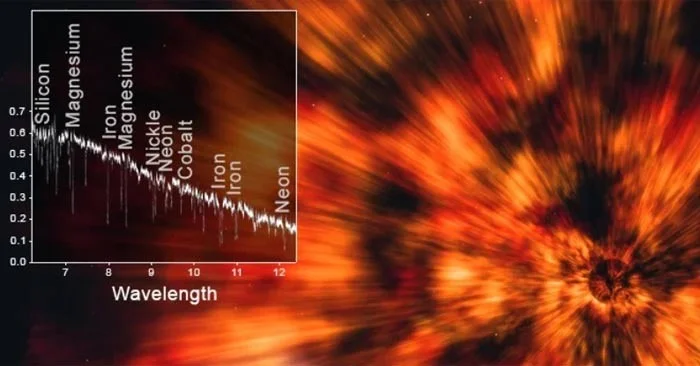
To understand the history of that system, the team looked at 2005 data from the Chandra spacecraft, taken when the system was particularly bright in the X-ray range.
Because Chandra collected spectral data from the system, the team was able to use that data to identify the different elements within it. They were able to determine the presence and relative abundance of 18 elements.
This is where astroarchaeology comes in. The elements produced in a star’s core depend on the star’s initial mass and composition. By looking at 18 elements and their abundances, the team was able to reconstruct each of the star’s early features.
They found that the progenitor star to the black hole had the mass of 25 Suns, dwarfing its companion star. This means that most of the material from the original star was ejected into interstellar space, either by the initial supernova explosion or by subsequent stellar winds generated by the system over time.
This type of reconstruction allows astronomers to see how binary stars evolve and how the larger star becomes a black hole or neutron star.
By using this method on other systems, we should be able to better model the dynamics of dying stars.
Mix five vivid, approachable Halloween cocktails with measured recipes, simple prep tips, and an alcohol-free option for your party guests.
Find 15 office-friendly Halloween costume ideas for 2026, with practical checks for dress codes, respectful themes, comfort, and workplace safety.
Plan a fun elementary school Halloween party with easy crafts, games, inclusive treats, costume tips, and a sample 75-minute classroom schedule.
Compare realistic side hustles for 2026 by startup cost, fees, flexibility, and income control, with current tax and scam guidance from official sources.
Upgrade your home office ergonomics with current OSHA and NIOSH guidance on chair fit, monitor height, laptop setup, lighting, and movement.
Learn why emotional intelligence matters in leadership, where it helps most, how to strengthen it, and how to tell whether your approach is working.
A practical roadmap for moving into tech without a degree: choose an accessible role, build job-ready skills, prove them with projects, and use hiring feedback to improve.
Build a credible LinkedIn personal brand in 2026 with current profile, content, newsletter, analytics, verification, and visibility guidance from LinkedIn.
Quiet quitting and quiet firing are catchy labels, not diagnoses. Learn what is verified, what depends on context, and what employees and managers can do next.
Fractional executives offer senior leadership without a full-time hire. Learn when the model works, what to ask, and the risks to manage.