Home
» Today
»
What Is Tether (USDT)? How Its Dollar Peg Works—and Where the Risks Lie
What Is Tether (USDT)? How Its Dollar Peg Works—and Where the Risks Lie
Tether (USDT) is a dollar-pegged stablecoin: a cryptocurrency token designed to track the value of one U.S. dollar. Tether issues and redeems tokens under its own rules and says circulating USDT is backed by reserves. Yet a target price of $1 is not a guaranteed market price, owning a token is not the same as holding a bank deposit, and not every holder can redeem directly with Tether.
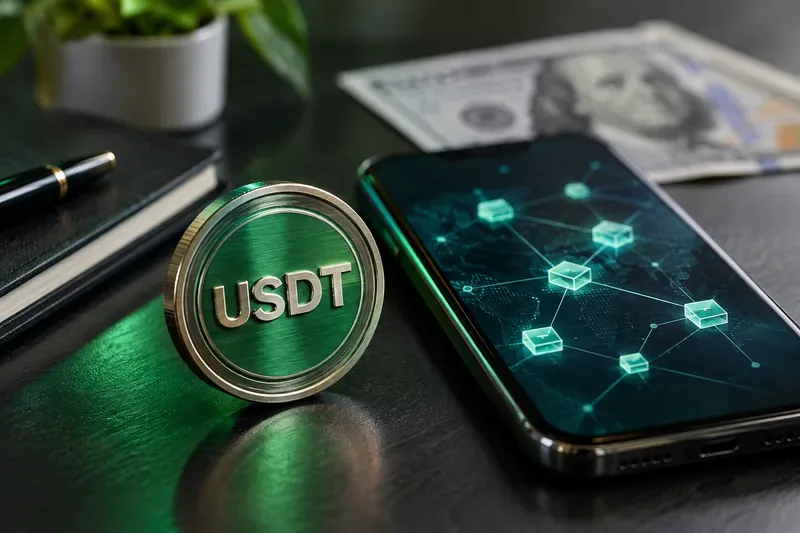
A USDT token, a smartphone showing a blockchain network, and a U.S. dollar bill represent the token's digital transfer system and intended dollar peg—not a guarantee of dollar redemption.
USDT at a glance
Question
Short answer
Who issues it?
Tether-affiliated issuing entities.
What is the target value?
Approximately $1 per USDT, not a fixed exchange price.
What backs it?
A reserve portfolio reported by Tether, not necessarily one cash dollar segregated for each holder.
Where does it run?
On multiple blockchains, each with specific token contracts or protocols.
Can anyone cash out with Tether?
No. Direct redemption requires eligibility, verification, minimum amounts, and applicable fees.
Is it FDIC-insured?
No. USDT is a crypto asset, not an insured bank deposit.
How Tether works: issuing, circulating, and redeeming USDT
Tether describes an issuance process in which eligible, verified customers supply funds and receive tokens. Tokens can then move on supported blockchains between wallets, exchanges, and businesses. A holder may buy USDT on a crypto exchange without dealing directly with the issuer. Tether's issuance primer distinguishes authorized tokens in its treasury from issued tokens in circulation; authorization alone is not the same as a new customer-held token.
When a qualified customer redeems directly, Tether processes a return of eligible tokens and pays fiat currency under its terms, subject to fees and restrictions. Other holders ordinarily obtain dollars by selling USDT through an exchange or another buyer. The exchange price depends on actual bids, offers, trading fees, and liquidity. For that reason, it can vary above or below $1.
What is verified: Tether documents its own issuance and redemption procedures. What depends on circumstances: whether your location, identity, platform, available liquidity, and payment rails permit a particular transaction. What to do: identify whether you are trading with another market participant or redeeming with the issuer before treating a quoted price as a guaranteed cash-out amount.
Misconception 1: “Every USDT is literally one dollar in a bank account”
That is not how Tether describes its current reserve model. Its official issuance explanation says reserves can contain traditional currency, cash equivalents, other assets, and receivables from loans. Different asset types carry different risks, and the location, liquidity, credit quality, and valuation of those assets matter.
Reserve claims also need historical context. On October 15, 2021, the U.S. Commodity Futures Trading Commission announced a $41 million penalty against Tether for misleading statements about fiat backing during a historical period, including June 2016 through February 2019. The findings do not independently establish today's reserve composition, but they are relevant when assessing the importance of transparent evidence. Read the CFTC enforcement announcement rather than relying on slogans about being fully backed.
What remains to check: the newest reserve breakdown, report date, independent accountant's scope, valuation approach, liabilities, and events after the reporting date. A snapshot attestation should not be casually called a continuous full financial-statement audit. What to do: review original reserve disclosures and accounting reports, and distinguish the issuer's assertions from what an external professional actually examined. This article does not assert an independently verified October 2026 reserve total.
Misconception 2: “If USDT is worth $1, I can always redeem $20 directly for $20”
Tether's token terms state that direct issuance and redemption are contractual services for verified customers. Its published fee page currently lists a $100,000 minimum acquisition or redemption amount, a redemption fee of the greater of $1,000 or 0.1%, and a $150 verification fee. These amounts may change; check the live schedule before any transaction.
For U.S. readers, eligibility is especially important: Tether's U.S. residents policy says ordinary U.S. residents and citizens cannot access direct issuance and redemption services, with limited potential exceptions. Buying or selling USDT on an exchange is a separate service and does not bypass the issuer's contractual restrictions.
What to do: before buying, check your trading venue's supported fiat withdrawal methods, account restrictions, liquidity, spread, and actual cash-out fees. Never assume the ability to redeem directly with Tether because an app displays a $1 balance.
Misconception 3: “USDT is the same token on every blockchain”
USDT exists on several networks; Ethereum and Tron are familiar examples, and other supported implementations include Solana. A token on one network cannot simply be sent to an unrelated address or deposit system on another without an explicitly supported transfer or bridging route. Tether maintains official protocol and contract information, while its deposit guidance warns that using the wrong transport protocol can cause unrecoverable losses.
Fake tokens can also copy a familiar name or ticker. A display reading “USDT” is insufficient proof of authenticity. What to do: verify the network, token contract or asset identifier, recipient address, and exchange deposit support using official documentation. For meaningful amounts, test a small transfer first and verify its receipt before sending the remainder.
Misconception 4: “Stablecoin means no financial or technical risk”
A dollar target may reduce exposure to ordinary cryptocurrency price swings, but it cannot eliminate every cause of loss. The FDIC’s crypto deposit-insurance fact sheet explicitly says crypto assets issued by nonbanks are not FDIC-insured. Deposit insurance for an eligible bank account does not automatically protect a USDT holder from a token issuer's failure.
Risk
Why it matters
Practical check
Reserve and issuer risk
Assets or operational arrangements may fail to support all obligations under stress.
Examine original disclosures, reporting dates, and terms.
Depegging and liquidity
Exchange bids can fall below $1 when buyers demand a discount.
Look at executable prices and market depth, not just a chart.
Exchange and custodian risk
A third-party platform can freeze withdrawals, be hacked, or fail.
Understand custody arrangements and withdrawal conditions.
Network and transfer mistakes
Congestion, contract issues, or wrong-network transfers can delay or lose funds.
Verify chain, contract, and address before sending.
Administrative freezes
Some issuer-controlled token contracts allow addresses to be restricted.
Review issuer policies and consider access limitations.
Legal and jurisdictional risk
Availability, exchanges, and redemption rights vary by location.
Check your jurisdiction and provider's current terms.
Tether has publicly described freezing USDT linked to law-enforcement investigations, including a 2023 wallet-freeze announcement. That capability can help disrupt suspected crime, but it also means USDT is not universally censorship-resistant in the way some users assume. What to do: consider whether you need a payment token, a custodial balance, or an insured deposit; these serve different purposes.
Why does USDT usually trade near a dollar?
Two mechanisms help explain the intended peg. First, the issuer offers qualified participants a redemption pathway at a defined contractual value, less applicable fees. Second, traders may buy discounted USDT or sell premium-priced USDT when they expect the market price to move back toward one dollar. This is often called arbitrage, but it works only when trading, redemption, banking, network, and counterparty access remain available and economical.
In an illustrative example, a market quote of $0.995 would not mean a retail buyer can automatically pocket half a cent per token. Transaction fees, minimums, timing, restrictions, and price movement may consume the apparent difference. What to do: compare executable net proceeds after all fees; do not treat a peg as a promise of immediate convertibility.
When might people use USDT?
Common use cases include temporarily holding a dollar-denominated balance on a crypto trading platform, transferring value between supported wallets, or settling payments where both parties accept the asset and local rules permit it. Each use case has distinct costs and operational risks.
For a short exchange trade, spreads and venue controls may matter more than blockchain fees. For an international transfer, recipient network support and local conversion rules become central. For long-term savings, issuer and custody exposure deserve more attention than the convenience of moving tokens. What to do: match the tool to the task instead of assuming one stablecoin is best for trading, payments, and savings.
A short checklist before buying, holding, or sending USDT
Confirm the asset is genuine USDT on the intended blockchain, not a lookalike token.
Understand whether you will rely on an exchange or the issuer for cash-out.
Check access eligibility, fees, limits, spread, and network charges.
Read the latest available reserve evidence and note exactly what was independently reviewed.
Consider platform failure, token freezes, lost keys, and wrong-network transfers.
Avoid putting money needed for near-term essentials into a product whose access or redemption could be delayed.
Recheck official terms and local rules immediately before acting; conditions can change.
Frequently asked questions
Is Tether the same as Bitcoin?
No. Bitcoin does not promise a one-dollar price target. USDT is an issuer-managed token designed to follow the dollar and depends on issuer operations and reserves.
Can USDT lose its peg?
Yes. Market prices can move away from $1, particularly under stress. A peg describes a goal and supporting arrangements, not guaranteed liquidity or price.
Does holding USDT pay interest?
USDT itself does not automatically pay interest simply because it is held in a wallet. Any yield offer is a separate product with additional terms and risks. Investigate who pays it and how.
Is USDT safe to keep instead of cash?
It has different protections and vulnerabilities. USDT is not an FDIC-insured deposit, and its issuer, custody, trading, technical, and legal risks require separate assessment.
Sources and scope of this explainer
Reviewed October 13, 2026. Primary sources include Tether's official issuance primer, terms last updated February 26, 2026, protocol documentation, direct redemption and fee pages, the CFTC's October 15, 2021 enforcement action, and FDIC guidance on crypto assets and deposit insurance. Current prices, market capitalization, day-to-day liquidity, and present reserve totals are intentionally not stated because they change and were not independently verified for publication. This is general educational information, not personalized financial, investment, tax, or legal advice.