Home
» Technology
»
AI-Powered Surgical Robotics: A Practical Guide to Precision, Autonomy, and What Is Actually in the OR
AI-Powered Surgical Robotics: A Practical Guide to Precision, Autonomy, and What Is Actually in the OR
AI-powered surgical robotics is best understood as a stack of technologies rather than a single “robot surgeon.” In today’s operating room, the most mature systems still keep the surgeon in control while software improves planning, visualization, instrument guidance, motion control, workflow analysis, or selected automated tasks. The practical question is not whether a platform “uses AI,” but which decisions and actions the software performs, what the clinician still controls, and whether those capabilities are authorized and validated for the intended procedure.
That distinction matters because “precision” can mean several different things: reproducing a planned bone cut more accurately, stabilizing an instrument, constraining motion inside a virtual boundary, measuring tissue force, recognizing phases in surgical video, or proposing a patient-specific plan. These functions can be valuable, but none automatically guarantees a better clinical outcome for every patient or procedure.
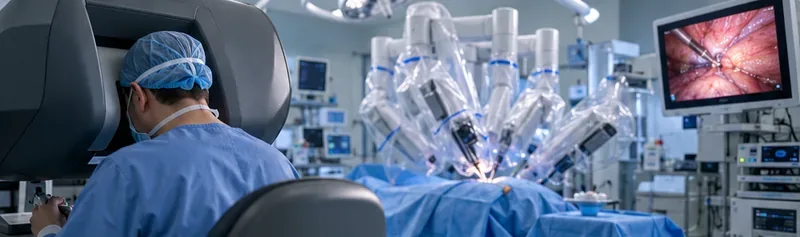
A surgeon works from a console while a multi-arm robotic system operates at the bedside. The scene reflects the human-supervised architecture that still defines most current robotic surgery.
Quick Reference: What AI and Automation Actually Do in Surgical Robotics
Use case
What the technology does
Typical human role
Practical maturity
Robot-assisted teleoperation
Translates surgeon hand movements into instrument motion; may filter tremor or add motion scaling.
Surgeon continuously controls the instruments.
Established in many minimally invasive procedures.
Patient-specific planning
Uses imaging and software to build a plan around individual anatomy.
Surgeon reviews, adjusts, and approves the plan.
Established in several orthopedic, spine, and navigation workflows.
Haptic or geometric constraints
Limits or guides instrument movement relative to a planned boundary.
Surgeon performs the task within system-defined constraints.
Established in selected orthopedic and navigation systems.
Computer vision and video analytics
Identifies procedural phases, instruments, anatomy, or patterns in recorded video.
Clinician reviews analytics and decides how to use them.
Commercially available for some post-operative analytics; real-time capabilities vary.
Task automation
Executes a bounded, preprogrammed task once parameters are set.
Surgeon selects, supervises, and can intervene.
Available in limited, procedure-specific forms.
High-level autonomous surgery
Would independently plan and execute major portions of a procedure while adapting to changing anatomy.
Primarily supervisory.
Still research-oriented rather than routine clinical practice.
Start With the Most Important Distinction: Robotics Is Not the Same as AI
The U.S. Food and Drug Administration describes robotically assisted surgical systems as computer-assisted devices that allow trained physicians to control instruments during surgery. For many soft-tissue systems, the robot does not independently perform the operation; the surgeon remains the active controller. The FDA’s computer-assisted surgical systems guidance is a useful baseline because it separates the popular image of an autonomous robot from the actual role of many current systems.
AI can be added to that robotic foundation in several places. A machine-learning model might segment anatomy from an image, recognize a procedural phase, flag a pattern in video, or help generate a patient-specific plan. But advanced robotics can also improve precision without machine learning. Force feedback, tremor filtering, robotic kinematics, motion constraints, and deterministic planning algorithms may all be sophisticated without being “AI” in the regulatory sense.
The FDA’s AI-enabled medical device list can help verify whether an authorized device has been identified as AI-enabled, although the FDA explicitly notes that the list is not comprehensive.
Where Surgical Robotics Can Improve Precision
1. Motion can be steadier and more constrained
Robotic mechanisms can scale motion, filter tremor, hold an instrument at a fixed pose, or prevent a cutting tool from moving beyond a virtual boundary. In orthopedics, for example, Stryker describes its Mako systems as using patient-specific planning and haptic boundaries that constrain a tool relative to the planned anatomy. The relevant point is not the brand claim itself, but the engineering pattern: software defines a geometric plan and the robot physically helps keep the instrument within that plan.
For a concrete example, Stryker’s Mako Spine documentation describes automatic patient registration, smart segmentation, algorithm-driven screw suggestions, and haptic guidance. Some of those functions are algorithmic rather than necessarily machine learning, which is exactly why buyers should ask what “AI” means in a specific system.
2. Force sensing can add information that vision alone cannot provide
Intuitive’s da Vinci 5 received FDA 510(k) clearance in March 2024. One of its notable additions is force-sensing technology that can measure forces at the instrument and feed a sense of tissue force back to the surgeon. Intuitive describes this capability in its da Vinci 5 clearance announcement.
Force feedback is a good illustration of why “AI-powered” can be an imprecise label. This feature may improve the information available to the surgeon, but it is fundamentally a sensing-and-control capability rather than an autonomous decision-maker.
3. Computer vision can turn surgical video into structured data
Video is one of the richest data streams in a modern operating room. AI can divide a procedure into phases, detect instruments, estimate how long anatomy remains in view, and support post-operative review. Medtronic’s Touch Surgery Performance Insights is a current commercial example of AI-enabled analysis for selected procedures.
The limitation is just as important as the capability. Medtronic states that, at present, the platform does not provide real-time decision support or live critical-structure identification. That is a useful reality check: post-operative AI analytics are already practical, while some of the more dramatic “AI guiding the surgeon live” scenarios remain limited, procedure-specific, investigational, or unreleased.
4. Patient-specific planning can reduce variation in repeatable tasks
Planning systems can use CT, MRI, intraoperative imaging, registration, and anatomical models to propose where an implant, screw, cut, or trajectory should go. The robot may then help the surgeon execute that plan. This is especially relevant in orthopedics, spine surgery, and stereotactic procedures, where a target can be represented geometrically.
The tradeoff is dependence on data quality and registration accuracy. A perfect robot following an inaccurate model is still following the wrong model. Teams therefore need clear checks for imaging quality, registration error, plan approval, and conditions that require abandoning or revising the robotic workflow.
How Autonomous Are Surgical Robots Today?
A 2024 systematic review in npj Digital Medicine examined FDA-cleared surgical robots from 2015 through 2023 using a six-level autonomy framework. Of 49 systems identified, 86% were classified as Level 1 robot assistance, 8% as Level 2 task autonomy, and 6% as Level 3 conditional autonomy. The review found no Level 4 or Level 5 systems in that dataset. It also reported that only two systems had machine-learning-enabled features explicitly recognized in FDA submissions, while some additional products used AI-related claims in marketing materials.
Those numbers should not be treated as a complete picture of the 2026 market because the review stops at 2023. They are still useful as a baseline: clinically deployed surgical robotics has historically been dominated by surgeon-controlled assistance, with higher autonomy appearing in narrow, bounded tasks rather than whole-procedure replacement of the surgeon.
The market has continued to evolve. In July 2026, Johnson & Johnson announced FDA De Novo authorization for the OTTAVA robotic surgical system for multiple upper-abdominal general surgery procedures. That is meaningful competition in soft-tissue robotics, but authorization of a robotic platform should not be interpreted as authorization for autonomous surgery or for every AI feature a company may be developing.
What About Fully Autonomous Surgery?
Research has demonstrated increasingly autonomous surgical tasks, especially in controlled preclinical settings. One widely cited example is the Smart Tissue Autonomous Robot (STAR), which performed laparoscopic intestinal anastomosis in pig models in a 2022 study described by Johns Hopkins University. The project showed that a robot could plan and execute a complex soft-tissue suturing task while adapting to tissue movement.
That is scientifically important, but it is not evidence that autonomous soft-tissue surgery is ready for routine human care. Moving from a preclinical demonstration to a broadly deployable clinical system requires robust performance across variable anatomy, bleeding, unexpected findings, device faults, team interactions, and emergency handoff conditions. The reliability requirement in surgery is much higher than simply achieving high average accuracy in a laboratory benchmark.
Precision Is Not the Same as Better Outcomes
Hospitals should separate technical precision from patient benefit. A system may place an instrument closer to a planned trajectory or reproduce a geometric target more consistently, yet clinical outcomes can still depend on procedure selection, surgeon experience, complications, anesthesia, infection control, tissue biology, and post-operative care.
The FDA recommends that patients considering robotically assisted surgery discuss the risks, benefits, alternatives, and the surgeon’s training and experience. That advice remains relevant even as AI features become more capable. A higher-technology workflow should be justified by the clinical problem, not by the novelty of the platform.
A Practical Evaluation Checklist for Hospitals and Surgical Teams
Regulatory and intended-use checks
Is the robotic system authorized for the exact procedure, anatomy, and patient population being considered?
Which software functions are part of the authorized device, and which are research, optional, or future features?
If a vendor uses the term “AI,” is the machine-learning component identifiable in regulatory documentation?
Does the system provide recommendations, enforce constraints, execute a bounded task, or independently select actions?
Clinical validation checks
What endpoint was validated: geometric accuracy, procedure time, complications, conversion rate, length of stay, functional outcome, or another measure?
Was performance tested under clinically realistic conditions and across representative patient groups?
Are subgroup results available for difficult anatomy, obesity, prior surgery, or other factors relevant to the local patient population?
What are the known failure modes, confidence limits, and situations in which the AI or robotic feature should not be used?
Human-factors and training checks
Who is responsible for approving plans and monitoring automated actions?
Can the surgeon immediately override or disengage the robot?
What is the credentialing pathway for surgeons, bedside assistants, nurses, and technicians?
How does the system behave during camera loss, registration failure, instrument collision, power interruption, or network failure?
Does the workflow create new blind spots, alarms, or cognitive load for the team?
Data, AI, and lifecycle checks
What data trained the model, and how similar are those data to the hospital’s population and workflow?
Is local acceptance testing required before clinical deployment?
How is performance monitored after deployment?
Can the model change over time, and if so, how are updates validated and communicated?
What data leave the hospital, where are they stored, and how are surgical video and patient identifiers protected?
These questions align with the FDA’s emphasis on total-lifecycle controls. The agency’s Good Machine Learning Practice principles emphasize representative data, clinically relevant testing, the performance of the human-AI team, clear user information, and monitoring of deployed models.
For AI functions expected to change after authorization, the FDA’s final August 2025 Predetermined Change Control Plan guidance describes how manufacturers can define planned modifications, validation methods, and impact assessments in advance.
A Simple Maturity Framework for Decision-Makers
Question
Lower-risk interpretation
Higher-governance interpretation
What does the algorithm control?
Display, analytics, recommendation, or bounded guidance.
Instrument motion, task execution, or procedural strategy.
Can the clinician verify the output?
Output is visible and easy to cross-check.
Logic is opaque or difficult to independently confirm during the procedure.
Can the clinician override it?
Immediate manual control or disengagement is available.
Override requires workflow interruption or is difficult under time pressure.
What happens if data are wrong?
Error is likely to be detected before action.
Error can directly influence anatomy, trajectory, energy delivery, or tissue manipulation.
How does the model change?
Fixed software version with controlled updates.
Adaptive or frequently updated model requiring lifecycle monitoring.
The closer a system moves toward the right-hand column, the more important formal governance becomes. That includes multidisciplinary review, simulation, incident reporting, version control, post-market surveillance, and a documented process for pausing a feature when performance is uncertain.
Questions Patients Can Ask Without Needing to Understand the Technology
Why is robotic surgery being recommended for my specific procedure?
What are the alternatives, including conventional laparoscopic or open surgery?
How much experience does the surgeon and operating-room team have with this exact system and procedure?
Which parts of the operation are controlled directly by the surgeon, and which are automated?
What evidence shows a benefit for patients like me?
What happens if the robot cannot be used or must be stopped during the procedure?
Will surgical video or other data be stored or used for AI analysis?
What Is Likely to Change Next
The near-term direction is more likely to be progressive augmentation than an abrupt jump to autonomous surgery. Expect better computer vision, more automatic segmentation and registration, richer force and motion sensing, context-aware alerts, smarter surgical video indexing, and tightly bounded automated subtasks. Multimodal models may eventually combine video, instrument telemetry, imaging, pathology, and patient data to improve situational awareness.
The difficult part will not be generating an AI suggestion. The difficult part will be proving when that suggestion is reliable enough to change surgical action, defining safe behavior when confidence is low, and validating performance across hospitals, surgeons, devices, and patient populations.
Bottom Line
AI-powered surgical robotics is already changing the operating room, but its most credible value today comes from augmenting expert teams rather than replacing them. The strongest use cases are those where the technology has a clearly defined role: planning around patient-specific anatomy, stabilizing or constraining motion, extracting structured information from surgical video, improving visualization, or automating a narrow task under supervision.
For hospitals, surgeons, and patients, the right question is not “Is this robot AI-powered?” It is “What exactly does the system do, how was that function validated, who remains responsible for the decision, and what happens when the technology is wrong?” That framework turns a broad technology trend into a practical safety and value assessment.