Home
» Technology
»
Where to Study UAV Engineering in 2026: Top Aerospace Programs by Career Goal
Where to Study UAV Engineering in 2026: Top Aerospace Programs by Career Goal
If you are choosing a university for UAV engineering in 2026, one recent change is worth noticing: on February 25, 2026, Purdue University announced that the Federal Aviation Administration had selected its Unmanned Aerial Systems program for the FAA's UAS Collegiate Training Initiative. The FAA describes UAS-CTI as a program that recognizes colleges and universities with UAS curricula that prepare students for drone-related careers. Purdue's announcement is available on the university's official news site.
The practical takeaway is not that one new badge suddenly determines the best school. It is that UAV education is becoming more structured, and applicants need to distinguish among several very different paths: an engineering degree that teaches you to design aircraft and autonomy systems, a UAS degree centered on operations and integration, and a graduate program that specializes in controls, robotics, sensing, or uncrewed aircraft research.
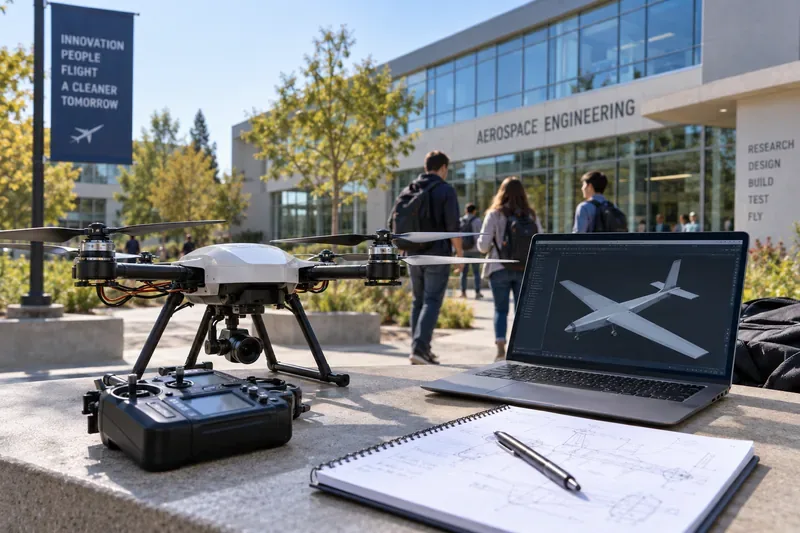
A UAV-focused aerospace education often combines flight hardware, software, controls, design tools, and hands-on testing rather than treating drones as a single isolated subject.
What “UAV engineering” actually means
There is no single standard degree called “UAV Engineering” across universities. In many of the strongest technical programs, the relevant degree is aerospace engineering, aeronautical engineering, mechanical engineering, electrical engineering, robotics, or computer science, with UAV work appearing through electives, laboratories, capstone projects, and graduate research.
If your goal is to design airframes, propulsion systems, flight-control laws, autonomous navigation, embedded avionics, or safety-critical software, a rigorous engineering curriculum is usually the stronger foundation. In the United States, applicants can check engineering accreditation through the ABET accredited-program search. ABET's 2026-2027 aerospace criteria specifically call for modeling, simulation, computing, testing, and aerospace-system design and analysis, which are directly relevant to UAV development.
If your goal is instead to become a professional UAS operator, mission planner, fleet manager, sensor operator, or regulatory specialist, an aviation or UAS operations program may be a better fit. The FAA's UAS-CTI recognition is useful in that context, but it should not be confused with ABET engineering accreditation. These credentials answer different questions.
Top programs to consider, organized by fit
This is not an absolute 1-to-8 ranking. The schools below stand out for different reasons, and the right choice depends on whether you want undergraduate engineering breadth, direct UAS specialization, advanced autonomy research, or a professional master's path.
Program
Best fit
UAV-related strength
Important distinction
Purdue University
Hands-on undergraduate UAS study
Dedicated Unmanned Aerial Systems major and 2026 FAA UAS-CTI selection
The UAS major is in Purdue Polytechnic's School of Aviation and Transportation Technology, not the same degree as Purdue's aerospace engineering program
Embry-Riddle Aeronautical University
Direct UAS bachelor's pathway and specialized graduate study
UAS operations, mission planning, GIS, autonomy, plus a dedicated engineering master's
Choose carefully between aviation-oriented UAS degrees and the engineering-focused master's
Oklahoma State University
Graduate UAV engineering
Mechanical and Aerospace Engineering M.S. and Ph.D. pathways specifically labeled Unmanned Aerial Systems
Strongest fit for students who already have an engineering foundation
University of Colorado Boulder
Autonomy, controls, and research-intensive aerospace
Autonomous Systems graduate focus and a dedicated Research and Engineering Center for Unmanned Vehicles
UAV work is embedded in a broader aerospace engineering research ecosystem
University of Michigan
Broad aerospace bachelor's plus autonomy and controls
Flight software, flight testing, control, planning, and multiple UAV-oriented research groups
Not a dedicated UAV degree; specialization comes through courses and research
MIT
Advanced autonomy, controls, estimation, and aerospace systems
AeroAstro autonomy research and an Aerospace Information Technology option within Course 16
Best viewed as a broad, highly technical aerospace route rather than a drone-specific degree
Georgia Tech
Traditional aerospace engineering with design, controls, and UAV research access
ABET-accredited B.S. in Aerospace Engineering, controls labs, design options, undergraduate research, and unmanned-vehicle testing access
UAV specialization is built through choices inside a broad aerospace curriculum
Cranfield University
Focused postgraduate study in autonomous aerial vehicles
One-year Autonomous Vehicle Dynamics and Control M.Sc. with UAS dynamics, modeling, sensor fusion, guidance, navigation, and AI
Graduate-only specialist route rather than a conventional undergraduate aerospace degree
1. Purdue University: strong for an undergraduate UAS pathway
Purdue is a useful example of why applicants should read the degree title and school structure carefully. Purdue Polytechnic's Unmanned Aerial Systems undergraduate major covers aircraft systems, safety, regulations, flight planning, maintenance, data analysis, and uncrewed-system operations. The program's 2026 FAA UAS-CTI selection adds a current signal that its curriculum is connected to the FAA's UAS workforce and education initiative.
That does not make the major equivalent to an aerospace engineering degree. Students who want deep aerodynamics, structures, propulsion, vehicle design, and engineering analysis should compare it with Purdue's separate Aeronautical and Astronautical Engineering bachelor's program, which Purdue states is ABET-accredited and includes an Autonomy and Control specialization area. Purdue is therefore especially attractive to applicants who want practical UAS technology and aviation-system integration at the undergraduate level, while still having access to a large engineering university around them.
2. Embry-Riddle: one of the clearest direct UAS degree ecosystems
Embry-Riddle offers one of the most explicit UAS education ladders. Its B.S. in Uncrewed and Autonomous Systems is a 120-credit program that includes UAS operations, mission planning, remote piloting, air traffic procedures, data collection, GIS-related work, and autonomy topics. The university states that the program is recognized by the FAA UAS-CTI and accredited by the Aviation Accreditation Board International.
For engineers who already hold a technical bachelor's degree, Embry-Riddle also offers a 30-credit M.S. in Uncrewed and Autonomous Systems Engineering at Daytona Beach. That distinction matters: the graduate engineering program focuses on analysis, design, implementation, and technical development across uncrewed and autonomous systems, while the bachelor's pathway has a broader aviation and operations orientation.
Embry-Riddle is a strong choice when you want the word “uncrewed” to appear directly in the degree pathway rather than assembling a UAV focus from a general aerospace curriculum.
3. Oklahoma State University: unusually direct graduate UAV engineering
Oklahoma State stands out because its official catalog lists a Mechanical and Aerospace Engineering M.S. in Unmanned Aerial Systems. The 2026-2027 curriculum is 30 credit hours and includes options such as Unmanned Aerial Systems Design and Analysis, UAS Propulsion, Guidance and Control of Aerospace Vehicles, Aircraft Certification and Test, advanced aerodynamics, and atmospheric flight control.
For students aiming at research careers, Oklahoma State also lists a UAS-focused Ph.D. pathway. Its Mechanical and Aerospace Engineering research program includes unmanned and aerospace systems integration, flight dynamics, certification, testing, controls, and autonomy. This is one of the most direct fits for someone who wants “UAV engineering” to mean actual aircraft design, flight dynamics, propulsion, and control at graduate level rather than primarily operations.
4. University of Colorado Boulder: excellent for autonomous systems and flight research
CU Boulder's aerospace program is particularly compelling for autonomy-heavy UAV work. Its graduate curriculum includes an Autonomous Systems focus area covering robotics, artificial intelligence, estimation, controls, human-robot interaction, and unmanned systems.
The university also operates the Research and Engineering Center for Unmanned Vehicles, where work spans aerodynamics, propulsion, navigation, controls, telecommunications, robotics, platform design, and real-world applications. For a student interested in guidance, navigation and control, cooperative multi-vehicle systems, remote sensing, or research flight operations, this combination is more important than whether the diploma itself says “UAV.”
5. University of Michigan: broad aerospace engineering with serious autonomy depth
Michigan's aerospace program is a good fit for students who want a traditional aerospace engineering degree and enough flexibility to move deeply into autonomy. The university's Aerospace Engineering major highlights autonomous systems and control, including flight software systems, flight testing, aerospace vehicle control, and aerospace information systems.
Its Autonomous Systems and Control research area includes laboratories working on collaborative unmanned vehicles, autonomous aerospace systems, multi-agent safety and security, aerial robotics, and AI-enabled navigation. This is a strong route for students who want to keep the full aerospace toolkit—structures, aerodynamics, propulsion, computation, and controls—while specializing through research.
6. MIT AeroAstro: best for students drawn to autonomy as a core aerospace problem
MIT does not need a drone-specific bachelor's degree to be relevant to UAV engineering. The AeroAstro undergraduate curriculum includes controls, estimation, flight vehicles, software, communications, autonomous systems, and digital systems. Students in the flexible Course 16-ENG pathway can build depth in areas such as autonomous systems and computational engineering, while Course 16 offers an Aerospace Information Technology option.
MIT's Autonomous Systems and Decision-Making research area explicitly includes autonomous drones, perception, world modeling, planning, trustworthy autonomy, and human-robot teamwork. For students interested in mathematically intensive controls, estimation, decision-making, and autonomy, MIT is a powerful choice even though it is not packaged as a dedicated UAV degree.
7. Georgia Tech: strong classical aerospace foundations with UAV opportunities
For UAV-oriented students, the value comes from the surrounding design and research environment. Georgia Tech's official aerospace facilities page notes access to off-campus sites used for testing unmanned autonomous vehicles, while the curriculum supports undergraduate research and design-oriented options. This is the type of program to choose if you want a conventional engineering credential first and UAV specialization second.
8. Cranfield University: a focused international master's option
For students who already have a bachelor's degree in engineering, science, physics, or applied mathematics, the United Kingdom's Cranfield University offers a highly specialized M.Sc. in Autonomous Vehicle Dynamics and Control. The one-year program includes UAS dynamics and control, UAS modeling and simulation, sensor fusion, guidance and navigation, autonomous vehicle control, communications, and artificial intelligence for autonomous systems.
Cranfield also emphasizes a major group project and individual research project, and the university states that the M.Sc. is accredited by the Royal Aeronautical Society on behalf of the UK's Engineering Council for further learning toward Chartered Engineer registration. It is a strong option for a student who wants a concentrated postgraduate year rather than another broad aerospace degree.
Also worth a close look: TU Delft for micro-air-vehicle autonomy
TU Delft is especially relevant if your interest is small autonomous aircraft rather than a degree title containing “UAV.” The university's Micro Air Vehicle Laboratory focuses on autonomous flight of micro and nano air vehicles, hybrid aircraft, collision avoidance, perception, and control. Its official course list includes Autonomous Flight of Micro Air Vehicles, with practical quadrotor work in the Cyberzoo research environment.
For a research-minded master's student interested in lightweight autonomy, bio-inspired flight, computer vision, or aggressive small-drone control, this can be more relevant than a generic “drone degree.”
When a UAS operations degree is the better choice
Not every drone career requires an engineering degree. If you want to plan missions, operate aircraft, manage UAS programs, work with sensors, understand airspace integration, or lead commercial drone operations, a program such as the University of North Dakota's B.S. in Aeronautics in Unmanned Aircraft Systems Operations may fit better.
UND's program is explicitly operations-focused and includes UAS, aviation safety, aircraft systems, National Airspace System integration, and different operational tracks. One important current limitation is that UND states U.S. citizenship is required for the UAS Operations bachelor's degree because of export-controlled technology and curriculum; international students can pursue the UAS minor. That is exactly the kind of eligibility detail applicants should verify before treating two similarly named programs as interchangeable.
How to compare programs before you apply
Start with the job you want to do
If you want to design the aircraft, prioritize aerodynamics, structures, propulsion, flight mechanics, CAD, simulation, and flight testing. If you want to build autonomous behavior, prioritize controls, estimation, embedded systems, computer vision, robotics, machine learning, and real-time software. If you want to operate fleets professionally, prioritize aviation safety, airspace integration, regulations, mission planning, remote sensing, and hands-on flight operations.
Look for access to real hardware, not just a drone elective
A single elective is useful, but a stronger UAV environment usually includes laboratories, flight-test space, student design teams, capstones, research aircraft, motion-capture facilities, autonomy software, or partnerships that let students test systems outside a classroom. The exact equipment changes over time, so verify the current lab and student-access pages for your intended entry year.
Separate engineering accreditation from UAS recognition
For U.S. engineering degrees, verify the exact program in ABET's official database. For UAS workforce-oriented programs, FAA UAS-CTI recognition can be another positive signal. They are not substitutes for each other. A school can be excellent for UAV operations without offering an ABET-accredited aerospace engineering degree, and a top aerospace engineering department can produce outstanding UAV engineers without having a dedicated UAS major.
Check how early undergraduates can join research
At research universities, the difference between simply taking aerospace classes and actually becoming a UAV engineer often comes from joining a laboratory or design team. Look for explicit undergraduate research pathways, faculty projects in controls or autonomy, and capstones where students design, build, or flight-test vehicles.
Read the current catalog before making a final decision
Degree requirements, specializations, faculty availability, and even program names can change. Use university catalogs and official department pages for the academic year in which you expect to enroll. For graduate study, identify two or three faculty members whose current research matches your interests before applying; the quality of that research match can matter more than the program's general reputation.
Which program is best for which student?
Best direct undergraduate UAS pathway: Purdue or Embry-Riddle, if you want a degree centered on uncrewed systems rather than a conventional aerospace engineering curriculum.
Best graduate engineering specialization explicitly labeled UAS: Oklahoma State.
Best for autonomy and UAV research inside a broad aerospace program: CU Boulder, Michigan, MIT, or Georgia Tech, depending on your preferred mix of controls, robotics, systems, and aircraft design.
Best focused one-year postgraduate option: Cranfield.
Best for micro-air-vehicle autonomy research: TU Delft's MAVLab environment.
Best if your target is professional UAS operations rather than engineering design: UND deserves separate consideration.
Bottom line
The strongest way to study UAV engineering is not necessarily to find the school with “drone” in the degree name. Start by deciding whether you want to engineer the vehicle, engineer its autonomy, or operate the system. Then compare the curriculum, accreditation, laboratories, research access, flight-test opportunities, and current faculty work.
As of September 2026, Purdue's new FAA UAS-CTI recognition is a meaningful update for students considering direct UAS education, but it also illustrates the broader rule: labels matter less than what the program actually teaches. A technically deep aerospace degree with strong controls and autonomy research can be the better UAV-engineering route for some students, while a dedicated UAS degree can be more efficient for others. The best choice is the one whose coursework and hands-on environment match the work you want to do after graduation.