Checked October 23, 2026: AQA’s live dates page currently links to the May/June 2027 GCSE timetable, version 1.2. AQA calls its confirmed timetables definitive and advises candidates to check back for the latest version. The dates below are a quick reference for Computer Science, English Language, and Mathematics; they are not a replacement for the complete PDF or for the timetable issued by a student’s exam center.
A student checks an exam schedule on a laptop; the screen does not show AQA’s live timetable.
Which AQA GCSE Summer 2027 dates should students add first?
The AQA May/June 2027 GCSE timetable groups exams by subject code and shows the date, morning or afternoon session, and paper duration. Use the entry code on the statement of entry when matching a row. In particular, the three Computer Science Paper 1 codes refer to different programming-language routes, so a student should follow the code entered for them rather than assume all three papers apply.
Date
Subject and paper
Session and length
What to note
Monday, May 10, 2027
Computer Science 8525/1A (C#), 8525/1B (Python), or 8525/1C (VB.Net)
Morning; 2 hours
Paper 1: computational thinking and programming skills. Match the correct code.
Friday, May 14, 2027
Mathematics 8300/1F or 8300/1H
Morning; 1 hour 30 minutes
Paper 1 is non-calculator; both tiers are listed.
Wednesday, May 19, 2027
Computer Science 8525/2
Afternoon; 1 hour 45 minutes
Computing concepts.
Monday, May 24, 2027
English Language 8700/1
Morning; 1 hour 45 minutes
Paper 1: creative reading and writing.
Thursday, May 27, 2027
Mathematics 8300/2F or 8300/2H
Morning; 1 hour 30 minutes
Paper 2 is calculator; both tiers are listed.
Tuesday, June 8, 2027
English Language 8700/2
Morning; 1 hour 45 minutes
Paper 2: writers’ viewpoints and perspectives.
Monday, June 14, 2027
Mathematics 8300/3F or 8300/3H
Morning; 1 hour 30 minutes
Paper 3 is calculator; both tiers are listed.
For example, a student whose entry statement says 8300/2H should mark May 27 for the Higher calculator paper, then verify the center’s own start time and room. They should not swap it with Paper 3, which is on June 14. The course code, tier, paper number, and date work together; checking only the subject name can miss a meaningful difference.
What does “morning” mean, and what time should candidates arrive?
AQA’s published standard start times are 9:00 a.m. for morning exams and 1:30 p.m. for afternoon exams. These are UK civil times. On the May and June 2027 exam dates, the United Kingdom is on British Summer Time, or BST (UTC+01:00): 9:00 a.m. BST is 08:00 UTC, while 1:30 p.m. BST is 12:30 UTC. For the scheduled Computer Science Paper 1 slot on Monday, May 10, the published morning start therefore corresponds to 08:00 UTC.
The published slot is not necessarily the exact time on an individual student’s notice. AQA’s timetable notes allow a school or college to start an exam up to 30 minutes earlier or later than the published time without notifying AQA. That means a morning paper may begin between 8:30 and 9:30 a.m. BST, and an afternoon paper between 1:00 and 2:00 p.m. BST, under that rule. The center’s written instructions determine when a candidate must report. Check them before arranging transportation, work, childcare, or other commitments; do not treat the public timetable alone as an arrival notice.
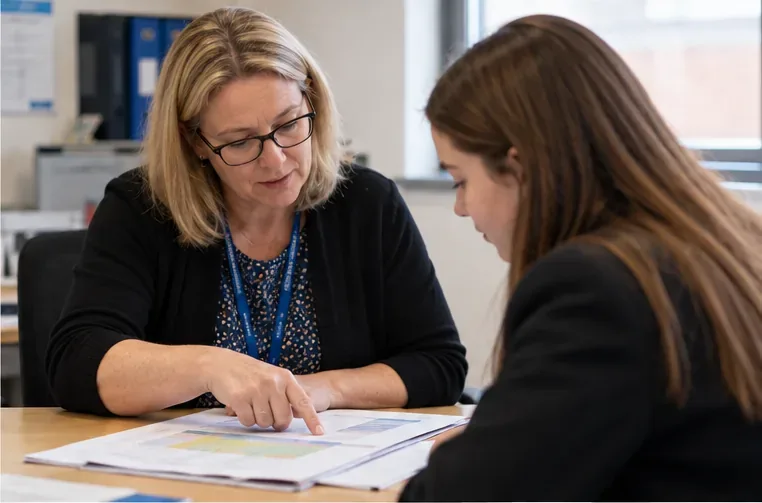
A student reviews a printed schedule with a school staff member, illustrating why center-specific instructions matter.
How can candidates confirm their personal exam schedule?
Start with the statement of entry or exam timetable provided by the school or college. Compare each line against the current AQA PDF using the full qualification and paper code, not just a broad label such as “math” or “English.” Check the date, AM or PM session, tier where applicable, duration, and any location or reporting information. If a paper is missing, a code appears unfamiliar, or two exams seem to clash, contact the exams officer promptly. AQA’s student guidance likewise directs candidates to their school or college for their individual schedule and says to raise timetable clashes with the exams officer.
For an entry marked “submit by,” read the row carefully: that wording identifies a submission deadline for assessed work, not necessarily a written exam appointment. For example, the timetable lists English Language Spoken Language (8700/C) as a non-exam assessment with a May 7, 2027 submission deadline. It is different from the fixed written-paper dates for 8700/1 and 8700/2. The full document also contains practical, oral, and non-exam assessment arrangements that centers must organize under the relevant subject instructions.
Find the current May/June 2027 GCSE timetable from AQA’s live dates page.
Check the PDF version and the date of the page you opened.
Match your statement of entry to the subject code, paper, and tier.
Copy the date and session into your calendar, then use the center’s notice for the actual reporting time and venue.
Recheck AQA’s page near the exam period in case it links to a revised timetable.
Private candidates also need a center-specific plan. AQA says a private candidate must arrange entry through an AQA-approved school or college willing to take responsibility for all parts of the qualification, including required non-exam assessment. The center should provide the candidate with the relevant entry information and details such as venue and starting time where those differ from the published timetable. Confirm these arrangements directly with the approved center rather than relying on a general calendar.
When are the Modern Foreign Language speaking tests?
AQA sets a speaking-test window from Monday, April 12, through Friday, May 21, 2027. The timetable note says schools and colleges may test during only five weeks within that window. It does not assign every student one nationwide speaking date or start time. The school chooses its assessment arrangements within the permitted period, so ask the subject teacher or exams officer for the individual day, reporting time, room, and any preparation instructions. Keep this separate from the written listening, reading, and writing papers, which have their own entries in the timetable.
A student speaks with a teacher in a classroom, a setting that reflects why each school confirms its own language-test appointment.
What is the contingency day, and when are results available?
Wednesday, June 23, 2027 is AQA’s designated contingency day for the summer examination series. Awarding bodies reserve it in case national or significant local disruption means the contingency plan has to be used. Candidates are expected to remain available through that date. It is a reserved date, not a prediction that an exam will be moved; follow messages from the school or college and keep the day free until the series has concluded.
AQA’s timetable gives two different results milestones. Results are due electronically to schools and colleges on Wednesday, August 18, 2027. Students can receive their results on Thursday, August 19, 2027. The document does not establish an individual school’s opening time or delivery method for each student, so check the school’s results-day instructions for those details.
A hand circles a date on a paper calendar beside a notebook, a reminder to keep the published contingency day available.
Where should candidates check for changes?
Use AQA’s live dates and confirmed-timetable page as the route to the current file. As checked on October 23, 2026, the linked May/June 2027 GCSE document is version 1.2; AQA says the page’s confirmed timetables are definitive and asks readers to check frequently for the latest version. The May/June 2027 GCSE timetable PDF contains the subject-by-subject schedule and notes. Candidates can also review AQA’s student guidance on exam timetables and its private-candidate entry guidance. For the time conversion, GOV.UK lists March 28, 2027 as the UK clock change to BST; its clock-change calendar is the official reference. Reopen these sources before finalizing travel plans because the AQA timetable or a center’s instructions may be updated.