Home
» Health
»
Cold Plunge Therapy: Benefits, Risks, and What the Evidence Actually Shows
Cold Plunge Therapy: Benefits, Risks, and What the Evidence Actually Shows
Cold plunge therapy has moved from athletic recovery rooms into home wellness routines, but the evidence is more nuanced than social media makes it sound. Some benefits are reasonably supported, especially for post-exercise soreness. Other claims—such as reliably boosting immunity, melting body fat, or treating anxiety and depression—remain uncertain or overstated.
As of September 2026, that balance has not fundamentally changed. A recent field study followed 20 middle-aged recreational athletes with continuous rhythm monitoring during 64 cold-water immersion sessions at an average water temperature of about 7°C. The researchers observed a low arrhythmic burden during immersion, but the study was small, observational, and involved people healthy enough to participate in a cold-water event. It does not establish that cold plunging is safe for everyone. You can review the study on PubMed.
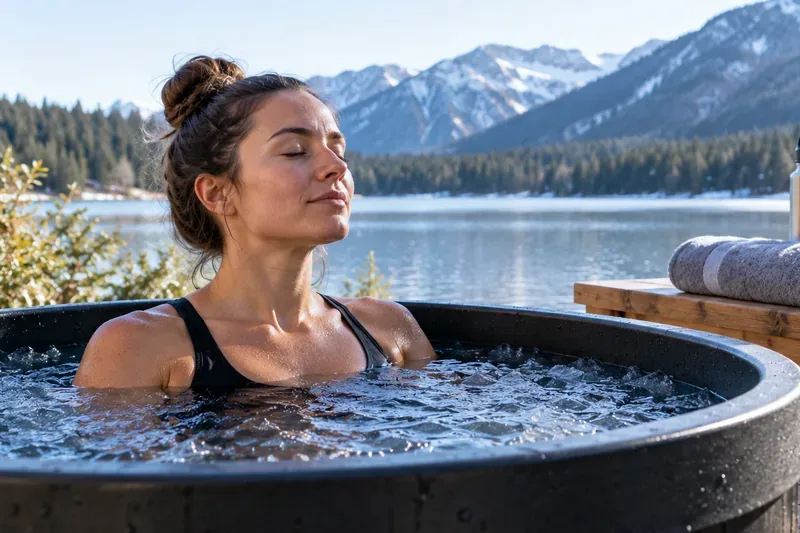
A controlled cold-plunge setup with the head above water illustrates the kind of deliberate immersion discussed in this article; open-water swimming adds additional environmental and drowning risks.
A hypothetical example: Maya is deciding whether cold plunging is worth it
Consider Maya, a hypothetical 38-year-old recreational runner who also lifts weights twice a week. She has no known heart disease and has never used a cold plunge. After a hard weekend run, she hears that cold water can reduce soreness. She also sees claims that a daily plunge will improve her mood, strengthen her immune system, increase metabolism, and make her more resilient.
Maya's situation is useful because those goals are not interchangeable. The evidence for muscle soreness is different from the evidence for mental health, immunity, or fat loss. Cold exposure can also work against one of her goals if she uses it at the wrong time: repeated cold-water immersion immediately after resistance training may blunt some muscle-building adaptations.
The best way to evaluate cold plunge therapy is therefore not to ask whether it is simply "good" or "bad." A better question is: What outcome are you trying to improve, how strong is the evidence for that outcome, and what tradeoff are you accepting?
What is cold plunge therapy?
Cold-water immersion generally means placing much of the body in cold water for a limited period. Research protocols vary widely. A 2025 systematic review and meta-analysis in PLOS ONE included randomized trials in healthy adults using cold showers, ice baths, or plunges at 15°C (59°F) or colder for at least 30 seconds. Across the included studies, temperatures ranged from 7°C to 15°C and exposure times ranged from 30 seconds to two hours. That enormous variation is one reason there is no single scientifically established "ideal" wellness protocol. Read the review in PLOS ONE.
That distinction matters for Maya. A protocol designed for an athlete recovering between competitions is not automatically the right protocol for a beginner looking for a morning ritual.
Can a cold plunge reduce muscle soreness after exercise?
This is one of the better-supported uses. A 2024 network meta-analysis of 57 studies involving 1,220 healthy participants compared cold-water immersion, contrast-water therapy, hot or thermoneutral immersion, cryotherapy, and control conditions after exercise-induced muscle damage. Cold-water immersion was associated with lower delayed-onset muscle soreness and favorable changes in some recovery outcomes compared with control. The full paper is available from BMC Musculoskeletal Disorders.
A larger 2026 network meta-analysis also emphasized that results depend on the exercise type, temperature, duration, timing, and outcome being measured. In other words, cold-water immersion is not a universal recovery accelerator. It may help how sore or recovered someone feels after strenuous exercise, while objective performance outcomes can be inconsistent.
For hypothetical Maya, a plunge after an unusually hard run may therefore be a reasonable recovery option if she tolerates cold safely. It is not mandatory, and it should not replace the basics that have a broader evidence base for recovery: adequate sleep, nutrition, hydration, and sensible training load.
Does cold plunging improve mood, alertness, or stress?
There are promising signals, but the evidence is still limited. In the 2025 PLOS ONE review of 11 studies and 3,177 participants, stress was significantly lower 12 hours after cold-water immersion, but not immediately afterward, one hour afterward, 24 hours afterward, or 48 hours afterward. The same review found some reported improvements in sleep quality and quality of life, but those outcomes often came from single studies and should be interpreted cautiously. The review did not find a consistent overall improvement in mood.
A smaller 2023 experimental study offers a useful clue. Thirty-three healthy adults who were not regular cold-water swimmers completed a five-minute, head-out immersion at 20°C. Afterward, participants reported more positive affect and less negative affect, including feeling more active, alert, attentive, and inspired. Brain-imaging changes were also observed. However, this was a small pre-post experiment rather than proof that cold plunging treats depression or anxiety. The study is available through PubMed Central.
For Maya, this means a cold plunge might feel energizing or mentally clarifying, but she should treat that as an individual response rather than a guaranteed therapeutic effect. Cold plunging should not be presented as a substitute for evidence-based mental health care.
Does cold plunge therapy boost the immune system?
The popular claim is stronger than the evidence. The 2025 PLOS ONE meta-analysis found no significant immediate or one-hour improvement in measured immune function after cold-water immersion, and the certainty of evidence for immunity was low. One cold-shower study included in the review reported a 29% reduction in sickness absence, but that does not prove that participants had fewer infections or that their immune systems became stronger.
This is an important distinction for Maya. If her main goal is to avoid seasonal illness, a cold plunge is not a replacement for vaccination when recommended, adequate sleep, good nutrition, hand hygiene, and appropriate medical care.
Does cold water reduce inflammation?
Not in the simple way the claim is often phrased. Cold-water immersion may reduce soreness and alter some markers after exercise, but the general-wellbeing literature does not support saying that a plunge simply "turns off inflammation." In fact, the 2025 PLOS ONE meta-analysis found a significant increase in inflammatory measures immediately and one hour after cold-water immersion. That acute response may be part of the body's reaction to a strong physical stressor.
The practical lesson is that soreness, inflammation, muscle damage markers, and long-term health are related but not interchangeable outcomes. Feeling less sore after a plunge does not necessarily mean the body's inflammatory response has been globally suppressed.
Can cold plunges help with fat loss or metabolism?
Cold exposure makes the body work to defend its core temperature, so it can increase heat production and energy expenditure acutely. That biological mechanism is real. What is not established is that a typical cold-plunge routine produces meaningful, sustained weight loss in everyday life.
For someone like Maya, choosing cold plunges mainly for fat loss would be a poor trade. Nutrition, overall activity, resistance training, sleep, and sustainable calorie balance have much stronger practical relevance. A short-term physiological response should not be confused with a proven long-term weight-management strategy.
What is the downside for strength training and muscle growth?
This is where Maya's mixed training routine becomes important. Regular cold-water immersion immediately after resistance exercise may reduce some of the adaptations that lifters are trying to create.
A 2024 systematic review and meta-analysis concluded that post-exercise cold-water immersion may attenuate resistance-training-induced muscle hypertrophy. The authors found evidence that muscle growth was greater with resistance training alone than when training was repeatedly paired with cold-water immersion. You can read the paper in PubMed Central. An earlier meta-analysis also reported that post-exercise cold-water immersion could attenuate strength gains in some settings; the abstract is available on PubMed.
That does not mean strength athletes must avoid cold water forever. It means timing and priorities matter. If Maya's main goal on a given day is to maximize muscle-building adaptation from a lifting session, routinely jumping straight into a cold tub afterward may be counterproductive. If her priority is recovering quickly between closely spaced competitions or hard endurance sessions, the tradeoff may be different.
How strong is the evidence for the most common cold-plunge claims?
Claim
What the evidence supports
Practical takeaway
Reduces post-exercise soreness
Reasonably supported, especially for perceived soreness after hard exercise, although protocols and results vary.
Potentially useful for recovery-focused days.
Improves mood
Small studies show acute positive affect, but larger reviews do not show a consistent mood benefit.
Possible individual benefit; not a mental health treatment.
Reduces stress
A 2025 meta-analysis found lower stress at 12 hours, but not at several other time points.
Promising but time-dependent and not yet definitive.
Boosts immunity
Immediate immune effects were not significant; longer-term evidence is limited and inconsistent.
Do not rely on cold plunges for infection prevention.
Reduces inflammation
Too simplistic. Acute inflammatory markers can rise after immersion even when soreness later improves.
Do not equate less soreness with globally lower inflammation.
Builds muscle faster
Evidence points the other way when cold immersion is repeatedly used immediately after resistance training.
Avoid making it an automatic post-lifting habit if hypertrophy is the goal.
Causes meaningful fat loss
Cold increases thermogenesis acutely, but convincing evidence for substantial long-term weight loss from plunging is lacking.
Not a primary weight-management strategy.
Is cold plunge therapy safe?
Cold-water immersion creates a real cardiovascular and respiratory stress. The American Heart Association describes the initial response as a rapid increase in breathing, heart rate, and blood pressure. The involuntary gasp and hyperventilation of cold shock can be especially dangerous if the face is submerged or if someone loses control of breathing. The AHA specifically urges caution for people with a cardiac history. See the American Heart Association discussion of cold-water risk.
Cold-water exposure can also create competing autonomic signals to the heart. A peer-reviewed review describes how the cold-shock response and the diving response can combine to increase susceptibility to arrhythmias, particularly when facial immersion and breath-holding are involved. The review is indexed on PubMed.
The small 2026 field study mentioned earlier is reassuring in a narrow context: the monitored recreational athletes had few significant rhythm events during their cold-water sessions. But it should not be used to dismiss established cold-shock physiology or to generalize safety to people with cardiovascular disease.
Who should get medical guidance before trying it?
Anyone with known heart disease, a history of arrhythmia, poorly controlled blood pressure, unexplained fainting, or medications that substantially affect heart rate or blood pressure should discuss deliberate cold-water immersion with a qualified clinician before experimenting. The same is sensible for anyone with a medical condition that makes sudden cold exposure risky.
Stop an immersion and seek medical attention when appropriate if there is chest pain, fainting, severe or persistent shortness of breath, confusion, or a sustained abnormal heartbeat. Feeling uncomfortable is expected in cold water; serious cardiopulmonary symptoms are not a badge of toughness.
How should Maya apply this information?
Maya can make a better decision by matching the tool to the goal rather than adopting a daily ritual by default.
After a demanding run: cold-water immersion may be worth considering if soreness reduction and short-term recovery are the priority.
Immediately after hypertrophy-focused lifting: she has a reason to skip it, because repeated post-lifting cold exposure may blunt muscle growth adaptations.
For mood or alertness: she can view any positive effect as a personal response, not a guaranteed clinical benefit.
For immunity: the evidence is too weak to justify treating cold plunging as an immune-boosting intervention.
For weight loss: the physiological response to cold does not make the plunge a proven fat-loss method.
Most importantly, Maya does not need to make the water colder or stay in longer to prove that the practice is working. The general-wellbeing research does not establish a universal dose-response rule in which more cold equals more benefit.
If you choose to try a cold plunge, prioritize control over intensity
This is not a step-by-step prescription, because there is no single evidence-based beginner protocol for everyone. The research uses widely different temperatures and exposure times, and individual cardiovascular responses vary.
Use a controlled environment with an easy exit rather than treating open water as interchangeable with a tub.
Have another person nearby, especially when you are inexperienced.
Keep your head above water and focus on steady breathing; do not combine cold immersion with intentional hyperventilation or prolonged breath-holding.
Do not chase extreme temperatures or long exposure times simply because athlete studies used them.
Exit promptly if breathing does not come under control, coordination deteriorates, or you develop chest pain, faintness, severe shortness of breath, or palpitations.
Dry off and rewarm afterward rather than extending exposure for the sake of a challenge.
For context, accidental cold-water immersion can quickly impair breathing and motor control. The U.S. Centers for Disease Control and Prevention describes an early cold-shock phase characterized by gasping and hyperventilation, followed by progressive loss of useful movement. That guidance is written for occupational water safety, not wellness plunges, but the physiology is relevant. See the CDC/NIOSH cold-water safety guidance.
The bottom line
Cold plunge therapy has legitimate uses, but its strongest case is narrower than many wellness claims suggest. Post-exercise cold-water immersion can help reduce soreness and may support short-term recovery in some athletic contexts. There are also intriguing signals for stress, sleep, quality of life, and acute positive affect, but the general-health evidence remains limited and highly dependent on timing, protocol, and study population.
The tradeoffs matter. Cold exposure can acutely stress the cardiovascular system, and routinely plunging immediately after resistance training may work against muscle-growth goals. Claims about immunity, chronic inflammation, depression treatment, and meaningful fat loss are not established strongly enough to present as proven benefits.
For hypothetical Maya, the sensible conclusion is not "cold plunges work" or "cold plunges are useless." It is more specific: use cold immersion only when the likely benefit matches the goal, avoid turning it into an automatic post-lifting habit, and treat safety as part of the intervention rather than an afterthought.