Home
» Health
»
Greenwashing: How to Spot Fake Eco-Friendly Claims Before You Buy
Greenwashing: How to Spot Fake Eco-Friendly Claims Before You Buy
Illustrative example: Imagine Maya standing in a store aisle with two fictional laundry detergents in front of her. One bottle is covered in leaves and earth tones and says “planet-friendly,” “100% recyclable,” “made with recycled materials,” and “carbon neutral.” It also carries a green leaf seal called “Earth Promise Certified.” None of those details describe a real product, company, certification, or test result; they are a hypothetical example used to show how greenwashing can work.
The most important rule is simple: do not judge an environmental claim by how green it looks; judge it by how specific, limited, measurable, and verifiable it is. The Federal Trade Commission’s current Green Guides caution marketers against broad, unqualified claims such as “green” or “eco-friendly” because those sweeping messages are difficult, and sometimes impossible, to substantiate. The U.S. Environmental Protection Agency similarly advises consumers to be careful with vague environmental language and to look for credible ecolabels and meaningful product information.
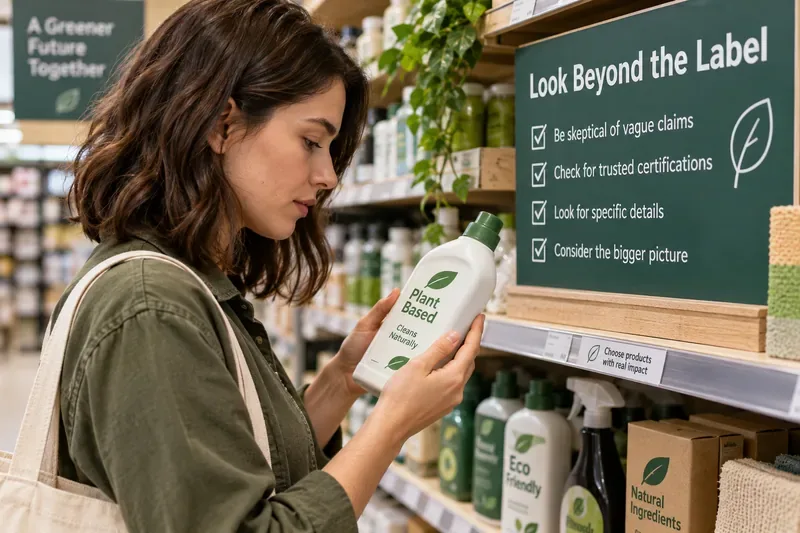
A shopper compares an environmentally themed cleaning product with broader claims around it. Green colors, leaves, and words such as “plant based” can attract attention, but the environmental claim still needs specific evidence.
Start by asking what the claim actually promises
Back to Maya’s fictional detergent. “Planet-friendly” sounds positive, but it does not identify a measurable benefit. Does it mean lower greenhouse gas emissions? Less plastic? Safer ingredients? Reduced water use? A refillable package? A claim that never answers that question gives the shopper very little to verify.
The FTC’s Environmental Claims: Summary of the Green Guides says marketers should not make broad, unqualified general environmental benefit claims such as “green” or “eco-friendly.” When a broad claim is qualified, the benefit should be clear, prominent, specific, and significant rather than a tiny improvement presented as if it makes the whole product environmentally superior.
That distinction matters because greenwashing often works through implication rather than an obviously false sentence. A package may be technically correct about one feature while visually suggesting something much broader. A bottle that contains some recycled plastic, for example, is not automatically evidence that the detergent formula, manufacturing process, shipping footprint, and end-of-life disposal are all environmentally preferable.
Use a five-question test on any eco-friendly claim
Claim you see
Question to ask
What stronger evidence looks like
“Eco-friendly” or “green”
What specific environmental benefit is being claimed?
A defined attribute, measurement, scope, and relevant qualification.
“Made with recycled content”
How much, and does the percentage apply to the product or only the package?
A percentage and a clear statement of which component contains the recycled material.
“100% recyclable”
Can consumers actually recycle the entire item through programs reasonably available where it is sold?
Clear instructions and qualifications when recycling access is limited or components differ.
“Carbon neutral”
What emissions are included, for what period, and does the claim depend on offsets?
A disclosed scope, calculation method, reduction strategy, and transparent treatment of offsets.
“Certified green”
Who created the standard, what does it evaluate, and can the certification be verified?
Public criteria, a named certifier, disclosed relationships, and a searchable or otherwise verifiable record.
“Recyclable” and “recycled” are not the same claim
Maya’s fictional bottle says both “100% recyclable” and “made with recycled materials.” Those statements address different things. Recyclable concerns whether the item can enter an appropriate recycling stream after use. Recycled content concerns material that was recovered or diverted from the waste stream and used to make the item.
Under the FTC’s current Green Guides, marketers should qualify a recyclable claim when appropriate recycling facilities are not available to at least 60% of consumers or communities where the product is sold. The FTC also says partial recycled-content claims should state the amount—for example, a package made with 30% recycled material rather than an undefined “made with recycled content” message.
For Maya, the useful follow-up is not “Is there a recycling symbol?” It is “Which parts are recyclable in my local program, and what percentage of this bottle is recycled material?” A pump, cap, shrink sleeve, multilayer pouch, or label may follow different disposal rules from the main container. Local acceptance matters.
Be careful with biodegradable and compostable language
“Biodegradable” is another word that can sound more useful than it is. The FTC’s guidance says an unqualified degradable claim for solid waste should be supported by evidence that the entire product or package completely breaks down and returns to nature within a reasonably short period after customary disposal; the Guides identify one year as the benchmark for solid waste products. They also caution that items destined for landfills, incinerators, or recycling facilities generally should not carry unqualified biodegradable claims when they will not break down within that period.
“Compostable” also depends on conditions. The marketer should have evidence that the material safely breaks down into usable compost in about the same time as the materials with which it is composted. If the item is suitable only for an industrial or municipal composting facility, or if those facilities are not widely available, the claim should be qualified rather than making shoppers assume they can toss it into a backyard compost bin.
So if Maya’s fictional detergent came in a “compostable refill pouch,” she should look for the disposal condition, not just the word compostable. A claim that works only in a specialized facility is materially different from one that works in a home compost pile.
A green seal is not automatically independent proof
The fictional “Earth Promise Certified” seal on Maya’s bottle looks official, but a professional-looking logo proves nothing by itself. The FTC says certifications and seals can operate as endorsements. Marketers should disclose material connections to a certifying organization when that relationship could affect credibility, and seals that do not clearly explain the basis of certification should identify the specific environmental benefits being evaluated.
A practical check takes less than a minute: search for the certifier’s official site, read the standard, and confirm that the exact product or model appears in a public database when one is available. If the seal was created by the brand itself, if the criteria are not published, or if the seal merely repeats broad words such as “green approved,” treat it as marketing rather than independent evidence.
That does not mean every company-created environmental label is false. It means the evidence behind the label matters more than the artwork.
Know what credible labels do—and what they do not do
Some government-backed programs make their criteria and verification process public. For household cleaners and related products, the EPA’s Safer Choice program evaluates ingredients against human-health and environmental criteria and also reviews elements such as performance and packaging. The current Safer Choice Standard was updated in August 2024, according to the EPA’s standard and criteria page.
For appliances and other covered product categories, ENERGY STAR is about energy-efficiency performance and requires certification against EPA specifications. For qualifying food and agricultural products, the USDA organic standards define requirements that must be verified by a USDA-accredited certifying agent.
The key is scope. An ENERGY STAR label does not tell you everything about materials, recyclability, labor practices, or total life-cycle impact. USDA Organic does not mean a product has zero environmental footprint. A trustworthy certification is useful because it verifies defined criteria—not because one logo can prove that a product is “good for the planet” in every possible way.
Carbon-neutral claims deserve extra questions
Suppose Maya turns over the fictional bottle and finds only the words “carbon neutral,” with no boundary, time period, emissions inventory, or explanation. That is not enough information to understand the claim.
The FTC’s current Green Guides contain specific guidance for carbon-offset claims: marketers should have competent and reliable scientific evidence, use appropriate accounting methods, avoid selling the same reduction more than once, and disclose when the purchased offset funds reductions that will not occur for at least two years. The Guides also say marketers should not advertise an offset when the underlying emissions-reduction activity is already required by law.
A shopper does not need to conduct a full carbon audit in the aisle. Look instead for basic transparency: What emissions are covered—manufacturing, operations, shipping, use, or the full product life cycle? Is the claim based primarily on direct emissions cuts or on purchased offsets? What standard or methodology was used? What period does the claim cover? If the company provides none of that, the claim is hard to evaluate.
Watch for irrelevant or strategically narrow claims
Some greenwashing is less about fabricating a fact and more about choosing a fact that distracts from the bigger picture. “Free of Chemical X” may sound meaningful even when Chemical X was never normally used in that type of product. The FTC says a “free-of” claim can be deceptive if the substance was never associated with the product category, or if the product excludes one substance while using another that poses a similar environmental risk.
Likewise, a company may advertise “10% less packaging” without identifying the comparison. The FTC recommends making source-reduction claims clear about both the amount of reduction and the basis for comparison. “10% less plastic than our 2025 bottle,” for example, gives the buyer something concrete to evaluate.
In Maya’s case, the best question is: “Compared with what?” If there is no baseline, date, prior model, industry benchmark, or measurable reference point, a comparative claim can sound more impressive than the information supports.
What Maya should buy in the hypothetical example
There is no automatic winner. The purpose of the scenario is not to recommend the fictional products but to show how to make a better decision. Maya should favor the option whose relevant environmental claims are specific and verifiable for the priorities she actually cares about.
If reducing virgin plastic is her priority, a bottle that clearly states “60% post-consumer recycled plastic, excluding cap and label” is more informative than “made with recycled materials.” If ingredient hazard is her priority, a verified program with published criteria may matter more than a leaf graphic. If she is trying to reduce disposal waste, a practical refill system she can actually use may be more relevant than a broad “planet positive” slogan.
Price, performance, durability, concentrated formulas, refill availability, shipping, and how much product is needed per use can also affect the practical choice. Greenwashing detection is not about finding a product with the most environmental badges. It is about separating evidence from impression.
A quick greenwashing checklist before checkout
Specific: Does the claim name a particular benefit instead of relying on “green,” “eco,” or “planet friendly”?
Scoped: Is it clear whether the claim applies to the product, package, factory, shipment, or company?
Measured: Are percentages, dates, baselines, or other quantities provided where they matter?
Qualified: Are important limitations easy to see rather than buried in fine print?
Verifiable: Can you find the standard, test basis, certification criteria, or product listing from an authoritative source?
Relevant: Is the benefit meaningful for this product category, or does it spotlight something trivial?
Locally workable: For recyclable or compostable claims, do the required facilities or collection programs exist where you live?
What U.S. guidance is current in 2026?
As of September 14, 2026, the FTC’s official Green Guides page still identifies the 2012 revision of 16 CFR Part 260 as the published Green Guides. The FTC began a regulatory review in December 2022 and held a May 2023 workshop focused on recyclable claims. The agency’s official pages reviewed for this article do not show a finalized replacement revision. That means shoppers should distinguish between proposals or review discussions and rules or guidance that have actually been finalized.
The EPA’s Buying Green for Consumers page also advises shoppers to be cautious with vague claims such as “environmentally friendly,” “eco safe,” and “green,” and to use credible ecolabels as one tool for comparing products.
If a claim appears deceptive
Keep the product name, photos or screenshots of the claim, the date, and any web page that explains the marketing statement. In the United States, consumers can report potentially deceptive marketing through the FTC’s official ReportFraud.ftc.gov portal. A suspicious claim is not automatically proof of a legal violation, but preserving the exact wording makes it easier to evaluate what was actually represented.
The most reliable defense against greenwashing is not cynicism. It is precision. When a claim tells you exactly what improved, by how much, compared with what, under which conditions, and who verified it, you have something useful to judge. When the marketing offers only leaves, earth colors, and a sweeping promise to “save the planet,” you mostly have a mood.