Home
» Health
»
The Future of Renewable Energy at Home: What Makes Sense in 2026 and Beyond
The Future of Renewable Energy at Home: What Makes Sense in 2026 and Beyond
The most important answer: the future of renewable energy at home is not one breakthrough device. It is a more coordinated home energy system in which clean electricity, storage, efficient electric equipment and smarter controls work together. For many homeowners, rooftop solar will remain the main way to generate renewable electricity on-site. For others, community solar, a heat pump powered by a cleaner grid, or a carefully timed battery investment may deliver more value.
The right choice depends on a few practical conditions: whether you own the property, how sunny or windy the site is, the age and shape of the roof, local electricity rates, compensation for exported power, outage risk, how long you expect to stay, and what incentives are actually available where you live. In 2026, that last point deserves extra attention: the IRS says the federal Residential Clean Energy Credit is not available for property placed in service after December 31, 2025. That means older articles describing a continuing 30% federal homeowner credit are no longer current for 2026 installations. See the current IRS Residential Clean Energy Credit guidance.
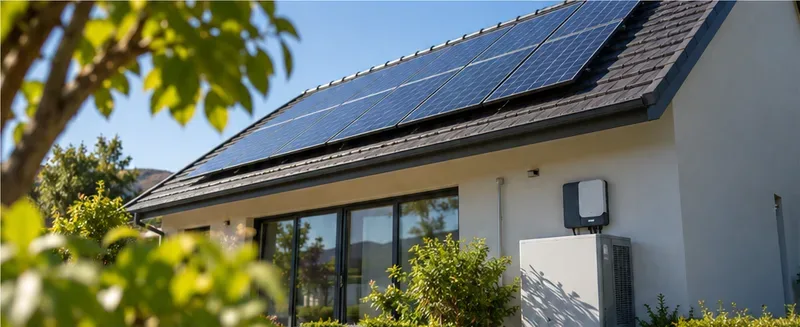
A modern home with rooftop solar panels and outdoor energy equipment illustrates how future household energy systems can combine on-site generation with efficient electrical technology.
Home renewable energy is growing, but the winning setup will vary by household
Residential solar is already a meaningful part of U.S. electricity supply. In its August 26, 2026 release, the U.S. Energy Information Administration estimated that residential small-scale solar photovoltaic systems generated about 35.6 million megawatt-hours in the first half of 2026, compared with about 31.7 million megawatt-hours in the first half of 2025. The figures are preliminary, but they show that household-scale solar is still expanding. The underlying data are available in the EIA Electric Power Monthly residential generation table.
Growth does not mean every home should copy the same design. A sunny detached house with a newer roof, high daytime electricity use and favorable utility rules may be a strong rooftop-solar candidate. A renter in an apartment cannot make the same decision. A rural household with strong, unobstructed wind might consider small wind generation, while the same turbine would be impractical on a typical suburban lot. The future is therefore likely to be more modular: households will combine the pieces that match their building, budget and local energy market.
Which home energy options are likely to matter most?
Option
Best fit
Main trade-off
Where it is heading
Rooftop solar
Owners with a suitable, relatively unshaded roof and enough time to benefit from the investment
Upfront cost, roof condition, permitting, interconnection and local export compensation
Likely to remain the core on-site renewable generator for many homes
Solar plus battery
Homes that value outage backup, face time-of-use rates, or receive limited value for exported solar
Higher cost, finite storage capacity and some energy loss during charging and discharging
Increasingly integrated with smart controls and flexible household loads
Community solar
Renters, condo residents and households with shaded or unsuitable roofs
Availability, contract terms and savings vary by program and location
A key path for expanding access beyond single-family rooftops
Heat pump plus renewable electricity
Homes replacing aging heating or cooling equipment
A heat pump does not generate renewable power; economics depend on climate, electricity rates and the existing system
More homes can shift heating and cooling toward electricity that can increasingly come from clean sources
Bidirectional EV charging
Households with a compatible EV, charger and electrical setup that want backup power or flexible energy use
Vehicle and charger compatibility, installation cost, utility rules and interconnection requirements
Promising as mobile storage, but not yet a universal plug-and-play home feature
Small wind
Rural or open sites with verified wind resources, adequate space and permissive zoning
Highly site-specific; towers, permitting and maintenance can make it unsuitable for many homes
Likely to remain a specialized option rather than a mainstream suburban solution
Rooftop solar will stay important, but the roof and utility tariff matter as much as the panels
Solar modules can work in a wide range of climates, but site conditions still determine whether rooftop solar is a sensible purchase. The Department of Energy notes that roof age, shade, size, shape and slope all matter. A heavily shaded roof that needs replacement soon can turn a seemingly attractive solar quote into a poor project. DOE also points homeowners to tools such as PVWatts for estimating production, while emphasizing that installers should provide site-specific estimates. See the Department of Energy Homeowner's Guide to Solar.
Example: suppose two homes use the same amount of electricity. Home A has an unshaded roof with 20 years of expected life remaining. Home B has mature trees over the roof and shingles likely to be replaced in three years. Home A may be ready for solar now. Home B may be better off replacing the roof first, evaluating a ground-mounted system if space allows, or using community solar instead. The panels are only one part of the decision.
Home batteries are becoming more useful as electricity becomes more time-sensitive
A battery does not create renewable energy. It changes when electricity can be used. Paired with solar, it can store some daytime production for the evening or for selected loads during an outage. DOE explains that storage can improve flexibility and resilience, while also noting an unavoidable physical trade-off: energy storage is not 100% efficient because some energy is lost during conversion and retrieval. See DOE's solar and energy storage basics.
A battery is especially worth examining if your utility charges much more during evening peak hours, pays relatively little for solar exports, or you experience outages that make backup power valuable. If your utility credits exported solar at a very favorable rate and outages are rare, the purely financial case for a battery may be weaker. That does not make the battery bad; it means resilience and convenience may be the main reasons to buy it.
Consumers should also ask a concrete backup question before comparing battery capacities: what do you actually want to keep running? A refrigerator, lights, internet equipment and a few outlets require a very different design from whole-home air conditioning, electric water heating and EV charging. Backup duration depends on both stored energy and the power draw of connected loads.
Smart energy management may be the less-visible part of the future
As homes add solar, batteries, heat pumps, water heaters and EV charging, simply owning efficient hardware is not enough. Timing becomes valuable. A home can pre-cool while solar output is high, heat water before a peak-price period, charge a battery when electricity is cheap, or delay EV charging until the grid is less constrained.
The Department of Energy is actively working on the integration of distributed energy resources, including generation, storage and flexible loads. DOE describes a future distribution grid in which these decentralized resources can be coordinated while maintaining reliability and affordability. See the agency's distributed energy resources overview.
For consumers, the practical implication is simple: when buying major electrical equipment, pay attention not only to efficiency but also to controls, interoperability, warranty terms and whether your utility offers time-of-use rates or demand-response programs. A technically sophisticated smart panel may add little value if your rate never changes and you have no flexible loads. In a home with solar, a battery, an EV and variable electricity pricing, coordination can matter much more.
Heat pumps belong in the conversation, even though they do not generate renewable energy
A heat pump is an efficiency and electrification technology, not a renewable generator. It moves heat rather than creating heat by combustion. DOE says modern heat pumps can serve all climates, with cold-climate models designed for low temperatures. The main types include air-source systems and ground-source, or geothermal, heat pumps. More detail is available in DOE's Heat Pump Systems guide.
Why does this matter in an article about renewable energy? Because a home that generates solar electricity can use some of that electricity for heating and cooling. Even without rooftop solar, a heat pump can increasingly run on grid electricity supplied by a growing mix of renewable generation. The sequence can also be practical: if a furnace or air conditioner is near end of life, replacing it with a well-sized heat pump may be a more urgent decision than installing generation equipment.
Renters and shaded-roof households are not excluded from solar
Community solar is one of the most important alternatives to the idea that renewable energy must sit on your own roof. DOE defines community solar as a project or purchasing program in which benefits from a solar project flow to multiple customers. Participants commonly subscribe to a share and receive bill credits associated with the electricity generated. It can be particularly relevant for renters, households that cannot afford or host rooftop systems, and buildings whose roofs are unsuitable. See DOE's Community Solar Basics.
The trade-off is that community solar is not one standardized product nationwide. Availability, cancellation terms, subscription pricing and bill-credit rules vary. Consumers should compare the actual contract against their current utility bill rather than assuming every community-solar offer produces the same savings.
Your electric car may become part of the home energy system
Bidirectional charging allows a compatible EV to receive electricity and later discharge electricity to another load. Vehicle-to-home, or V2H, can potentially use the large battery already parked in a driveway as backup power. DOE notes that bidirectional vehicles can support buildings and, in some configurations, the grid, but this requires compatible vehicles, charging equipment and electrical integration. Utility and interconnection rules also matter. See DOE's bidirectional charging overview.
This is a promising direction, not a reason to assume every EV can power every home. If backup power is a purchasing priority, verify the exact vehicle model, charger, transfer equipment, permitted installation and supported operating mode before buying.
Small wind will remain valuable in the right place—and wrong in many others
Home wind is a good example of why site conditions matter more than technology enthusiasm. DOE's current Small Wind Guidebook says a useful residential wind installation generally needs an adequate wind resource, space, zoning that permits a tower, workable interconnection and favorable economics. The guide notes that turbines large enough to make a significant contribution to a typical U.S. home's electricity use generally require about an acre or more. See the DOE Small Wind Guidebook.
For a farm, ridge, coastal site or remote property, wind can be worth a detailed assessment. For a dense neighborhood surrounded by trees and buildings, rooftop solar or community solar will usually be far easier to evaluate and install.
What changed for U.S. homeowners in 2026?
The largest consumer-policy change to check before using an older solar calculator or article is federal tax treatment. According to the IRS page updated for current law, the Residential Clean Energy Credit covered qualifying property installed from 2022 through December 31, 2025, and is not available for property placed in service after that date. This affects solar electric panels, solar water heaters, wind turbines, geothermal heat pumps, fuel cells and qualifying battery storage that previously fell under the credit.
State, local and utility incentives can still exist, and electricity-rate structures can be just as important as rebates. Because these programs change, do not build a 10- or 20-year payback estimate from a sales presentation alone. Confirm the applicable utility tariff, interconnection rules, export compensation and incentives using current documents for your location.
A practical decision order for the next five to ten years
You do not need to predict the entire energy market to make a sensible home decision. A useful order is:
Reduce avoidable demand first. Air sealing, insulation, controls and efficient appliances can reduce the size of the renewable system you need.
Know your electricity profile. Look at annual consumption and, if available, hourly or time-of-use patterns.
Check the physical site. Roof age, shade, electrical service, parking location, wind exposure and space can eliminate or strengthen options quickly.
Read the utility rules. Export compensation, time-of-use pricing, interconnection and demand-response programs change the economics of solar, storage and EV charging.
Separate savings from resilience. A battery bought for blackout protection should be judged partly on backup value, not only on simple payback.
Plan for equipment replacement cycles. A failing HVAC system, aging roof or upcoming EV purchase may determine the smartest sequence of upgrades.
Verify current incentives at the time of purchase. In 2026, relying on pre-2026 federal tax-credit assumptions can materially distort the cost comparison.
The likely future: homes become flexible energy participants, not isolated mini power plants
The most realistic future is not that every house disconnects from the grid. It is that more homes produce some electricity, store some, shift some loads and interact more intelligently with utilities. Solar can supply local generation; batteries can shift timing; heat pumps can electrify major energy uses; EVs can add a large controllable load and, in some cases, a source of backup power; community solar can serve people without suitable roofs.
That future is already visible, but the best consumer decision remains local. If you own a sunny home with a sound roof and expect to stay for years, rooftop solar deserves serious analysis. If outages or time-of-use rates are a major concern, add storage to the comparison. If you rent or have a shaded roof, look for a well-structured community-solar option. If your heating system is aging, a heat pump may be the more immediate clean-energy upgrade. And if you have rural land with verified wind resources, small wind may be worth the specialized site study that most suburban homes do not justify.
The technology will keep changing. The durable strategy is to start with your home's constraints, your utility's rules and the service you actually want—lower bills, cleaner energy, resilience, or some combination of the three—then choose the renewable-energy pieces that serve those goals.