Home
» Health
»
Sustainable Investing (ESG) in 2026: A Beginner’s Guide to Choosing Funds
Sustainable Investing (ESG) in 2026: A Beginner’s Guide to Choosing Funds
Sustainable investing is easier to access than it was a decade ago, but the label is still less standardized than many beginners assume. In 2026, the most useful change is not that regulators have created one universal definition of a “good” ESG investment. They have not. Instead, fund naming and disclosure rules are becoming more specific, which makes it easier to ask better questions about what a fund actually owns and how it applies environmental, social, and governance criteria.
What changed for ESG investors in 2026?
In the United States, the Securities and Exchange Commission’s amended Investment Company Names Rule is especially relevant to funds whose names suggest a particular investment focus or characteristic. The rule’s expanded 80% investment-policy framework can apply to names using terms that suggest environmental, social, governance, sustainability, or similar characteristics. The SEC previously extended the main compliance dates to June 11, 2026 for larger fund groups and December 11, 2026 for smaller fund groups. You can verify the rule history in the SEC’s Names Rule compliance-date announcement.
There was another update on February 18, 2026: the SEC extended only the related Form N-PORT reporting amendments to November 17, 2027 for fund groups with at least $10 billion in net assets and May 18, 2028 for smaller groups. That reporting extension should not be confused with a blanket postponement of the underlying Names Rule requirements. The SEC’s 2026 Investment Company Names rule page explains the distinction, while the 2025–26 Names Rule FAQs provide additional staff guidance.
For a beginner, the practical takeaway is simple: a fund name can now carry more regulatory weight, but the name still does not tell you whether the fund matches your values, offers broad diversification, charges a reasonable fee, or is likely to meet your financial goals. You still need to read the methodology and holdings.
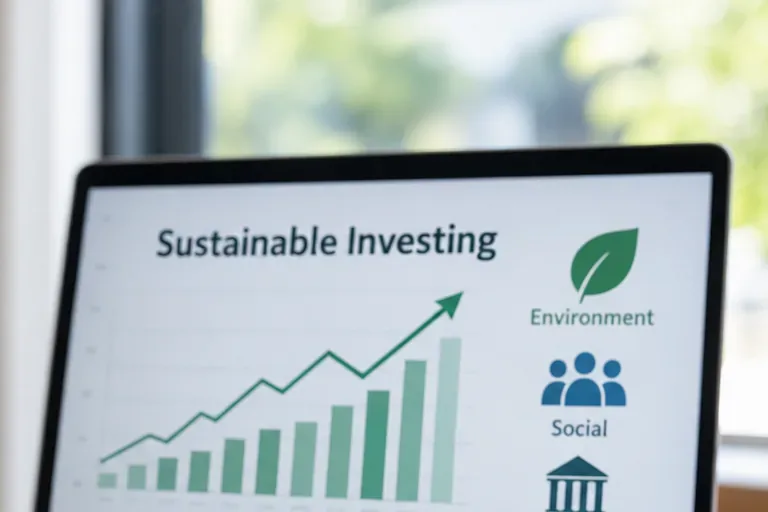
A laptop shows a simple ESG-themed chart and category symbols. Fund labels are a starting point; the methodology and disclosures determine what the strategy actually does.
Outside the United States, rules are moving too. On June 24, 2026, the Council of the European Union agreed its negotiating position on a revision of the Sustainable Finance Disclosure Regulation, or SFDR. The proposal aims to simplify sustainability disclosures and make products easier for retail investors to compare. As of September 2026, the revision is still going through the EU legislative process rather than being a finished replacement framework. The Council’s June 2026 announcement is the clearest official status update.
First, what does ESG actually mean?
ESG stands for environmental, social, and governance. It is a way of analyzing risks, opportunities, policies, and business practices that may not be captured by traditional financial statements alone. ESG investing is not one single strategy, and it is not automatically the same thing as impact investing, ethical investing, or excluding entire industries.
A globe and a living plant represent the environmental side of ESG, but sustainable investing also evaluates social and governance considerations alongside financial risk and return.
ESG pillar
What investors may examine
Examples
Environmental
How environmental conditions affect a business and how the business affects natural systems
Energy use, emissions, water, waste, climate exposure, pollution
Social
Relationships with workers, customers, suppliers, and communities
Worker safety, human rights, product safety, labor practices, supply-chain standards
Governance
How a company is directed, controlled, and held accountable
The SEC’s Investor Bulletin on ESG Funds emphasizes that different funds may define, weight, and apply these factors differently. A fund can emphasize governance while doing relatively little screening on climate or social issues. Another can focus almost entirely on a theme such as clean energy. Both may be marketed within the broad sustainable-investing universe.
Know the main sustainable-investing approaches
Before comparing products, identify the approach you actually want. The same stock can appear in one ESG fund and be excluded from another because the funds use different objectives and scoring systems.
Approach
What it does
What to check
ESG integration
Adds ESG information to ordinary financial analysis
How much ESG changes security selection, position size, or risk controls
Exclusionary screening
Avoids selected sectors, activities, or issuers
The exact exclusion thresholds and whether exceptions exist
Best-in-class selection
Prefers companies that score better than industry peers
Whether controversial sectors can still qualify as leaders within their industries
Thematic investing
Targets a sustainability-related theme
Concentration risk, valuation risk, and how directly holdings are tied to the theme
Shareholder engagement
Uses voting and dialogue to influence companies
Proxy-voting policy, engagement reports, escalation process, and evidence of follow-through
Impact investing
Seeks measurable environmental or social outcomes alongside financial return
How outcomes are defined, measured, and separated from ordinary business activity
A practical four-step process for beginners
1. Define the outcome you want before choosing a fund
Start with your financial objective, time horizon, and risk tolerance. Then add any sustainability preferences. For example, “I want a diversified long-term equity allocation and I prefer to avoid companies with high exposure to thermal coal” is much more actionable than “I want a green fund.” The first statement gives you criteria that can actually be checked.
Do not let ESG preferences replace ordinary portfolio planning. If the money is for a near-term goal, a volatile equity fund does not become suitable merely because its sustainability policy appeals to you.
2. Read the prospectus and methodology, not just the fund name
Look for the investment objective, principal strategy, index methodology if applicable, exclusions, portfolio-construction rules, and the way ESG data are used. If the fund uses an external index, understand whether the index removes companies, reweights them, selects only the highest scorers, or simply tilts the portfolio modestly.
Then ask a very concrete question: What would make this fund buy or reject a security? If you cannot answer after reading the fund materials, the strategy is not yet clear enough for an informed decision.
3. Compare holdings, fees, and concentration
Check the top holdings and sector weights against a broad-market alternative. Some ESG funds differ substantially from conventional funds; others are much closer than their branding suggests. Also look for overlap if you already own other funds. Owning several ESG ETFs does not automatically create diversification if they hold many of the same large companies.
Environmental, social, and governance criteria can be weighted very differently. A single composite score should not replace a review of the underlying methodology and holdings.
Fees deserve equal attention. The SEC’s July 2025 Mutual Fund and ETF Fees and Expenses Investor Bulletin notes that higher costs reduce the value of investment returns and that funds disclose operating expenses in a standardized prospectus fee table. Compare the expense ratio with both ESG peers and a broad-market benchmark.
4. Put ESG inside a diversified portfolio, then review it periodically
Once a fund passes your ESG and financial screens, decide what role it plays in your total portfolio. A narrowly focused clean-energy fund, for example, is not a substitute for a diversified stock allocation simply because it owns many securities. It may still be concentrated in one industry or theme.
The SEC’s Asset Allocation and Diversification guidance explains that diversification works both across asset classes and within them. It also cautions that a mutual fund or ETF is not necessarily diversified when it is narrowly focused.
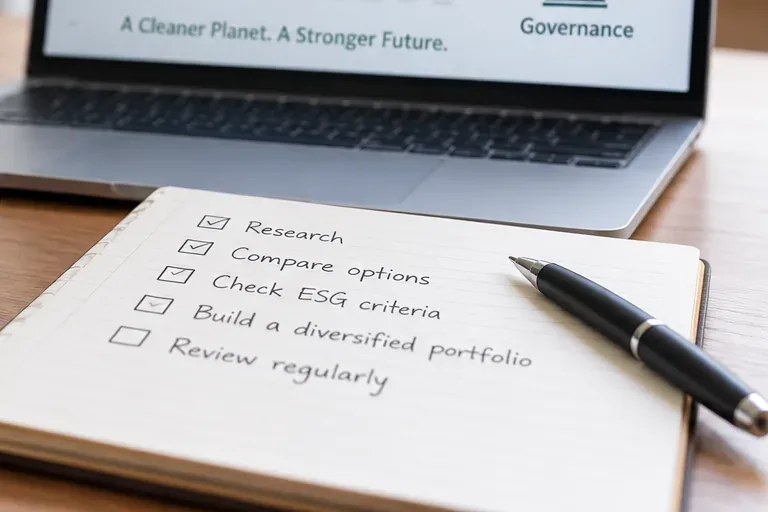
A simple research checklist—compare options, check ESG criteria, diversify, and review regularly—helps keep sustainability preferences connected to the rest of an investment plan.
Review the fund when its methodology changes, when its holdings drift materially, when fees change, or when your own goals change. You do not need to react to every headline or quarterly ranking.
Why two ESG ratings can disagree
A common beginner mistake is treating an ESG score like a credit rating with one broadly shared definition. In reality, ESG data providers can disagree because they measure different topics, use different indicators, and assign different weights. An original peer-reviewed study, “Aggregate Confusion: The Divergence of ESG Ratings”, compared six major rating systems and found substantial disagreement. The researchers attributed most of the divergence to differences in measurement and scope rather than weighting alone.
That does not make ESG analysis useless. It means you should treat a rating as a model output, not as a universal fact. Read what the rating measures, whether it evaluates financial exposure to ESG risks, a company’s effects on society and the environment, or some combination of both.
What greenwashing looks like in an investment product
Greenwashing is an exaggerated or misleading presentation of environmental or sustainability characteristics. For investors, warning signs include sweeping sustainability claims with no measurable criteria, a fund name that sounds more specific than its methodology, selective examples that do not match the full portfolio, or marketing that emphasizes a score without explaining how it is calculated.
More disclosure rules can help, but they cannot eliminate the need for judgment. Even a fund that follows its stated methodology perfectly may not match your personal definition of sustainability.
Quick comparison checklist
Objective: What financial job does this investment need to do?
ESG approach: Integration, exclusions, best-in-class, theme, engagement, or impact?
Definition: How does the fund define the sustainability terms it uses?
Holdings: Do the actual companies and sectors match your expectations?
Concentration: Is the fund heavily tilted toward a sector, country, style, or small group of companies?
Fees: How does the expense ratio compare with similar ESG funds and broad-market alternatives?
Data: Which ESG data or ratings are used, and what are their limitations?
Stewardship: If engagement is part of the strategy, how does the manager vote and report results?
Portfolio fit: Does the fund improve or reduce diversification when combined with what you already own?
Monitoring: What would cause you to review or replace the investment?
Common mistakes to avoid
Buying the label instead of the portfolio. “Sustainable” is not a substitute for reading the holdings and strategy.
Assuming ESG means low risk. ESG funds remain exposed to market, sector, interest-rate, currency, and other investment risks.
Assuming every ESG fund excludes fossil fuels, weapons, or controversial companies. Some do; others do not.
Ignoring price and fees. A strong sustainability methodology cannot erase the effect of high costs or an overvalued portfolio.
Chasing the highest ESG score. Ratings can differ materially because providers measure different things.
Confusing ESG integration with impact. A fund can consider ESG risks without being designed to create a measurable social or environmental outcome.
The bottom line
Sustainable investing in 2026 is becoming more transparent, but not more automatic. U.S. fund naming rules are giving investors more structure around what certain names imply, while the EU is still negotiating a simpler sustainability-disclosure framework. Those changes are useful, but neither creates a universal ESG score or guarantees that a product fits your goals.
A solid beginner process is to start with your financial objective, define the sustainability preferences you can actually verify, inspect the fund’s methodology and holdings, compare fees, and keep diversification in view. If you cannot explain in plain English why a fund belongs in your portfolio, more research is warranted.
This article is for general educational purposes and is not individualized investment, tax, or legal advice.