Home
» Health
»
The Truth About Fast Fashion in 2026: What Changed and How to Shop Smarter
The Truth About Fast Fashion in 2026: What Changed and How to Shop Smarter
Fast fashion in 2026 is not suddenly sustainable. The basic model still depends on rapid trend turnover, high volumes, low prices, and frequent purchasing. What has changed is the level of regulatory pressure, especially in the European Union, and the amount of scrutiny applied to waste, green claims, and producer responsibility.
For shoppers, the practical takeaway is simple: do not judge a garment by price, a green-colored tag, or a brand slogan. Judge it by how much you are likely to wear it, how well it is made, whether the seller gives specific evidence for environmental claims, and what happens to the item when you are done with it.
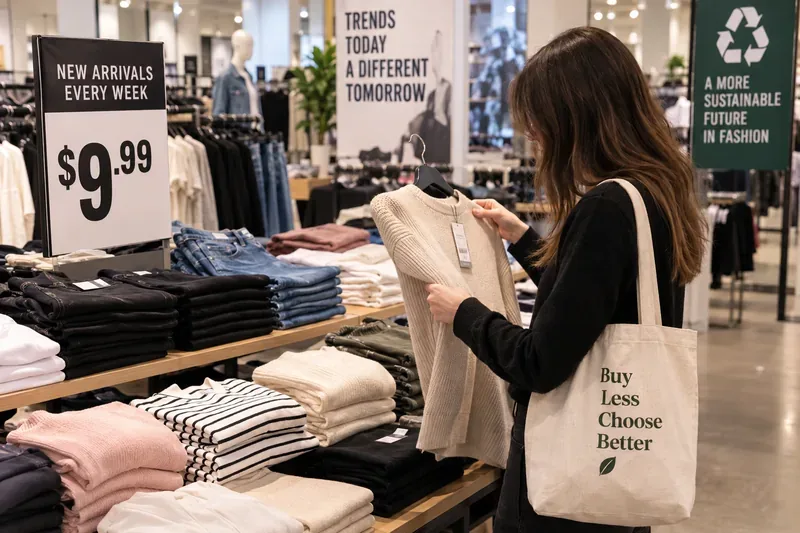
A shopper inspects a knit garment in a high-volume clothing store, a useful reminder to look beyond low prices and sustainability slogans and examine the product itself.
Fast fashion in one minute
Question
Practical answer
What is fast fashion?
A retail model built around frequent new styles, rapid production cycles, high sales volume, and low-to-moderate prices.
Is every inexpensive garment fast fashion?
No. Price alone does not identify a business model, product quality, or environmental performance.
Is every expensive garment sustainable?
No. A higher price can reflect design, branding, distribution, materials, or margin without proving better labor or environmental performance.
Is “recycled,” “conscious,” or “eco” enough evidence?
No. Look for a specific, verifiable claim that explains what part of the product or process it covers.
What usually matters most for a shopper?
Buying fewer pieces, choosing items you will wear often, caring for them well, repairing them when practical, and keeping them in use longer.
What actually changed in 2026?
1. The EU ban on destroying unsold clothing is now in force for large companies
One of the clearest 2026 changes arrived on July 19. Large companies in the EU are now prohibited from destroying unsold clothing, clothing accessories, and footwear, except in specified circumstances such as safety issues, damage, or other limited exemptions. Medium-sized companies are scheduled to come under the rule in 2030.
This matters because unsold inventory is a hidden part of the fast-fashion problem. The European Commission says businesses should prioritize selling, discounting, donating, repairing, refurbishing, or otherwise keeping products in use. The Commission also cites an estimate that 4% to 9% of textile products placed on the European market have historically been destroyed before use. Read the European Commission notice on the July 2026 ban.
2. New EU anti-greenwashing rules are about to apply
As of September 14, 2026, another important change is just ahead. Directive (EU) 2024/825 on empowering consumers for the green transition applies from September 27, 2026. It strengthens consumer protection against misleading environmental marketing and early-obsolescence practices.
The rules target generic environmental claims when recognized excellent environmental performance cannot be demonstrated, and they restrict sustainability labels that are not based on a qualifying certification scheme or established by public authorities. The directive also addresses certain claims based on greenhouse-gas offsetting. The practical effect is that words such as “green” or “eco-friendly” should not be treated as meaningful evidence on their own. See the European Commission sustainable consumption guidance and the official text of Directive (EU) 2024/825.
3. Textile producers face growing responsibility for end-of-life waste
The EU's revised Waste Framework Directive entered into force on October 16, 2025. It requires Member States to create extended producer responsibility, or EPR, schemes for textiles and footwear. EPR means producers help finance or organize the management of products after consumers discard them.
Member States have 20 months to transpose the revised directive into national law and 30 months to establish textile and footwear EPR schemes, with the EU framework pointing to April 17, 2028 as the deadline for those schemes. That distinction is important: in 2026, the legal direction is clear, but implementation is still underway and is not identical in every country. The European Commission summary of the revised Waste Framework Directive explains the timetable and producer obligations.
The environmental problem is still largely about scale
Fast fashion is often discussed as if the problem were one particular fiber, one country, or one brand. In reality, scale is a central issue. A garment can use a lower-impact material and still contribute to a high-impact system if huge volumes are produced, bought, returned, discarded, and replaced quickly.
The United Nations Environment Programme reports that the textile industry accounts for an estimated 2% to 8% of global greenhouse-gas emissions. That wide range reflects different system boundaries and methods, so it should be treated as an estimate rather than a precise universal figure. UNEP's broader point is that textiles have substantial climate, water, chemical, and waste impacts. See UNEP's 2025 overview of fashion's environmental footprint.
European data also show how consumption can overwhelm efficiency gains. The European Environment Agency estimated that people in the EU consumed an average of 19 kilograms of clothing, footwear, and household textiles per person in 2022, up from 17 kilograms in 2019. The same EEA assessment estimated about 16 kilograms of textile waste per person in 2022. Those are EU figures, not global averages, but they illustrate why simply making each item somewhat more efficient does not solve overconsumption. See the European Environment Agency circularity briefing.
The labor issue is not solved by a sustainability collection
Environmental claims and labor conditions are separate questions. A shirt made with recycled fiber does not automatically tell you who sewed it, how much they were paid, how safe the workplace was, or whether workers could exercise fundamental labor rights.
The International Labour Organization reported in 2025 that the textiles and clothing sectors provide jobs to more than 90 million people worldwide, predominantly women, while continuing to face decent-work challenges that include poor working conditions, low wages, and gender inequality. The sector also provides essential income and economic opportunities, which is why simplistic calls to “stop buying clothes from producing countries” can miss the point. Better purchasing practices, credible due diligence, worker voice, and enforcement matter more than blanket assumptions about a country of origin. See the ILO brief on decent work in textiles and clothing.
How to evaluate a garment before you buy it
You do not need a laboratory or a perfect supply-chain map. A quick physical and informational check can help you avoid obvious bad buys.
Start with intended use. Ask whether the item fills a real gap, works with clothes you already own, and is likely to be worn at least dozens of times rather than once or twice.
Check the seams. Look for even stitching, secure seam endings, no loose threads at stress points, and fabric that does not pull apart when gently tensioned.
Inspect fabric behavior. Hold it to the light, stretch it gently if appropriate, and look for snagging, distortion, excessive shedding, or a finish that feels unlikely to survive normal washing.
Read the fiber label and care instructions. Fiber content alone does not determine sustainability, but it affects comfort, care, drying, durability, and recycling options. A garment you will not realistically care for is a poor purchase.
Check hardware. Test zippers, snaps, buttons, drawcords, and fasteners. Weak hardware can shorten the useful life of an otherwise wearable garment.
Look at the return policy. High-return shopping habits create logistics and inventory pressure. If you are unsure about size or fit, use measurements and reviews before ordering several versions simply to return most of them.
How to read sustainability claims without getting fooled
A useful claim answers five questions: what changed, how much, compared with what, which part of the product it covers, and who verified it. “Made with recycled polyester” is more specific than “planet friendly,” but it still does not tell you the recycled percentage unless that figure is stated. “Organic cotton” says something about a fiber source, not automatically about dyeing, worker pay, shipping, durability, or the entire company.
Use this quick test:
Claim
What to ask next
“Sustainable” or “conscious”
What measurable attribute makes it so?
“Recycled”
What percentage is recycled, and which component does that percentage describe?
“Lower carbon”
Lower than what baseline, over what lifecycle boundary, and was the reduction measured or offset?
Certification logo
What standard does it certify: fiber, chemicals, factory process, labor practice, or the whole product?
Take-back program
What happens to collected garments: reuse, resale, recycling, downcycling, export, or disposal?
What is usually better than chasing the “perfect” brand?
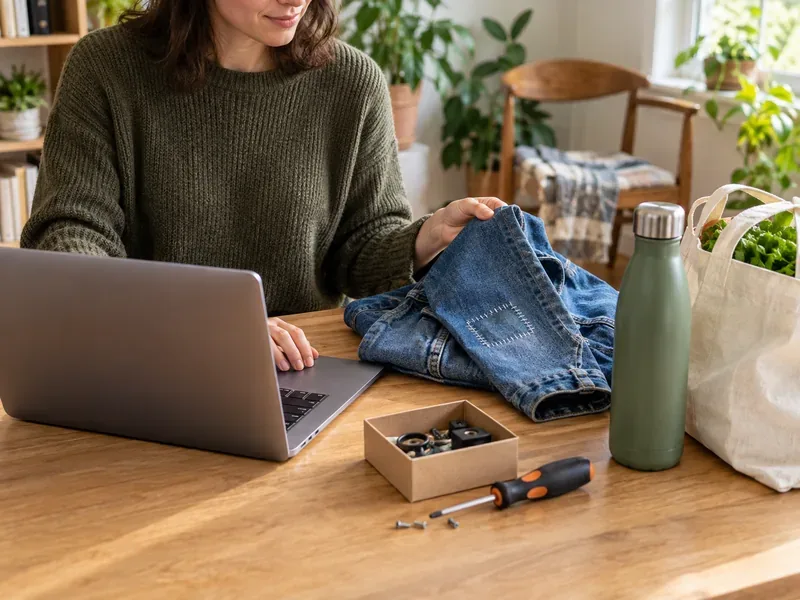
For most people, a lower-consumption wardrobe is more practical than trying to identify a flawless brand. Start with the clothes you already own. Wear them more often. Wash only when needed, follow care instructions, air-dry when suitable, repair small failures early, and alter pieces that almost fit.
When you do need something, secondhand can reduce demand for new production and keep an existing garment in use, although the benefit depends on what you buy and whether it actually replaces a new purchase. Rental can make sense for occasional formalwear or specialized clothing, but it is not automatically low-impact because cleaning and transport also matter.
For new items, cost per wear can be a useful personal metric. Divide the price by the number of times you realistically expect to wear the item. A $120 coat worn 120 times costs $1 per wear; a $15 novelty top worn twice costs $7.50 per wear. This is not an environmental lifecycle assessment, but it is a simple way to shift attention from sticker price to useful life.
What should you do with clothes you no longer want?
Use a hierarchy. First, keep and repair. Second, sell, swap, or donate items that are genuinely wearable. Third, use textile collection or recycling systems where available for items that are no longer suitable for reuse. Do not assume every donation will find a local wearer; sorting systems can redirect clothing to resale, export, recycling, downcycling, or disposal depending on quality and local infrastructure.
EU Member States have been required to provide separate textile collection since 2025, but collection capacity and downstream outcomes still vary. A collection bin is therefore better understood as an entry point into a system, not a guarantee that a garment will become a new garment.
Fast-fashion shopping checklist for 2026
Do I have a specific use for this item?
Would I still want it if it were not on sale?
Can I make at least three outfits with clothes I already own?
Do the seams, fabric, and hardware look durable enough for my intended use?
Can I follow the care instructions realistically?
Are sustainability claims specific, measurable, and verifiable?
Does a certification clearly explain what it covers?
Can the item be repaired or altered if a small part fails?
Am I buying one good-fit item rather than multiple sizes or colors I expect to return?
What will I do with the garment at the end of its useful life?
The bottom line
The truth about fast fashion in 2026 is more complicated than “cheap clothes are bad” or “buy sustainable brands.” Regulation is getting stricter, especially in Europe: destruction of unsold apparel is now restricted for large companies, producer responsibility is expanding, and tougher rules on vague green claims are about to apply. But those changes do not erase the underlying pressure created by high-volume, short-life consumption.
The most reliable consumer strategy remains surprisingly ordinary: buy with a purpose, examine quality, demand precise evidence for claims, wear garments longer, repair what you can, and keep usable clothing in circulation. You do not need a perfect wardrobe. You need fewer purchases that you regret and more clothes that earn their place by being worn.