Home
» Health
»
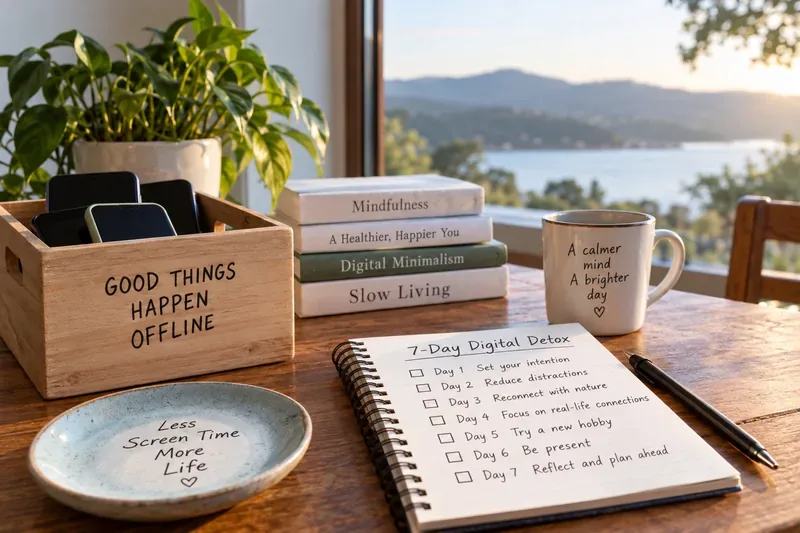
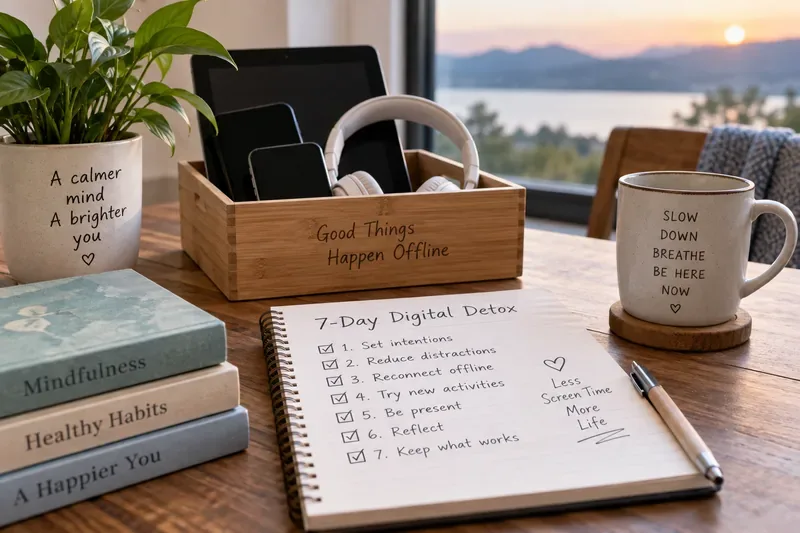
Digital Detox: A Practical 7-Day Guide to Better Mental Health
Digital Detox: A Practical 7-Day Guide to Better Mental Health
You may open your phone to answer one message and look up 25 minutes later wondering where the time went. The same pattern can happen at breakfast, during work, in line at a store, and again in bed. By the end of the day, the problem is not simply “too much screen time.” It is that checking has become automatic, attention is fragmented, sleep gets pushed later, and online activity can crowd out movement, quiet, or face-to-face connection.
A digital detox does not require throwing away your phone or disappearing from everyone for a week. A more useful goal is to identify which digital habits are costing you something and then reduce those habits without cutting off work, safety, navigation, health care, or people you care about.
That distinction matters because the research is mixed. A 2022 randomized trial of 154 adults found that a one-week break from several social media platforms improved well-being, depression, and anxiety scores in that study. A 2025 randomized trial in healthy university students found improvements in stress, sleep quality, depressive symptoms, and well-being after three weeks of reducing smartphone screen time to no more than two hours a day. But a 2025 systematic review and meta-analysis of 10 social-media-abstinence studies involving 4,674 participants found no significant overall effect on positive affect, negative affect, or life satisfaction. In other words, a detox can help, but abstinence is not a guaranteed mental-health treatment and may not be the best strategy for everyone. See the original research on the one-week social media trial, the 2025 smartphone reduction trial, and the 2025 abstinence meta-analysis.
What This 7-Day Digital Detox Is Designed to Fix
This plan targets four common problems: reflexive checking, notification-driven interruption, late-night device use, and digital activity that replaces restorative offline behavior. It starts with easy changes and gets progressively more demanding, so you can learn what actually affects you instead of forcing an all-or-nothing rule.
Problem
What you will test
What to watch for
Automatic checking
Measure triggers and add friction
Fewer pickups that have no clear purpose
Constant interruptions
Reduce nonessential alerts
Longer periods of uninterrupted focus
Late-night scrolling
Create a screen-free bedtime buffer
Easier wind-down and more consistent sleep timing
Online time replacing recovery
Swap some scrolling for movement, hobbies, and people
Better mood, energy, or sense of connection
Sleep deserves special attention. The CDC recommends consistent sleep timing and turning off electronic devices at least 30 minutes before bedtime. It also notes that adequate sleep supports mood, attention, memory, and stress regulation. Review the CDC sleep guidance.
Before You Start: Set a Safe, Realistic Baseline
Keep essential digital functions. If your phone is needed for medical monitoring, authentication, work calls, caregiving, transportation, or emergency access, do not disable those functions simply to meet an arbitrary screen-time target. The aim is to reduce low-value use, not useful access.
Write down four baseline numbers before Day 1: yesterday's total phone screen time, your approximate social media time, your bedtime, and a 0–10 rating for stress or mental overload. If your device provides pickup or unlock counts, record those too. These are not medical measures; they are practical comparison points for the end of the week.
Day 1: Observe Before You Restrict
For one day, do not try to be unusually disciplined. Instead, catch the moment before you unlock your phone and ask: “What am I here to do?” Label the trigger in a note: boredom, work, habit, loneliness, news, messaging, entertainment, navigation, or something else.
At night, identify your two most expensive patterns. “Expensive” means they cost sleep, concentration, time, or emotional energy. For one person it may be short-video scrolling in bed; for another it may be checking work messages every five minutes. Pick only two patterns to target this week.
Day 1 starts with a baseline: notice when and why you reach for screens before deciding what to change.
Day 2: Remove the Interruptions You Do Not Need
Today, reduce prompts rather than relying on willpower. Turn off nonessential push notifications, promotional alerts, badges, and sounds. Keep alerts that are genuinely time-sensitive, such as calls from important contacts, security notices, calendar reminders you depend on, or health-related alerts.
Next, move your most distracting apps away from the first home screen or sign out of one app that you open automatically. Put the phone out of arm's reach during one 30-minute work or household task. The goal is not inconvenience for its own sake; it is to create enough pause that checking becomes a choice.
If you notice anxiety when alerts disappear, that is useful information. Do not compensate by manually refreshing every few minutes. Instead, schedule two or three specific check-in times and see whether anything important is actually missed.
Day 2 reduces friction by moving nonessential devices and alerts out of immediate reach.
Day 3: Protect the Last 30–60 Minutes Before Bed
Tonight, choose a specific time when casual phone use stops. The CDC's general sleep guidance recommends turning off electronic devices at least 30 minutes before bedtime. Start there if an hour feels unrealistic. Charge the phone outside the bedroom if that is practical, or place it across the room with Do Not Disturb settings that still allow emergency contacts.
Replace the screen with a low-stimulation routine: shower, stretch, prepare clothes for tomorrow, read on paper, listen to calm audio without browsing, or write down tomorrow's priorities. Keep the replacement simple enough that you will actually repeat it.
Do not judge success only by whether you fell asleep faster on one night. Look for reduced bedtime drift, less “just one more thing” behavior, and a calmer transition into sleep.
Day 3 protects the evening by giving the phone a place to stay outside the final part of the bedtime routine.
Day 4: Replace 30 Minutes of Scrolling With Movement or Outdoor Time
Removing a digital habit creates empty space. If you do not fill that space deliberately, the old habit usually returns. Today, replace at least 30 minutes of discretionary screen time with walking, cycling, gardening, errands on foot, stretching, or another form of movement that fits your health and mobility.
This is not just a distraction technique. The CDC states that physical activity can provide immediate benefits for sleep and anxiety and that regular activity supports long-term mental and physical health. See the CDC overview of physical activity benefits.
Leave the phone in a pocket or bag unless you need it for safety, directions, accessibility, or communication. The point is to let attention settle on the activity rather than continuously switching between the real environment and the feed.
Day 4 replaces some scrolling with a restorative offline activity such as walking, sitting outdoors, or gentle movement.
Day 5: Make Social Media More Social
Today, do not assume that all online contact is bad. For many people, group chats, communities, and social platforms are genuine sources of support. The more useful question is whether your use creates connection or leaves you depleted.
Try a targeted restriction: no passive feed scrolling until a chosen time, or a fixed 15–20 minute window for the platform you use most automatically. Keep direct messages from people you value. Then use some of the saved time for a phone call, shared meal, walk with someone, or an in-person conversation.
This targeted approach is important because total abstinence can backfire for some people. Studies of social media breaks have produced inconsistent results, and the 2025 meta-analysis cited above found no universal improvement in affect or life satisfaction. If reducing a platform makes you substantially more isolated, adjust the rule rather than treating discomfort as proof that the detox is “working.”
Day 5 is about intentional connection: keep useful communication, but reduce automatic checking and passive scrolling.
Day 6: Try One Longer Offline Block
Choose one 2–4 hour block when you do not need to be continuously reachable. Tell anyone who reasonably expects a fast response. Keep emergency access available if necessary, but place the phone somewhere you will not see it.
Use the block for one activity with a clear beginning and end: cooking a meal, visiting someone, cleaning a room, doing a hobby, reading, exercising, working on a personal project, or spending time outdoors. Avoid replacing the phone with endless laptop or television use unless that screen is part of the activity you intentionally chose.
Notice the first 20 minutes. Restlessness, phantom checking, or a sense that you should be consuming something can reveal how strongly the habit is cued. The National Institute of Mental Health recommends identifying stress triggers, keeping a journal, exercising, maintaining sleep routines, and using relaxation or mindfulness strategies when useful. See the NIMH stress and anxiety fact sheet.
Day 6 tests a longer protected block for a meal, hobby, conversation, or focused task without routine phone checking.
Day 7: Build the Version You Can Keep
A seven-day challenge is only useful if it teaches you what to do on Day 8. Review the week and keep the two or three changes that produced the clearest benefit. Good long-term rules are specific and easy to verify, such as:
No social feeds before breakfast.
Nonessential notifications stay off.
Phone charges outside the bedroom on weeknights.
One 45-minute focus block each workday with the phone out of reach.
Social media is checked at planned times instead of continuously.
One meal a day is screen-free.
Avoid rules that depend on perfection, such as “never waste time online again.” If an important part of your work or social life happens online, design a healthier pattern around that reality.
Day 7 turns the experiment into a sustainable system by keeping the boundaries that actually helped.
How to Check Whether the Detox Actually Helped
Repeat the same measurements you took before Day 1. Compare total screen time, social media time, bedtime, and your 0–10 stress or overload rating. Then answer these questions without trying to make the experiment look successful:
Did I fall asleep or wind down more easily on most nights?
Did I have at least one longer period of focused attention each day?
Did I feel less compelled to check my phone without a reason?
Did I spend more time moving, resting, creating, or talking with people?
Did I feel more connected—or more isolated?
Which restriction felt useful enough to maintain for another two weeks?
Success is not reaching zero screen time. A better result is that two or three specific digital behaviors improved while your necessary communication and responsibilities still worked. If your numbers barely changed but your sleep or focus improved, that can still be meaningful. Likewise, a large screen-time reduction is not automatically beneficial if it increases loneliness or disrupts important support.
The final check is not whether you used zero screens; it is whether sleep, mood, focus, and real-life connection improved enough to keep the new habits.
When to Change the Plan Instead of Pushing Harder
Change your approach if the detox creates persistent loneliness, interferes with required work or care, causes you to miss important communications, or simply shifts compulsive use from one device to another. You may do better with scheduled use, notification control, bedtime boundaries, or app-specific limits rather than full abstinence.
A digital detox is also not a substitute for treatment for depression, anxiety, trauma, insomnia, or another mental health condition. NIMH advises seeking professional help when distress is severe, persistent, or interferes with daily functioning; its broader self-care guidance is available at Caring for Your Mental Health.
If you are in the United States and you or someone you know is in a mental health, substance use, or suicidal crisis, SAMHSA says you can call or text 988 or use the 988 chat service for 24/7 support. See the official 988 Suicide & Crisis Lifeline information. If there is immediate danger or a medical emergency, use local emergency services.
The Practical Takeaway
The most useful digital detox is usually not a dramatic disappearance from technology. It is a short, measurable experiment that makes automatic behavior visible, removes unnecessary prompts, protects sleep, and gives offline activities room to compete. After seven days, keep the boundaries that measurably improve your life and discard the ones that merely make technology harder to use.
Evidence check: Sources and recommendations in this article were reviewed on September 14, 2026. Research on digital disconnection is still evolving, and results vary by population, platform, baseline use, and the reason people use technology.