Home
» Today
»
Do the Clocks Go Back Tonight? UK Time Change Explained
Do the Clocks Go Back Tonight? UK Time Change Explained
Yes, if you mean Saturday night, October 24, into Sunday, October 25, 2026. At 2:00 a.m. BST (UTC+01:00) in London on Sunday, the clocks go back to 1:00 a.m. GMT (UTC+00:00). The change happens at 01:00 UTC on October 25. If you are reading this on Sunday, the switch has already happened. The same change applies across England, Scotland, Wales, and Northern Ireland.
The UK government lists October 25 as the 2026 autumn clock-change date. Here is the exact timing, why the hour repeats, and what to check on devices, alarms, and overnight plans.
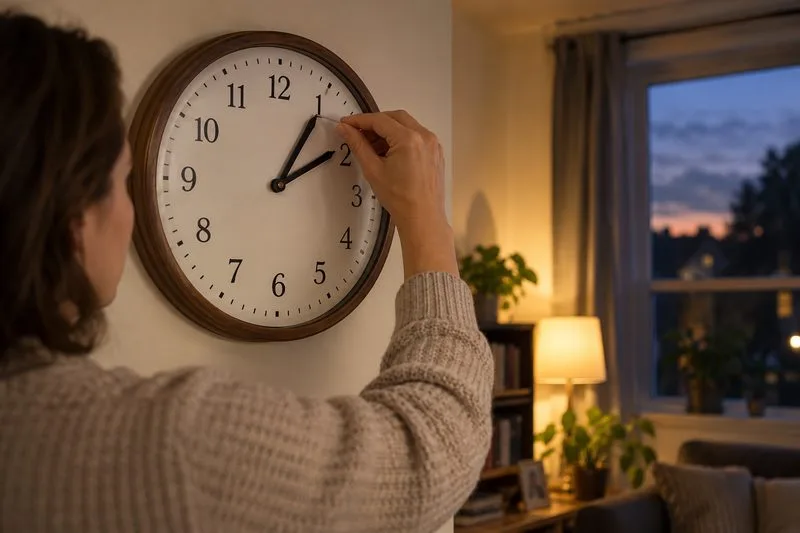
A person manually adjusts an analog wall clock before the UK changes from BST to GMT.
What time do the clocks go back?
The change is at 2:00 a.m. British Summer Time on Sunday, October 25, in London and throughout the UK. BST is UTC+01:00. At that instant, the clock returns to 1:00 a.m. Greenwich Mean Time, which is UTC+00:00. In UTC, the transition is 01:00 on Sunday, October 25.
Before the change, the UK is on BST (UTC+01:00).
At 2:00 a.m. BST, clocks move back to 1:00 a.m. GMT (01:00 UTC).
After the change, UK standard time is GMT (UTC+00:00).
That means the local clock hour from 1:00 to 1:59 occurs twice: first as 1:00 to 1:59 a.m. BST, then again as 1:00 to 1:59 a.m. GMT. The calendar date remains Sunday, October 25. The National Physical Laboratory explains that the UK changes its clocks between BST and standard time while UTC itself stays unchanged. See the official UK clock-change dates and NPL's explanation of BST and UTC.
Why does the UK change its clocks?
BST moves the clock one hour ahead of standard time during the lighter part of the year. The UK uses it from the last Sunday in March until the last Sunday in October, giving more daylight in the evening during summer. When clocks go back, the country returns to GMT for winter. This is a change to the time shown on clocks, not a change to the passage of time itself.
Because the hour repeats, the night is one hour longer by the clock. Some people can use that hour for sleep, but it is not an automatic extra hour of rest: shift workers, caregivers, and anyone awake during the change may experience it differently.
What should you check tonight?
A quick check can prevent confusion on Sunday morning, especially if you have a manual clock, an early alarm, or a commitment during the repeated hour.
Phones, tablets, and computers: Keep automatic date, time, and time-zone settings enabled, then check that the displayed time is correct after the change. Automatic behavior depends on the device and its settings. Follow the official instructions for Apple devices, Android, or Windows if a clock looks wrong.
Manual clocks: Set wall clocks, ovens, car dashboards, and other devices that do not update automatically back by one hour. Radio-controlled clocks that receive the UK MSF time signal may adjust themselves; check the display rather than assuming every model does.
Alarms and appointments: Do not manually move a phone alarm by an hour if the phone already uses the correct UK time zone. If you need an alarm between 1:00 and 2:00 a.m., confirm how that device handles the repeated hour or set a backup outside that window.
Overnight work or travel: A local time such as 1:30 a.m. happens twice on this date. If a shift, pickup, or journey is scheduled in that window, confirm with the employer or transport operator whether the time refers to the first BST hour or the second GMT hour.
Common questions about the UK clock change
Do clocks go back at midnight?
No. In 2026, the UK change occurs at 2:00 a.m. BST on Sunday, October 25, when the time returns to 1:00 a.m. GMT. You do not need to change anything at midnight.
Do clocks go back everywhere in the UK?
Yes. England, Scotland, Wales, and Northern Ireland follow the same clock-change schedule. If you are traveling across the UK, you do not need to account for a regional time-zone difference.
Do I gain an hour of sleep?
The clocks repeat an hour, so you may have an extra hour available for sleep if your schedule allows. An overnight shift or an alarm set during the repeated hour can make the practical result different.
When do the clocks go forward again?
The next UK change is Sunday, March 28, 2027. At 1:00 a.m. GMT, clocks will move forward to 2:00 a.m. BST, according to the GOV.UK schedule.