Home
» How to
»
Google Photos and OneDrive: Which is the best photo backup tool?
Google Photos and OneDrive: Which is the best photo backup tool?
Thanks to the development of photo backup tools today, the fear of losing photos is no longer a concern. Many people (especially on Android) use Google Photos as a photo backup app. But, is it really the best backup tool? Is OneDrive the perfect alternative?
This article will evaluate the advantages and disadvantages of Google Photos and OneDrive so that you can choose the best photo backup tool for yourself.
Some people don't even realize that OneDrive also offers photo backup services because it's not as famous as a Google product. This problem is partly due to Microsoft's way of developing OneDrive. It integrates photo backup right into the OneDrive experience. No separate "OneDrive Photos" brand, no standalone app, and no separate URL for viewing on the web.
In 2018, Microsoft released the Photo Companion application through Microsoft Garage. But this test ended and Photo Companion is no longer supported. Currently, users need to download the main OneDrive app to back up photos to its cloud storage servers. This application is currently available on Android, iOS, Windows and Mac.
Google Photos is available as a standalone app on Android & iOS. It also has a backup tool for Windows, Mac and a URL for users who browse instant photo galleries on the web.
Google Photos and OneDrive prices
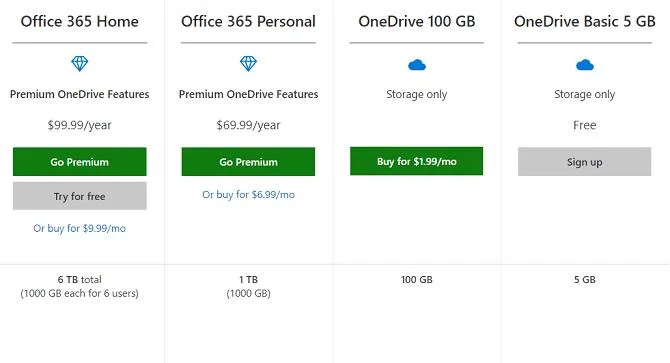
Price list to use the OneDrive service
Google Drive, despite its own name, is actually a part of Google Drive. That means, any photos uploaded to this service will consume space. The free storage limit on Google Drive is 15GB. If you need more, you can spend up to 300TB on additional purchases.
However, there is an interesting thing about this limit. If you're willing to let Google compress images to 16MP (or 1080p with videos), photos won't count toward 15GB for free. Meaning you can back up unlimited photos for free.
Compressing your birthday or personal vacation is probably not a big deal. However, if you like photography or are an experienced photographer, you certainly do not want to do it with hundreds of high quality photos, right?
OneDrive does not offer any free uploads. Photos you back up will count towards your storage. All users get 5GB for free. You can buy 100GB for $ 2.29 / month or Office 365 subscription (starting with $ 69.99 / year) and you get 1TB for free.
Google Photos is more limited, only supports the following image file formats: JPG, PNG, WEBP and some RAW.
Photo management of Google Photos and OneDrive
Both services provide a range of features to help users manage and view the photo library easier.
Album and Tag
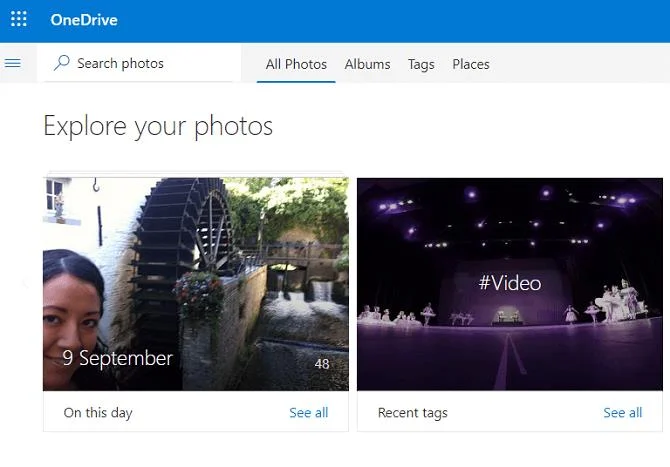
OneDrive supports automatic tagging of photos
OneDrive can use proprietary algorithms to automatically create new albums when you back up photos to the service. They can be classified by date, location or person involved. Of course, you can create your own album. Besides albums, OneDrive also adds tags automatically. The tag is usually a generic noun like #city, #animal, # sunset ... This service allows users to customize the tag as they wish.
Google Photos will categorize content into albums, thanks to smart machine learning algorithms that have helped the service shine. It silently analyzes images, then groups them by faces, landmarks, locations, and more. You just need to tell Google whose face was mentioned when and the application will handle the rest. Thanks to that algorithm, you can search for specific information, for example, my wife in the Colosseum at night or family vacation in Hawaii in 2018 ....
Both services allow you to turn off the automatic feature if you do not want Google or Microsoft to scan images.
Share photo
As expected, both OneDrive and Google Photos allow users to share personal photos as well as entire albums with friends and family.
However, once again, Google Photos has excelled in the field of photo backup thanks to the Live Albums feature . When activated, it automatically adds any new photos that meet certain criteria to an album that you can share right away. Thus, you do not have to manipulate manually, time consuming as before.
For example, if you have a new baby, you can ask Google to automatically add a backed up photo of your child to the Live Album, and then let parents, grandparents and other members freely access it at any time. This feature ensures they never miss the latest pictures.
Free up space
One of the most prominent benefits when moving photo collections to the cloud is freeing up space on mobile devices.
Instead of having to manually delete photos, Google offers a convenient feature called Free Up Space . It will scan the storage drive on the device to identify the images copied to the cloud. You will then see the One-tap button to delete all duplicates from the local drive.
Edit photo
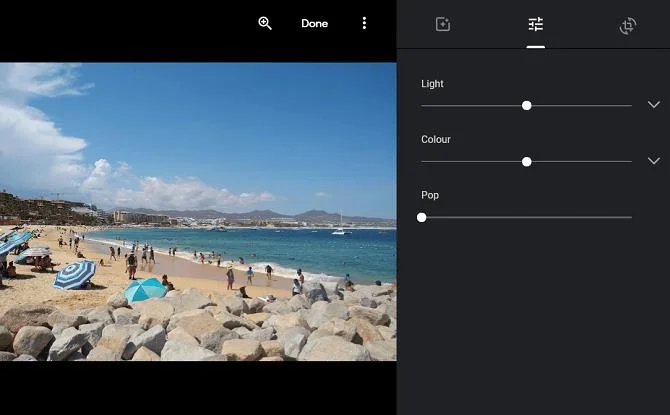
Google Photos supports photo editing
Google Photos offers a number of key features for fixing backed up photos, including changing brightness, color and background color, and a few different filters.
OneDrive does not provide such features.
Google Assistant
Lastly, the Google Photos assistant is worth mentioning. It provides a set of cards to help you manage your photo inventory better. 4 types of cards available include:
Creations : Movies, albums, collages automatically created from your photos.
Rediscover : Choose photos from this day of the past
Rotations : Suggestions to edit photos in landscape mode should turn into portrait mode and vice versa.
Archive : Recommend the work to be archived and Google Assistant will not use those images for movies or animations.
Obviously, in terms of features, Google Photos has beaten OneDrive. It is easy to use and offers more photo management features in the gallery. On the work side, sometimes OneDrive has the upper hand, especially with Windows 10 and Office 365 users .
Hope the article will help you choose the image backup that best suits you.