


Apply the SLES 15 STIG Safely with OpenSCAP

Use SUSE’s supported STIG profile to scan SLES 15, test remediation, review remaining findings, and retain assessment evidence.
It can be said that Zalo chat application is gradually becoming a national application when the Government is aiming for a society 4.0. The journey procedures are strongly shifting from traditional to online, we can be easier, more convenient and more transparent. Especially now a mountainous district of Cu M'gar in Dak Lak province has been able to make an online identity card on the Zalo application with a few convenient and quick steps.
Download Zalo on Android Download Zalo on iOS
The National Public Service Portal, which was launched by the Government not long ago, is also clear evidence in the effort to build State 4.0. Currently all citizens of M'gar district, Dak Lak province can declare the required information to receive an appointment for ID card. Although not all procedures can be completed, people will receive a specific appointment similar to the online passport of the Ministry of Public Security which is being implemented across the country. Below will be specific instructions on how to do online identification on Zalo for everyone.
Conditions: Citizens need to have a Zalo application installed on their phone and can take clear pictures.
Step 1:
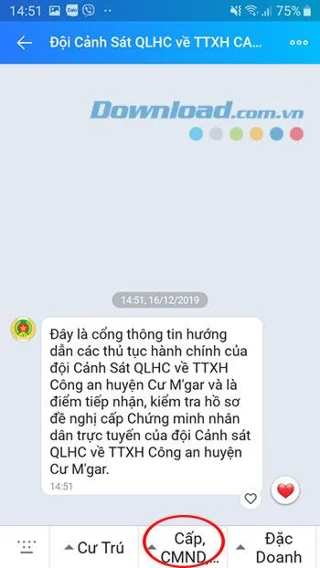
At the main interface of the Zalo application, enter the phrase " Police Administration Team on Cu M'gar Social Security Center " then click on the official page that appears on the top - Electronic portal of Cu M district police gar.
Immediately you will be taken to the home page of the QLHC Police Team about the Cu M'gar Social Security Center, here click Interested for first time access or click Send message if you are interested.

Step 2:
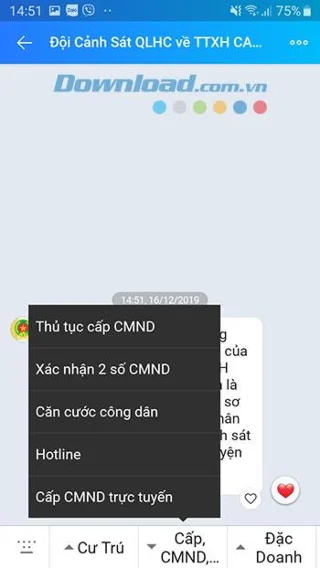
The interface to send a message to the QLHC Police Team about the Cu M'gar CAH appears, you will see here there are the main items: Cu Tru, Level ID - CCCD, Specialties . We can see the details of the basic administrative procedures for temporary registration, identity card, household registration book, etc.
To register as an ID card online, click on the numeric keypad (in the bottom left corner) and enter the message: I want to issue an ID card (full name, address, photograph of the household registration book and application form) request for issuance of ID card certified by police in ward, commune).
Step 3:
Soon you will receive a message instructing the documents to be taken to return in full, including:
Your full name, address, a copy of your household registration booklet and an application for the ID card certified by the Commune Police for the District Police to check and make an appointment for the ID card at the District Police.
Step 4:
We will continue to receive appointments to compare records as well as fingerprints to complete identification.
Note: When a citizen is scheduled to issue ID card, ask the citizen to arrange a time to go on schedule and when to bring all kinds of documents (household registration book and petition). Any case of going to the wrong appointment may not be resolved by the District Police but will be rescheduled at another time.
Use SUSE’s supported STIG profile to scan SLES 15, test remediation, review remaining findings, and retain assessment evidence.
Trace a failed Cockpit connection through DNS, port 9090, the systemd socket, firewalld, TLS, and login settings using current SUSE guidance.
Create a redundant Ethernet connection on SLES 15 with YaST and Wicked, configure active-backup bonding, and verify both ports and failover.
Turn an existing SLES 15 system into a reviewed AutoYaST profile, validate it, and use it to deploy a test server with fewer manual steps.
Install the SLES 15 KVM and libvirt tools, enable the right host service, and configure selected virtual machines to start after a reboot.
Use systemd jobs and the previous boot journal to locate a slow service, mount, or storage dependency, then correct it without masking the cause.
Use firewall-cmd to inspect the active zone, allow HTTP safely, preserve SSH access, and verify that the rule survives a reload on SLES 15.
Trace a PAM failure to its service, account policy, or identity provider, then repair the right SLES configuration while preserving a working admin session.
Trace a failed kernel module at SLES startup, correct an obsolete boot entry or repair the required driver, and verify the next boot.
Prepare SCSI SAN paths, enable multipathd, inspect SUSE’s hardware defaults, and verify stable device maps without guessing array settings.








