Home
» Health
»
Holistic Approaches to Gut Health: A Practical, Evidence-Based Framework
Holistic Approaches to Gut Health: A Practical, Evidence-Based Framework
Gut health is often reduced to a single question—“Which probiotic should I take?”—but the digestive system is influenced by far more than one capsule or one microbe. Food quality, fiber intake, bowel habits, movement, stress, sleep, medications, and existing medical conditions can all shape how the gut functions. The gut microbiome matters, but it is only one part of a larger system that includes digestion, intestinal motility, the immune system, and two-way communication between the gut and the brain.
The National Institutes of Health describes the microbiome as the community of bacteria, viruses, fungi, and other microbes living in and on the body, with gut microbes helping with functions such as digestion and immune regulation. Importantly, healthy people can have very different microbial communities, so there is no single “perfect” microbiome profile to chase. See the NIH overview of what the microbiome is and what it does.
A fictional example: building a better baseline instead of chasing a quick fix
Illustrative example only: Maya is a fictional 34-year-old office worker who notices intermittent bloating, irregular bowel movements, and afternoon fatigue after several busy months. She has no known digestive disease and no alarm symptoms. This example is not a testimonial, diagnosis, or report of a real treatment result; it is simply a way to show how a holistic approach can be applied in everyday life.
Maya’s first instinct is to buy a high-dose probiotic and eliminate several food groups at once. A more evidence-based starting point would be to change fewer variables, observe patterns, and prioritize habits with broader health benefits. That makes it easier to tell what helps, what does not, and when professional evaluation is needed.
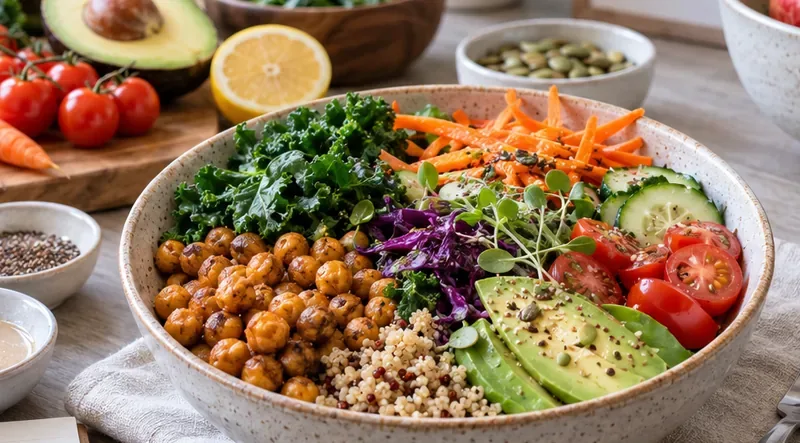
A varied meal built around legumes, greens, whole grains, berries, nuts, seeds, and fermented dairy illustrates the food-first foundation of a holistic gut-health routine.
Start with food variety and fiber, not a microbiome “reset”
For most generally healthy adults, the most practical dietary foundation is a varied pattern built around minimally processed, nutrient-dense foods. As of September 2026, the current Dietary Guidelines for Americans, 2025–2030 emphasize whole, nutrient-dense foods such as vegetables, fruits, whole grains, protein foods, dairy, and healthy fats.
Fiber deserves special attention because many fibers reach the large intestine, where gut bacteria can ferment them. Fiber also supports stool bulk and regularity. The National Institute of Diabetes and Digestive and Kidney Diseases (NIDDK) notes that adults generally need about 22 to 34 grams of fiber per day depending on age and sex, and it recommends increasing fiber gradually so the digestive tract can adjust. Good sources include legumes, whole grains, fruits, vegetables, and nuts. See NIDDK’s guidance on fiber and hydration for bowel regularity.
In Maya’s case, that might mean adding one serving of beans or lentils several times a week, choosing oats or another whole grain at breakfast, and rotating fruits and vegetables instead of trying to hit a trendy “30 plants” target overnight. If she currently eats little fiber, doubling it in a day could increase gas or bloating. Gradual changes are easier to tolerate and easier to evaluate.
Think in food groups, not “superfoods”
Legumes: lentils, chickpeas, black beans, soybeans.
Whole grains: oats, barley, brown rice, quinoa, whole-wheat foods.
Nuts and seeds: walnuts, almonds, chia, flax, pumpkin seeds.
Fermented foods, if tolerated: yogurt with live cultures, kefir, kimchi, sauerkraut, and other traditionally fermented foods.
The goal is not maximum variety at every meal. It is a sustainable pattern that supplies different types of fiber, micronutrients, and food substrates over time.
Fermented foods can be useful, but the evidence is not a license for excess
Fermented foods are frequently promoted as an easy way to “boost” the microbiome. There is some encouraging human evidence, but the effect should not be exaggerated. In a 17-week randomized prospective study of healthy adults, researchers compared a high-fiber diet with a high-fermented-food diet. The fermented-food group showed increased microbiota diversity and reductions in several inflammatory markers. The study was relatively small, however, and it does not prove that every fermented food, dose, or person will have the same response. The original study is available through PubMed.
For Maya, a reasonable experiment might be a serving of plain yogurt or kefir with breakfast, or a small portion of fermented vegetables with a meal, assuming she tolerates those foods. Fermented foods can also be high in sodium, sugar, or saturated fat depending on the product, so the food as a whole still matters.
Hydration and bowel routines are basic, but they matter
Hydration does not “flush toxins” from the gut, and drinking huge amounts of water will not correct every digestive problem. Still, adequate fluid intake helps fiber do its job and can be important for preventing dehydration. NIDDK advises drinking enough liquids when increasing fiber and tailoring fluid intake to body size, activity, health status, and environment.
Maya could pair a higher-fiber breakfast with water, avoid routinely ignoring the urge to have a bowel movement, and notice whether rushed mornings are contributing to irregularity. These steps are simple, but they target normal digestive mechanics rather than an undefined detox process.
Regular movement supports digestive function—and may influence the microbiome
Physical activity is already recommended for cardiovascular, metabolic, musculoskeletal, and mental health. It may also affect gut microbial activity, although microbiome responses differ between people. In a human study of 32 previously sedentary adults, six weeks of endurance exercise altered microbial composition and short-chain-fatty-acid patterns in ways that differed by obesity status; many changes reversed when participants returned to a sedentary period. Read the original exercise study on PubMed.
The useful lesson is not that one workout “repairs” the microbiome. It is that consistent movement may be one part of a healthy digestive environment. For Maya, walking after meals, cycling, strength training, or another activity she enjoys is more realistic than a short, punishing exercise challenge.
Treat stress as part of the gut picture, not as an imaginary cause
Digestive symptoms are not “all in your head.” At the same time, the gut and brain communicate continuously. NIDDK classifies irritable bowel syndrome as a disorder of gut-brain interaction, meaning changes in signaling between the brain and digestive tract can influence sensitivity and bowel contractions. See NIDDK’s explanation of gut-brain interaction in IBS.
Stress-reduction strategies therefore have a legitimate place in a holistic plan, particularly for people whose symptoms flare during stressful periods. A randomized wait-list controlled trial in 90 people with IBS found preliminary evidence that mindfulness-based stress reduction improved symptom severity compared with the control period, although the study had substantial dropout and does not establish mindfulness as a cure. The original trial can be reviewed on PubMed.
For Maya, that might translate into a 10-minute breathing practice, a calmer lunch away from her desk, or therapy if anxiety is persistent. The goal is not to force relaxation; it is to reduce one potential amplifier of symptoms.
Protect sleep, while keeping microbiome claims modest
Sleep belongs in a holistic gut-health discussion because it affects overall metabolic, immune, and psychological health, and because early research suggests sleep loss may also affect gut-related metabolites and microbial patterns. The evidence is still developing. A 2026 randomized crossover study of nine healthy adults found that three nights of restricted sleep altered 24-hour profiles of several circulating metabolites, including some of microbial origin. That is biologically interesting, but the study was far too small to define a specific “gut sleep protocol.” See the study on PubMed.
For general adult sleep health, the CDC notes that most adults should get at least seven hours of sleep per day. Its April 2026 report found that 30.5% of U.S. adults surveyed in 2024 averaged less than seven hours. See the CDC sleep data brief.
Maya does not need a special bedtime supplement marketed for the microbiome. A consistent sleep window and enough time in bed are lower-risk priorities with benefits that extend well beyond digestion.
Be cautious with probiotics, prebiotics, and supplement stacks
Probiotic products are not interchangeable. Different strains can have different effects, and evidence for one strain in one condition cannot automatically be applied to another product. The National Center for Complementary and Integrative Health (NCCIH) states that strong evidence is still lacking for many probiotic uses and that safety data, especially long-term data, are limited. People with serious illnesses or compromised immune systems may face higher risks. Review the official NCCIH probiotic guidance.
The American Gastroenterological Association’s clinical guideline also emphasizes condition- and strain-specific evidence; for symptomatic adults and children with IBS, it recommends probiotics only in the context of a clinical trial. See the AGA probiotic guideline.
That means Maya should not assume that a larger number of strains or colony-forming units is automatically better. If she wants to try a probiotic, it is more rational to choose a product linked to evidence for a specific goal, discuss it with a clinician when appropriate, and track whether symptoms actually change.
A simple way to test changes without confusing yourself
A holistic approach does not mean changing everything at once. In fact, doing too much at the same time makes it harder to identify what is helping. Maya could use a short symptom log that records meals, bowel frequency and stool pattern, bloating or pain, sleep duration, stress level, and exercise. She could then make one or two modest changes for a couple of weeks before adding another.
Area
Low-complexity starting point
What to watch
Fiber
Add one fiber-rich food daily and increase gradually
Stool regularity, gas, bloating
Fermented foods
Try a small serving if tolerated
Comfort, product sugar/sodium, consistency
Movement
Walk or exercise most days in a sustainable way
Energy, bowel regularity, overall symptoms
Stress
Use a repeatable relaxation or therapy strategy
Whether symptoms track stressful periods
Sleep
Protect a consistent schedule with enough sleep opportunity
Fatigue, appetite, stress, symptom patterns
This is not a diagnostic protocol. It is a way to reduce noise. If a food clearly worsens symptoms repeatedly, that pattern is more useful to bring to a dietitian or clinician than a long list of supplements taken simultaneously.
Know when “gut health” needs medical care
Persistent digestive symptoms should not automatically be blamed on the microbiome. Conditions such as celiac disease, inflammatory bowel disease, infections, medication side effects, thyroid disorders, and other problems can overlap with common complaints like bloating, diarrhea, constipation, or abdominal discomfort.
NIDDK advises prompt medical evaluation for symptoms such as severe abdominal or rectal pain, frequent vomiting, dehydration, black or tarry stools, or stools containing red blood or pus; adults with diarrhea lasting more than two days or a high fever should also contact a doctor. See NIDDK’s current guidance on when diarrhea requires medical attention. GI bleeding can be serious and warrants medical care; NIDDK’s GI bleeding guidance explains warning signs in more detail.
If Maya developed blood in her stool, unexplained weight loss, severe or worsening pain, persistent diarrhea, repeated vomiting, or symptoms that interfered substantially with daily life, the next step would not be another wellness product—it would be medical assessment.
The practical takeaway
Holistic gut health is less about finding one magical intervention and more about supporting the whole digestive system with repeatable habits: a varied food pattern, adequate and gradually increased fiber, hydration, regular movement, enough sleep, attention to stress, and cautious use of probiotics or supplements. The microbiome is important, but it should not become a reason to ignore basic nutrition, normal digestive physiology, or signs of disease.
For our fictional Maya, the most useful strategy is not to “fix” her microbiome in a weekend. It is to build a stable baseline, make measured changes, observe what happens, and seek professional help when symptoms are persistent, severe, or concerning. That approach is slower than a reset or cleanse—but it is far more consistent with what current evidence can actually support.