Home
» Technology
»
How Embodied AI Is Transforming Next-Generation Humanoid Robotics
How Embodied AI Is Transforming Next-Generation Humanoid Robotics
Humanoid robots can look remarkably capable in a short demonstration and still struggle when the lighting changes, an object is moved a few inches, a drawer sticks, or a task takes longer than the sequence used during training. That gap between a polished demo and dependable real-world work is the central problem next-generation humanoid robotics is trying to solve.
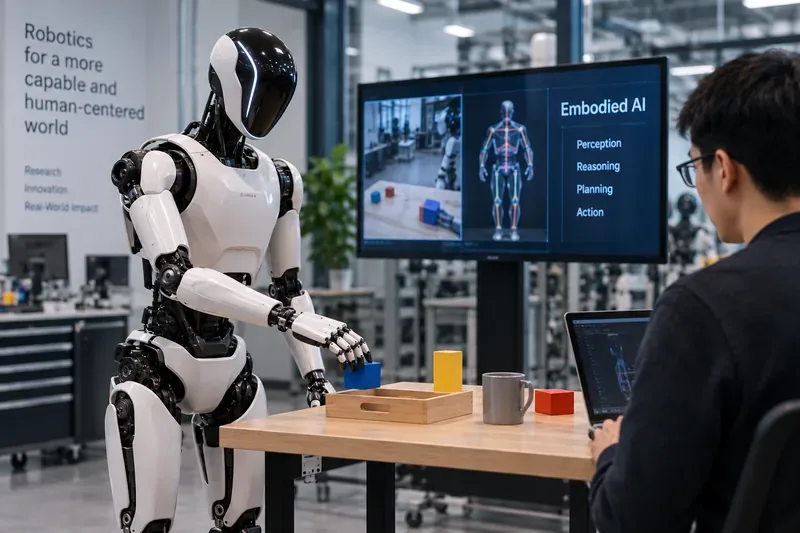
The shift now underway is from robots that mainly replay programmed motions toward robots that can perceive, reason, plan, and act through a physical body. This approach is commonly called embodied AI. In practical terms, the robot is not only running an AI model; its intelligence is tied to cameras, force sensors, joint positions, hands, legs, and the changing environment around it.
As of September 2026, several major robotics programs are pushing this direction. Google DeepMind introduced Gemini Robotics 2 in July 2026 with whole-body control and embodied reasoning; NVIDIA's GR00T 1.7 provides an open vision-language-action foundation model and end-to-end training workflow; Figure says Helix 02 extends its learned control from the upper body to full-body loco-manipulation; and Boston Dynamics is combining learned behaviors, reinforcement learning, and foundation-model research with its production Atlas platform. These developments are important, but they should be read as evidence of rapid progress—not proof that general-purpose humanoids are ready for every workplace or home.
A humanoid robot works at a test table while an engineer monitors the perception-to-action loop that embodied AI systems try to close in real time.
Why Traditional Robot Automation Breaks Down in Human Environments
Conventional industrial robots are extremely effective when the world is controlled. A fixed arm can repeat the same weld, placement, or assembly motion thousands of times because the object location, tooling, safety enclosure, and task sequence have been engineered around the robot.
Humanoid robots target a harder operating environment: spaces built for people. Shelves, doors, bins, tools, stairs, workstations, and parts may vary. The robot may need to walk, reach, balance, manipulate, recover from a bad grasp, and understand a spoken instruction without a technician rewriting a motion program every time something changes.
That creates four connected problems:
Perception uncertainty: the robot must recognize objects, surfaces, people, free space, and task state under changing conditions.
Long-horizon reasoning: a useful task often contains many dependent steps, and failure at one step can invalidate the rest of the plan.
Whole-body coordination: walking and manipulation are coupled. Reaching farther changes balance; lifting a load changes joint forces and stability.
Data scarcity: collecting high-quality robot demonstrations in the physical world is expensive and slow compared with collecting text or images for internet-scale AI.
Embodied AI is changing humanoid development because it attacks these problems as a connected learning system rather than treating perception, planning, and motion as isolated scripts.
1. Start With a Better Perception-to-Action Loop
The easiest conceptual improvement is also the most fundamental: the robot must continuously observe what happened after it acted. A scripted machine can execute “move hand to coordinates X, Y, Z.” An embodied system instead tries to answer a richer loop: “Where is the object now? Did I grasp it? Did it move? What should I do next?”
Modern vision-language-action models, usually shortened to VLAs, connect visual input and natural-language instructions to robot actions. Google DeepMind describes Gemini Robotics 2 as a VLA that converts vision and language into motor control. NVIDIA describes GR00T 1.7 as a cross-embodiment VLA that accepts multimodal inputs such as language, images, and robot state and produces actions.
This matters because the same model can potentially reuse broad concepts across many tasks. “Pick up the blue box and place it in the tray” no longer has to mean a hard-coded trajectory tied to one exact table layout.
2. Replace Single-Task Policies With Reusable Foundation Models
The next step is reducing how much behavior must be learned from scratch. A robot foundation model aims to encode reusable priors about objects, language, motion, and manipulation before a developer specializes it for a particular humanoid or workflow.
NVIDIA says GR00T 1.7 was pretrained on roughly 32,000 hours of real demonstration and egocentric human data plus about 8,000 hours of simulated rollouts and demonstrations. Developers can then post-train the base model for a specific embodiment and task rather than beginning with an empty policy.
The expected quality gain is not simply “the robot knows more.” The more useful outcome is generalization: a policy should continue working when object position, viewpoint, background, or task phrasing changes within reasonable bounds.
A good sign that this approach is helping is when a team can add a new object, scene layout, or instruction with less task-specific retraining than before. A warning sign is when every new variation still requires a separate policy, carefully staged environment, or manual recovery routine.
3. Use Simulation to Scale Experience Without Breaking Hardware
Physical robots are costly training devices. Motors heat up, hands wear, batteries run down, objects break, and a fall can stop development for hours or days. Simulation addresses this by letting policies practice many variations in parallel before testing on hardware.
Boston Dynamics describes training Atlas behaviors with reinforcement learning in simulation, then moving to real hardware and iterating from real-world results. NVIDIA's GR00T workflow similarly includes simulation setup, teleoperation data collection, policy training, evaluation, and deployment.
The critical phrase is sim-to-real: transferring what a model learned in simulation to a physical robot. Simulation is valuable, but it is not reality. Friction, contact, sensor noise, cable behavior, material compliance, and human unpredictability are difficult to model perfectly.
Teams should therefore treat simulation as a force multiplier, not a replacement for hardware validation. A policy that looks perfect in simulation but collapses under small real-world variations has not solved the deployment problem.
4. Move From Arm Skills to Whole-Body Intelligence
Humanoids become truly different from stationary robot arms when locomotion and manipulation are solved together. A person opening a heavy door naturally shifts weight, changes stance, rotates the torso, and adjusts grip. Humanoid robots must coordinate similar dependencies across many joints while remaining stable.
Figure announced Helix 02 in January 2026, saying its system links vision, touch, and proprioception to full-body actuation in a unified visuomotor network. The company demonstrated an autonomous dishwasher task that combined walking, balance, and manipulation over several minutes. This is a company-reported demonstration rather than an independent benchmark, but it illustrates the direction clearly: full-body autonomy is replacing the older split between “navigation first” and “arm task second.”
Google DeepMind's Gemini Robotics 2 release similarly emphasizes whole-body humanoid control, including coordinated movement from feet to fingertips. The broader engineering goal is not to make every humanoid move like a person. It is to let the robot choose stable, efficient body motions that achieve the task safely.
5. Add a Reasoning Layer for Long, Multi-Step Tasks
A VLA can handle local sensor-to-action behavior, but long tasks need higher-level reasoning. Consider “clear this workbench, put tools in their labeled drawers, throw away packaging, and report anything damaged.” The robot must identify subtasks, track which ones are complete, recognize failure, and change the plan when the environment does not match expectations.
Google DeepMind separates this role in Gemini Robotics ER 2, an embodied reasoning model intended for spatial understanding, task planning, tool orchestration, and success detection. The company describes a hierarchy in which a high-level reasoning model can hand motor execution to a lower-level VLA.
This layered design is important because high-frequency motor control and slow, deliberate task planning have different requirements. A humanoid hand may need rapid control updates, while a planner may only need to reconsider the next subtask after a meaningful event.
For production teams, the quality test is whether the system can recover from common mistakes. A robot that can perform eight steps only when every earlier step succeeds is still brittle. A stronger system can notice “the part slipped,” reacquire it, and continue without resetting the full task.
6. Push More Intelligence On-Device
Cloud reasoning can provide large models and heavy compute, but a physical robot cannot always wait for a network round trip before reacting. Balance, collision avoidance, grasp correction, and many control loops require low and predictable latency.
That is why on-device robotics models and edge accelerators matter. Google DeepMind's Gemini Robotics On-Device work focuses on running general-purpose manipulation intelligence locally, while NVIDIA's humanoid stack supports deployment through edge computing such as Jetson Thor.
The likely architecture for capable humanoids is hybrid rather than purely local or purely cloud-based: fast perception and control near the robot, with heavier planning, fleet analytics, or model updates running on more powerful infrastructure when latency and connectivity allow.
7. Turn One Robot's Experience Into Fleet Learning
The commercial advantage of embodied AI becomes larger when skills can be reused across many robots. Traditional automation often scales by copying the same program to identical cells. Learned humanoid behavior can potentially scale by distributing an improved policy, then using fleet data to discover new failure cases.
Boston Dynamics says learned Atlas behaviors can be redeployed across fleets and is developing Atlas for industrial tasks such as part sequencing and material handling. Its 2026 product program also includes collaboration with Google DeepMind on Gemini Robotics foundation models. See Boston Dynamics' Atlas evolution overview and its Google DeepMind partnership announcement.
Fleet learning raises a new requirement: evaluation discipline. A policy update that improves one task but creates failures elsewhere should not be deployed broadly without regression testing.
What Embodied AI Changes for Humanoid Robotics
Older approach
Embodied AI direction
Outcome to look for
Fixed scripts and coordinates
Closed-loop visual and proprioceptive control
Recovery when objects move or grasps fail
One policy per task
Foundation models and post-training
Faster adaptation to related tasks
Separate walking and manipulation
Whole-body learned control
Stable loco-manipulation across longer tasks
Small physical datasets
Real data plus simulation and teleoperation
Broader coverage of edge cases
Local task scripts
Hierarchical reasoning plus VLA execution
Longer sequences with self-correction
Single-robot tuning
Cross-embodiment and fleet learning
Reusable skills across platforms and deployments
Where the Revolution Still Has Limits
The progress is real, but several limits remain easy to underestimate.
Safety is harder than benchmark success
A model can score well on robotics evaluations and still be inappropriate for safety-critical deployment. Google DeepMind's Gemini Robotics ER 2 model card explicitly tells users to use discretion in production, commercial, or public environments and says the robotics models should not be used for safety-critical applications where malfunction could foreseeably cause injury, death, or property damage.
Dexterity remains uneven
Picking boxes is much easier than manipulating flexible cables, wet objects, deformable packaging, tight fasteners, or cluttered tool assemblies. Impressive demonstrations should therefore be judged by the diversity and repeatability of tasks, not just their visual complexity.
Long-horizon reliability compounds errors
If each individual action is highly reliable but not near-perfect, a task containing dozens or hundreds of dependent actions can still fail frequently. This is why success detection, recovery, and exception handling are as important as raw action accuracy.
Hardware remains part of the intelligence problem
Better models cannot compensate indefinitely for weak hands, poor sensing, overheating actuators, limited battery life, mechanical backlash, or difficult maintenance. Humanoid usefulness depends on software and hardware improving together.
How to Judge Whether a Humanoid System Is Actually Improving
The best way to evaluate embodied AI is to move beyond demo quality and ask whether the robot becomes more useful under variation. A practical self-check can include the following questions:
Task success: Does the robot complete the full task, not just the easiest substep?
Repeatability: Does it succeed over many trials rather than in a selected video?
Generalization: Can it handle new object positions, lighting, viewpoints, and similar unseen objects?
Recovery: Can it detect and repair common failures without human reset?
Time to teach: How much demonstration, labeling, programming, or fine-tuning is required for a new task?
Whole-body stability: Can it manipulate while walking, turning, bending, or carrying loads without fragile transitions?
Latency: Does the control loop remain responsive under realistic network and compute conditions?
Safety: Are human proximity, collision, force, workspace, and emergency-stop behaviors tested independently of task success?
Fleet transfer: Can a learned skill be deployed to multiple robots with predictable performance?
Operational value: Does the system reduce intervention, downtime, ergonomic burden, or process complexity enough to justify its cost?
If progress shows up only in carefully staged demonstrations but not in these measures, the team should change approach—often by narrowing the task, collecting better failure data, improving simulation coverage, strengthening low-level control, or adding explicit safety and recovery layers.
The Most Important Change Is Not the Humanoid Shape
Embodied AI is revolutionizing humanoid robotics because it changes how robots acquire and reuse skills. The key shift is from programming every motion to training systems that can connect perception, language, physical state, reasoning, and action in a continuous loop.
The strongest evidence in 2026 is not that humanoids have become universally general-purpose. It is that several previously separate technologies—multimodal foundation models, VLA policies, reinforcement learning, simulation, dexterous hardware, on-device inference, and fleet deployment—are converging into coherent robotics stacks.
That convergence makes humanoid robots more adaptable and easier to teach, but dependable autonomy still requires careful evaluation in the exact environment where the robot will work. The next generation will be judged less by whether a robot can perform a surprising demo and more by whether it can repeat useful work safely, recover from ordinary mistakes, and improve without constant manual reprogramming.