Leftover Halloween Candy and Pumpkins: What to Do Next

Sort leftover Halloween candy safely, share or repurpose sealed treats, and choose food use or compost for pumpkins based on their condition.
Windows provides a Run as Administrator option that allows users to run applications and programs with administrative privileges. You can also use it to troubleshoot your computer. But what if this feature malfunctions and strips you of your admin rights?
That’s where this guide comes in. So let’s see what you can do to fix Run as Administrator not working on Windows.
1. Restart your computer
If you are having trouble running applications with admin privileges, restarting your computer may resolve the issue. This simple solution will resolve any temporary issues and return your system to its default state.
2. Check your account type
Not all user accounts are created equal. To run programs with admin privileges, you need an admin account. So go to Control Panel and check your account type. If it's not labeled as an admin account, switch to a different account or create a new one.
3. Check User Account Control settings
Windows User Account Control (UAC) prevents malicious programs from installing on your computer. This security feature can prevent you from using elevated privileges.
To make sure the problem isn't related to UAC, go to Control Panel and check User Account Settings. If it's set to the highest level, bring it down to the default. Here's how:
1. Press Win + S at the same time to open the search box.
2. Type Control Panel in the search box and press Enter. This will open the Control Panel window.
3. View items under Large icons in Control Panel and click User Accounts.
4. On the right, click Change User Account Control settings . Doing this will open the User Account Control Settings window.
5. Here you will see a slider with four options: Always notify , Default , Notify me only when applications try to make changes to my computer and Never notify .
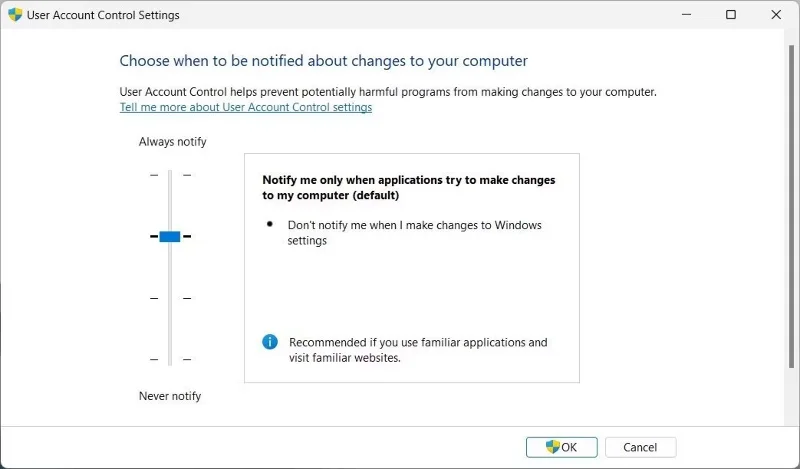
6. Drag the slider to Default , then click OK. This will set your UAC to the default level and allow you to run applications with admin rights .
Now, close the window and restart your PC. Then, try running the application with Run as Administrator and see if it works.
4. Change Group Policy settings
Is the Run as Administrator feature not working even though you've tried the suggestions above? It's possible that a group policy setting is blocking this feature. To fix this, go to the Local Group Policy Editor and check the settings.
Here's what you need to do:
1. Press Win + R at the same time to open the Run dialog box .
2. Type gpedit.msc into the text field and press Enter. This will open the Local Group Policy Editor window on your computer screen.
3. From the left navigation panel, go to the following path:
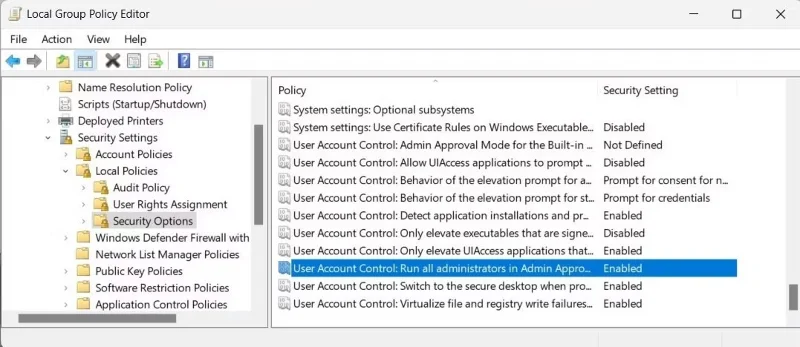
Computer Configuration > Windows Settings > Security Settings > Local Policies > Security Options4. On the right side, you will see a list of different security options. Scroll down and double-click the policy User Account Control: Run all administrators in Admin Approval Mode .
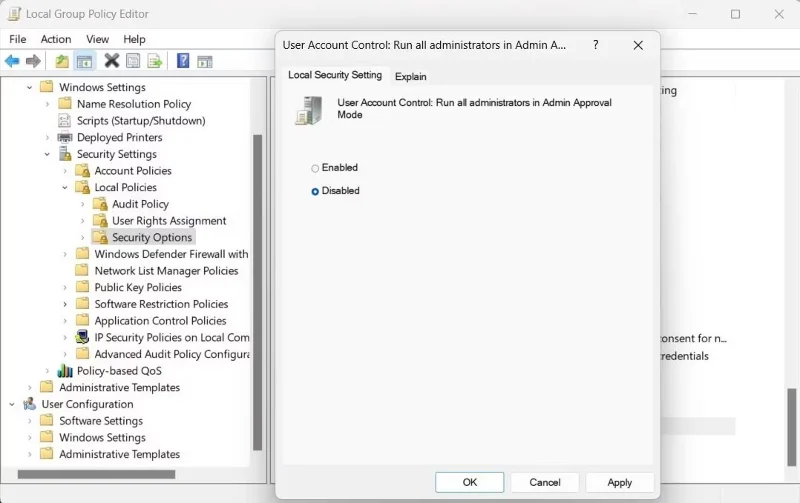
5. Doing this will open another window. Here, select the Disabled option and click Apply > OK .
6. Close Local Group Policy Editor and restart your computer.
After rebooting, try running a program with admin rights. It should work immediately. Don't forget to turn the Admin Approval Mode setting back on after you're done troubleshooting.
5. Clean up the context menu
When you right-click on a program or file, you should usually see the Run as Administrator option in the context menu. If it's missing, you should check your context menu items to see if they're cluttered.
Warning : This solution involves editing the Windows Registry. A mistake can cause serious problems. So be careful and create a registry backup before applying any changes.
Follow these steps to clean up the context menu:
1. Press Win + R on your keyboard to open Run.
2. Type regedit into the text field and press Enter. This will open Windows Reged Editor.
3. If the UAC window appears, click Yes to grant admin rights.
4. In the Registry Editor window, navigate to the following path:
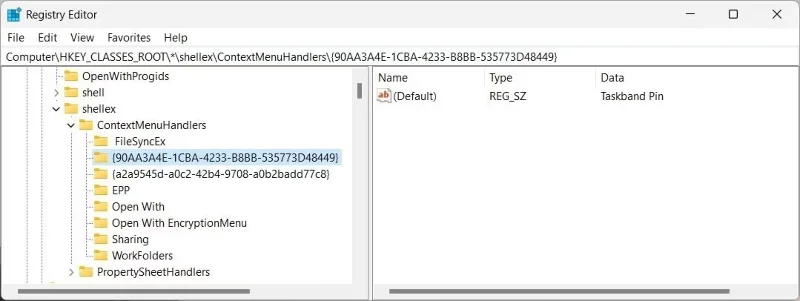
Computer\HKEY_CLASSES_ROOT\*\shellex\ContextMenuHandlers5. Next, expand the ContextMenuHandlers folder and look for any suspicious entries. If you find any, delete them.
6. Now, exit Registry Editor and restart your computer.
When your computer restarts, you should see the Run as Administrator option in the context menu. Try running a program with admin rights and see if it works.
6. Try some common fixes
In addition to the fixes mentioned above, there are some general solutions that should work in all situations. Try these if you are still having trouble running the application with admin rights:
Sort leftover Halloween candy safely, share or repurpose sealed treats, and choose food use or compost for pumpkins based on their condition.
Compare workplace Halloween costume choices by respect, dress code, mobility, and safety—and learn when a subtle accessory or a policy check is the better option.
Find a couples costume that fits your style, budget, and comfort level, from Addams Family classics to original inside-joke duos.
Need a last-minute high school Halloween costume? Compare 10 easy closet-based ideas by prep time, comfort, school-day practicality, and simple safety checks.
Use a simple 2026 Halloween decorating timeline for indoor décor, outdoor displays, and fresh pumpkins, with practical adjustments for weather and events.
Mix five vivid, approachable Halloween cocktails with measured recipes, simple prep tips, and an alcohol-free option for your party guests.
Find 15 office-friendly Halloween costume ideas for 2026, with practical checks for dress codes, respectful themes, comfort, and workplace safety.
Plan a fun elementary school Halloween party with easy crafts, games, inclusive treats, costume tips, and a sample 75-minute classroom schedule.
Compare realistic side hustles for 2026 by startup cost, fees, flexibility, and income control, with current tax and scam guidance from official sources.
Upgrade your home office ergonomics with current OSHA and NIOSH guidance on chair fit, monitor height, laptop setup, lighting, and movement.








