Imagine powering on your Windows 11 PC, only to be greeted by the dreaded "No Bootable Device Found" error. It's frustrating, right? 😩 This issue can halt your day, but don't worry—it's often fixable with a few targeted steps. In this guide, we'll walk you through the most effective ways to resolve the Windows 11 "No Bootable Device Found" error, using the latest troubleshooting methods. By the end, your system should be back up and running smoothly. Let's dive in and reclaim your productivity!
What Causes the "No Bootable Device Found" Error in Windows 11?
Before we jump into fixes, understanding the root cause helps you tackle it confidently. The "No Bootable Device Found" message typically appears when your PC can't locate a valid operating system to load. Common culprits include:
- BIOS/UEFI Settings Issues: Incorrect boot order or Secure Boot misconfigurations.
- Hardware Problems: Faulty hard drives, loose cables, or failing SSDs.
- Corrupted Boot Files: Damaged Windows boot sector from updates, power failures, or malware.
- Drive Partition Errors: Missing or inactive partitions where Windows resides.
Recent Windows 11 updates have refined boot processes, but they can sometimes exacerbate these issues if hardware isn't fully compatible. The good news? Most cases are software-related and reversible without advanced tools. Ready to fix it? Let's start with the basics.
Step 1: Basic Hardware Checks – Rule Out the Obvious First
Sometimes, the simplest solution is the most effective. 👆 Begin by ensuring your hardware is connected properly. Power off your PC completely, unplug it, and open the case (for desktops) or check connections (for laptops).
- Verify that your storage drive (HDD/SSD) is securely connected to the motherboard and power supply.
- Reseat RAM sticks—loose memory can mimic boot failures.
- If using an external drive, disconnect it and try booting internally.
Pro Tip: If you're on a laptop, remove the battery (if possible) and hold the power button for 30 seconds to discharge residual power. Reassemble and boot up. This resolves transient hardware glitches in many cases.

If hardware looks good but the error persists, move to BIOS adjustments—our next step.
Step 2: Adjust BIOS/UEFI Settings for Proper Boot Order
The heart of boot issues often lies in your system's firmware settings. Accessing BIOS/UEFI is straightforward and can instantly fix Windows 11 "No Bootable Device Found" by prioritizing the correct device.
- Restart your PC and enter BIOS by pressing the key during startup (common keys: Del, F2, F10, or Esc—check your motherboard manual).
- Navigate to the Boot tab.
- Set your Windows drive (usually labeled as "Windows Boot Manager" or your SSD/HDD) as the first boot device.
- Disable Secure Boot temporarily if enabled (under Boot or Security tab)—reenable later if needed.
- Ensure CSM (Compatibility Support Module) is disabled for UEFI mode, as Windows 11 prefers this for optimal performance.
- Save changes (F10) and exit.
Why does this work? Modern Windows 11 uses UEFI for faster, more secure booting. Misaligned settings can make your drive "invisible" to the system. After this, test booting—many users report success here! If not, we're escalating to recovery tools.
Step 3: Use Windows Recovery Environment to Repair Boot Files
If BIOS tweaks don't cut it, your boot files might be corrupted. Enter the Windows Recovery Environment (WinRE) to run repairs. This is a built-in lifesaver for no bootable device error fix.
To access WinRE:
- Create a Windows 11 bootable USB using Microsoft's Media Creation Tool on another PC (download from Microsoft's official site).
- Boot from the USB: Enter BIOS again, set the USB as the first boot device, and restart.
- Select Repair your computer > Troubleshoot > Command Prompt.
Now, in Command Prompt, run these commands one by one (press Enter after each):
| Command |
Purpose |
| bootrec /fixmbr |
Repairs the Master Boot Record. |
| bootrec /fixboot |
Fixes the boot sector. |
| bootrec /scanos |
Scans for Windows installations. |
| bootrec /rebuildbcd |
Rebuilds the Boot Configuration Data. |
| sfc /scannow |
Scans and repairs system files (run from X:\Windows\System32 if needed). |
Restart after these commands. This sequence addresses corrupted boot elements, a frequent issue post-Windows updates. Feeling optimistic? You're halfway there—keep going!
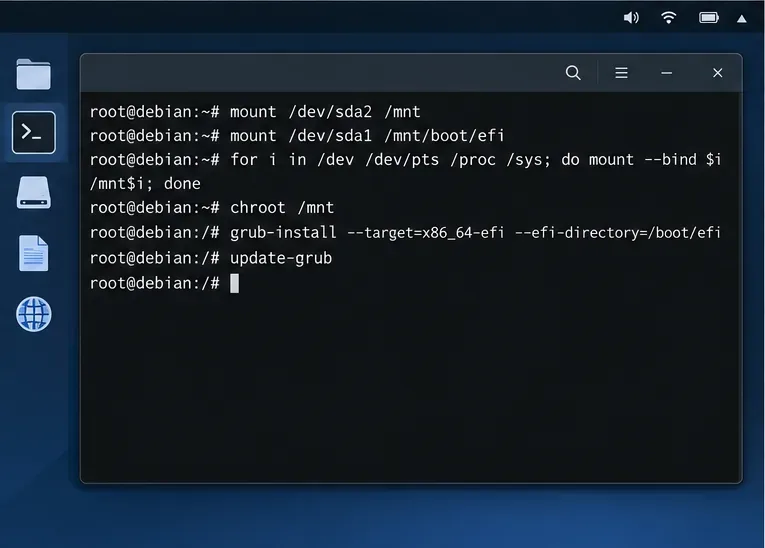
![Running boot repair commands in Windows Recovery for no bootable device fix]()
Step 4: Check and Repair Drive Partitions with Disk Management
Partitions can go awry, making your drive non-bootable. From WinRE's Command Prompt, use diskpart to inspect and fix.
- Type
diskpart and press Enter.
list disk – Identify your main disk (usually Disk 0).select disk 0 (replace 0 with your disk number).list partition – Look for the System or EFI partition (100-500MB, FAT32).- If inactive, select it:
select partition 1 (adjust number), then active.
- Exit with
exit and reboot.
For deeper issues, boot into Windows (if possible) or use WinRE's Startup Repair under Troubleshoot. This ensures your EFI partition is active, crucial for Windows 11's UEFI boot.
Step 5: Advanced Fixes – When Standard Methods Fall Short
If the error lingers, consider these next-level solutions:
- CHKDSK Scan: In Command Prompt, run
chkdsk C: /f /r to fix drive errors. Replace C: with your system drive.
- Reinstall Windows 11: As a last resort, use the bootable USB to reinstall while keeping files (select "Keep my files" during setup). Back up data first via another PC if needed.
- Hardware Diagnostics: Run built-in tools like Dell/HP diagnostics or MemTest86 for RAM issues. For SSDs, use manufacturer tools like Samsung Magician.
- Update Firmware/BIOS: Visit your motherboard maker's site for the latest BIOS version compatible with Windows 11.
Remember, if your drive is failing (e.g., unusual noises or SMART errors), replace it. Tools like CrystalDiskInfo can check drive health for free.
Preventing Future "No Bootable Device Found" Errors
Once fixed, protect your setup: Enable automatic Windows updates, use reliable power sources to avoid interruptions, and regularly back up with tools like OneDrive or external drives. Regular CHKDSK scans (monthly) keep partitions healthy. 🎉 You've conquered this—your PC is more resilient now!
Final Thoughts: Boot Up with Confidence
Fixing the Windows 11 "No Bootable Device Found" error doesn't have to be a nightmare. By methodically checking hardware, tweaking BIOS, and repairing files, most users restore access quickly. If these steps don't resolve it, professional help or Microsoft Support might be next. Share your success in the comments—what fixed it for you? Stay tuned for more Windows tips to keep your system running flawlessly. You've got this! 👍