Home
» Health
»
Mindfulness Practices to Reduce Year-End Stress Without Adding Another Task to Your List
Mindfulness Practices to Reduce Year-End Stress Without Adding Another Task to Your List
Year-end stress has a particular way of making even simple days feel crowded. Deadlines stack up, social plans multiply, budgets tighten, travel can disrupt routines, and many people start mentally reviewing everything they did or did not accomplish during the year. The result is often a mind that keeps jumping ahead while the body is still trying to finish the present task.
One useful current update comes from the U.S. Centers for Disease Control and Prevention. Its Managing Stress guidance, updated May 12, 2026, continues to emphasize daily stress management rather than waiting until stress becomes overwhelming. Among its practical recommendations are taking breaks, deep breathing or meditation, journaling, spending time outdoors, practicing gratitude, connecting with others, sleeping consistently, and moving regularly. That does not mean mindfulness is a cure-all. It means small, repeatable practices can be one useful part of a broader stress-management plan.
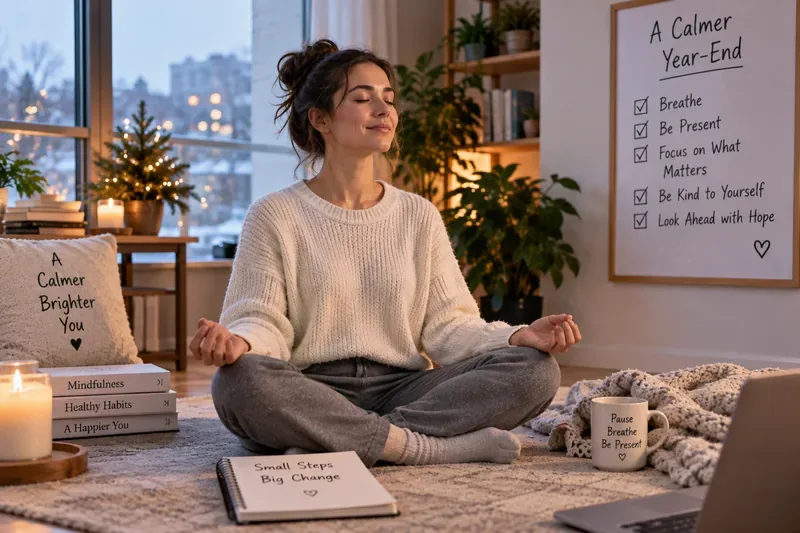
A quiet mindfulness pause at home can create a clear transition between a busy day and the next obligation.
What Mindfulness Actually Means
Mindfulness is the practice of paying attention to what is happening in the present moment without immediately judging, fixing, or reacting to it. The National Center for Complementary and Integrative Health, part of the National Institutes of Health, describes mindfulness as maintaining attention or awareness on the present moment without judgment. You can read its current overview of the evidence and safety considerations on the NCCIH meditation and mindfulness page.
That definition matters during the year-end rush. Mindfulness is not the same as emptying your mind, forcing yourself to feel calm, or pretending that an overloaded schedule is fine. The practice is closer to noticing, “My shoulders are tense, I am thinking about three unfinished tasks, and I am rushing this conversation,” then choosing what to do next with a little more awareness.
Research summarized by NCCIH suggests that mindfulness-based practices may help with stress, anxiety, depression, and sleep for some people, but the evidence varies by population and study quality. Some findings are encouraging, while others are mixed. Mindfulness should not be presented as a guaranteed treatment or as a replacement for professional care.
Why Year-End Stress Can Feel Hard to Switch Off
Many end-of-year pressures are not dramatic on their own. The difficulty comes from accumulation. A work deadline, a family gathering, an expense, a delayed flight, a performance review, a gift list, and a late night can all compete for attention within the same week. The brain keeps rehearsing future demands, which can make it harder to stay with the task in front of you.
Mindfulness is useful here because it gives you a way to interrupt automatic momentum. The goal is not to eliminate every stressful thought. The goal is to notice when your attention has been captured and deliberately bring it back to something concrete: your breathing, your body, the sound in the room, the person speaking to you, or the single task you chose to finish next.
Seven Mindfulness Practices That Fit Real Year-End Days
1. Use a 60-second arrival pause before starting the next thing
Before opening your inbox, entering a meeting, walking into a gathering, or starting a shopping trip, stop for roughly one minute. Feel both feet on the floor. Notice where your body is supported. Let your breathing happen naturally and observe a few breaths without trying to make them perfect.
Then ask one practical question: “What am I doing right now?” This question is intentionally small. It redirects attention from the entire December workload to the next useful action.
2. Anchor attention in breath, body, and sound
When your mind is racing, choose three neutral anchors. Notice one or two breaths. Notice a physical sensation, such as your hands resting on a desk or your feet inside your shoes. Then notice a sound in the environment.
You do not need to block thoughts. If a thought about tomorrow appears, note that it is there and return to one of the anchors. This is a simple way to practice present-moment attention without turning the exercise into another performance goal.
3. Put a mindful transition between work and home
Remote and hybrid work can blur the end of the workday, while office commutes can extend a stressful day into the evening. Create a transition that marks a boundary. Close the laptop, stand up, stretch gently, take several ordinary breaths, and notice the room before moving into your next role.
If you commute, try spending the first few minutes walking or riding without immediately checking messages. Notice the pace of your steps, the temperature, sounds, and physical sensations. The purpose is not to avoid responsibilities; it is to prevent one activity from spilling automatically into the next.
4. Practice single-tasking for one important block
Mindfulness can be applied to work, not only meditation. Choose one task that deserves uninterrupted attention. Silence nonessential notifications, keep only the materials you need visible, and work on that one task for a defined period.
When the urge to check email or switch tabs appears, notice the urge before acting on it. Sometimes you will still need to switch. The mindful part is recognizing the choice instead of moving automatically.
5. Turn one meal or drink into a reset
You do not need a silent retreat to practice mindful awareness. Pick one ordinary daily activity, such as morning coffee, lunch, or an afternoon snack, and do the first few minutes without a screen.
Notice temperature, taste, smell, texture, and the physical act of eating or drinking. If you catch yourself mentally drafting emails or replaying a difficult conversation, acknowledge it and return to the sensory experience. This practice is less about eating slowly than about reclaiming a few minutes from constant cognitive switching.
6. Use a brief gratitude check without forcing positivity
The CDC includes daily gratitude among healthy stress-management strategies. A practical version is to name one specific thing you appreciated today and why it mattered. “I am grateful for my team” is broad; “I appreciated that a coworker clarified the deadline before I spent an hour on the wrong task” is concrete.
Gratitude does not require you to deny frustration or grief. Two things can be true at once: the season can be difficult, and one part of the day can still be worth noticing.
7. End the day with a body scan and a short shutdown note
Before bed, move your attention slowly through the body, noticing the jaw, shoulders, hands, abdomen, legs, and feet. You are not trying to diagnose or repair every sensation. Simply notice tension and allow comfortable areas to soften if they can.
Then write down the unfinished tasks that are most likely to keep circulating in your head. Give each one a next action or a time to revisit it. Journaling is another strategy included in the CDC's stress guidance, and the combination of a body scan with a written shutdown can help separate “I need to remember this” from “I need to solve this right now.”
A Low-Friction Mindfulness Routine for Busy Weeks
The easiest plan is often one tied to moments that already happen. Instead of scheduling a long practice you may skip, attach short mindfulness cues to regular transitions.
Moment
Mindfulness practice
What to notice
Before opening email
60-second arrival pause
Feet, posture, breathing, next priority
Between meetings
Breath-body-sound anchor
One breath, one sensation, one sound
Lunch
Screen-free first few minutes
Taste, temperature, pace, fullness cues
End of work
Transition ritual
Close tasks, stand, stretch, shift attention
Evening
Specific gratitude note
One concrete event and why it mattered
Before sleep
Body scan plus shutdown note
Tension, unfinished tasks, next actions
Start with one or two of these anchors rather than adopting everything at once. A mindfulness routine should reduce friction, not become a new source of guilt.
Common Mistakes That Make Mindfulness Less Helpful
Trying to force yourself to relax
Mindfulness is not a demand to feel peaceful. You may notice irritation, fatigue, sadness, or restlessness. The practice is to observe what is present and respond wisely. If trying to focus on breathing makes you more uncomfortable, shift attention to external sensations such as sounds, contact with the floor, or the objects around you.
Using mindfulness to tolerate an unsustainable workload
A breathing practice cannot create missing staffing, fix financial pressure, or replace a needed boundary. If the real problem is too many commitments, mindfulness can help you notice that reality more clearly, but the next step may be declining an invitation, renegotiating a deadline, delegating a task, or asking for support.
Treating a streak as more important than the practice
Apps, timers, and streaks can be useful reminders, but missing a day is not failure. If your meditation tracker becomes another year-end metric, simplify. One intentional minute can still be a valid practice.
Assuming mindfulness is risk-free for everyone
NCCIH notes that meditation and mindfulness are generally considered to have few risks, but negative experiences have been reported and the safety research is still limited. People can sometimes experience increased anxiety, distress, or difficult emotions. If a practice consistently makes you feel worse, stop and discuss it with a qualified health professional rather than pushing through because you think meditation is supposed to help.
Mindfulness Works Better When the Basics Are Protected
Mindfulness is easier to use when it is part of a wider stress plan. The CDC's 2026 stress guidance also emphasizes sleep, movement, time outdoors, healthy eating, social connection, and breaks from constant negative information. These basics matter because year-end routines often become irregular precisely when stress increases.
Rather than aiming for a perfect wellness schedule, protect a few foundations. Keep a reasonably consistent sleep and wake time when possible. Move your body in ways that fit your health and schedule. Eat regular meals instead of relying on caffeine to compensate for exhaustion. Take brief breaks from news and social media when constant input is raising your stress level.
When Mindfulness Is Not Enough
Occasional stress is part of life, but persistent or overwhelming symptoms deserve attention. The National Institute of Mental Health advises seeking help when stress or anxiety interferes with everyday life, causes you to avoid things, or seems to be present all the time. Its stress and anxiety fact sheet also recommends learning your triggers, maintaining healthy routines, and using coping strategies that work for you.
Mindfulness should not delay treatment for a mental health condition or another medical problem. NCCIH specifically advises against using meditation or mindfulness as a replacement for conventional care or as a reason to postpone seeing a health care provider.
If you are in the United States and you or someone you know is in emotional distress or crisis, you can call or text 988 or use the chat options through the 988 Suicide & Crisis Lifeline. The service is available 24/7. If there is immediate danger, contact emergency services.
A Year-End Self-Check That Takes Less Than Five Minutes
At the end of a stressful week, ask yourself a few questions. The answers are more useful than trying to judge whether you were “mindful enough.”
Am I noticing stress earlier, before it becomes overwhelming?
Can I return my attention to the present task more easily after distraction?
Have I created at least one real boundary around work, messages, or social obligations?
Am I sleeping, eating, and moving regularly enough to support basic functioning?
Are mindfulness practices helping me feel more grounded, or are they making me more distressed?
Is stress interfering with my ability to work, sleep, connect with people, or manage everyday responsibilities?
If your answers suggest that stress is becoming more persistent or disruptive, the most mindful next step may be asking for help rather than adding another technique.
The Goal Is Not a Perfectly Calm December
Year-end stress often comes from real demands, so success does not mean reaching January without feeling tense, tired, disappointed, or busy. A more realistic goal is to notice your internal state sooner, interrupt automatic reactions when you can, and make deliberate choices about what deserves your attention.
Mindfulness is most useful when it is modest and practical: one breath before replying, one screen-free meal, one walk where you actually notice the walk, one honest boundary, one moment of gratitude, and one decision to seek support when coping alone is no longer working. Those small acts will not erase every year-end pressure, but they can help you move through the season with more awareness and less autopilot.