Home
» Technology
»
Smart Home Gadgets Worth Upgrading Before Winter: What Actually Makes a Difference
Smart Home Gadgets Worth Upgrading Before Winter: What Actually Makes a Difference
The best smart-home upgrades before winter are not the ones with the most app features. They are the devices that produce a measurable result: steadier indoor temperatures, earlier warning of water or carbon-monoxide hazards, better humidity control, and fewer automation failures when the weather is at its worst.
If your budget is limited, start with heating control, water-leak protection, and smoke/carbon-monoxide coverage. Add air-quality and energy-monitoring devices after those basics are working well. Decorative lighting, voice features, and whole-home platform changes can wait unless they solve a specific reliability problem.
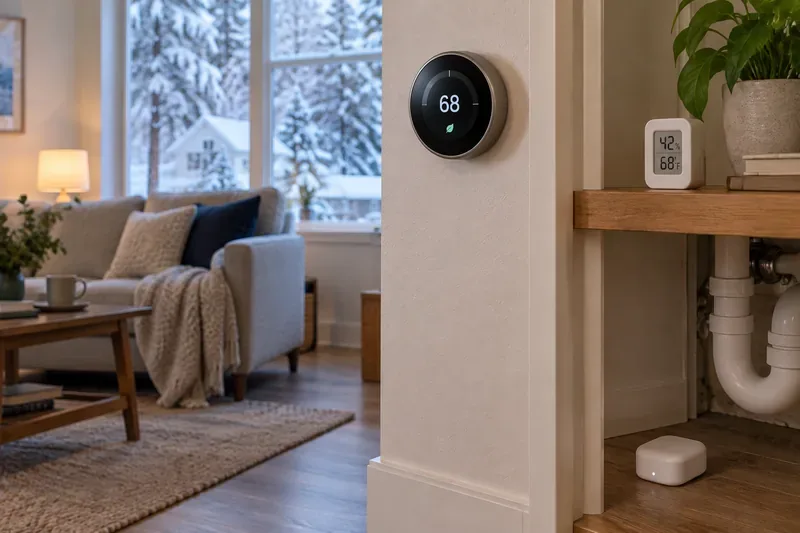
A useful winter smart-home setup focuses on outcomes: stable heat, monitored humidity, and early detection around vulnerable plumbing.
Which upgrades are most worth doing before winter?
Upgrade
Result to look for
Change course if...
Smart thermostat with compatible room sensors
Fewer manual adjustments, steadier occupied-room temperatures, useful HVAC runtime data
Rooms remain cold because of drafts, poor insulation, blocked airflow, or an HVAC problem
Leak and freeze sensors, ideally with automatic shutoff
Fast alerts from vulnerable plumbing areas and a tested way to stop water flow
Sensors cannot reach Wi-Fi/Thread/Zigbee reliably, or shutoff hardware cannot close the main valve
You are relying mainly on phone notifications or an internet connection
Temperature and humidity monitors
Indoor humidity stays in a reasonable range without persistent window or wall condensation
Condensation continues despite lower humidity; the building envelope or ventilation may need attention
Smart radiator or zone controls
Less overheating in individual rooms and more consistent zone comfort
Your heating system is not designed for independent zone control
Energy-monitoring plugs or outlets
Clear visibility into suitable plug-in loads and useful schedules
You plan to run portable electric heaters through them
1. Upgrade the thermostat first when heating control is the real problem
A smart thermostat is usually the highest-value winter upgrade when your current thermostat is difficult to schedule, the house is empty for predictable periods, or you frequently change the temperature by hand. The goal is not simply remote control. The goal is a heating schedule that matches how the home is actually used, with data that shows whether the system is running more or less than expected.
For U.S. households, an ENERGY STAR certified smart thermostat is a useful screening criterion because certification is based on real-world field data rather than a feature checklist alone. ENERGY STAR also requires certified models to provide scheduling, HVAC-use information, feedback about energy consequences, and basic thermostat operation even when service-provider connectivity is unavailable.
What success looks like: you make fewer overrides, occupied rooms are comfortable at the times that matter, and the thermostat's runtime history becomes understandable rather than erratic. If a model supports remote room sensors, they can be particularly useful when the thermostat is in a hallway that does not represent the bedroom, nursery, home office, or living area.
Change course if one room is still much colder than the rest after reasonable scheduling changes. A thermostat cannot repair missing insulation, leaky windows, closed dampers, undersized ducts, a weak circulator, or a furnace or heat pump that needs service. Compatibility also matters. Heat pumps, dual-fuel systems, multi-stage equipment, line-voltage heating, humidifiers, and zone-control panels can require specific thermostat support or professional installation.
2. Put leak and freeze sensors where winter failures are most expensive
Water protection is easy to overlook because it does nothing visible on a normal day. That is precisely why it is valuable. A small sensor under a sink, near a water heater, beside a washing machine, or in a basement can provide early warning before a slow leak becomes a large cleanup. In cold climates, temperature sensing near vulnerable pipes adds another layer of warning.
FEMA's winterization guidance notes that water-leak sensors and automatic water shutoffs can help reduce damage from burst pipes. The American Red Cross also identifies pipes in unheated basements, crawl spaces, attics, garages, cabinets, and exterior walls as common freeze risks and recommends conventional measures such as insulation, draining outdoor lines, and keeping adequate heat in the home.
The best result is not “I received an alert once.” It is a tested chain: the sensor detects water or low temperature, the alert reaches you away from home, and you know how to shut off the water. If you install an automatic valve, test that it can fully close the correct supply line before the first hard freeze.
Know the limit: sensors do not prevent freezing. If pipes are exposed to severe cold, address insulation, air leaks, heating, and plumbing protection directly. Smart detection is a backup layer, not a substitute for winterization.
3. Treat smart smoke and carbon-monoxide alarms as safety devices first
Winter increases the use of furnaces, fireplaces, boilers, portable generators, and other fuel-burning equipment. That makes smoke and carbon-monoxide coverage a higher priority than adding another convenience gadget.
In a January 2026 winter-safety notice, the U.S. Consumer Product Safety Commission recommended smoke alarms on every level and inside each bedroom, CO alarms on every level and outside sleeping areas, battery backup, and monthly testing. It also noted that interconnected alarms are preferable because one alarm can cause the others to sound. See the CPSC winter heating safety guidance.
A “smart” model is worth upgrading to when it preserves those fundamentals and adds genuinely useful status information, remote alerts, self-check reporting, or interconnection. The phone notification should be supplementary. A safety alarm still needs to warn people inside the home if the internet, router, cloud service, or phone is unavailable.
Replace or service an alarm when it reaches the manufacturer's end-of-life date, fails a test, shows a fault, or cannot provide the coverage required by your local code. In the U.S., CPSC recommends CO alarms that meet the current UL 2034 requirements. Outside the U.S., follow the applicable national or local alarm standard.
4. Add humidity monitoring when winter air feels dry or windows stay wet
Indoor humidity is one of the easiest winter conditions to measure and one of the easiest to mismanage. Very dry air can feel uncomfortable, while excess moisture can condense on cold windows, walls, or other surfaces.
The U.S. Environmental Protection Agency recommends keeping indoor relative humidity generally between 30% and 50% and acting quickly when condensation appears. Its indoor air quality guidance also emphasizes moisture control as part of maintaining a healthy indoor environment.
A temperature-and-humidity sensor is useful when it helps you make a better decision: reduce humidifier output when windows are wet, increase ventilation when moisture is building, or confirm that one room is much drier than another. A smart humidifier or whole-home humidifier control can then automate part of that response.
Do not chase a number blindly. In very cold weather, a home with cold window surfaces may need a lower indoor humidity level to avoid condensation. If moisture keeps collecting even after you reduce humidity, the next step may be ventilation, air sealing, insulation, or window improvements rather than another sensor.
5. Use smart radiator valves or zone controls only when the heating system supports them
Room-by-room control can be worthwhile in homes with compatible hydronic radiators, certain electric heating systems, or properly designed multi-zone HVAC. The desired outcome is simple: rooms that previously overheated can back off while occupied rooms stay comfortable.
This is not a universal retrofit. Closing too many radiator valves, adding unsupported controls, or trying to create software “zones” in a system that was designed as a single zone can cause comfort or equipment problems. Check the boiler, circulator, valve, thermostat, and control-panel requirements before buying. If the system has minimum-flow requirements or complex zoning, an HVAC professional is the safer route.
6. Use smart plugs for monitoring and scheduling, not as a shortcut for space heaters
Energy-monitoring plugs can be useful for lamps, holiday lighting, entertainment gear, and other compatible loads. Before winter, they can help you identify devices that stay on unnecessarily or verify that a schedule is working.
Portable electric heaters are different. CPSC's 2026 guidance says to plug electric space heaters directly into a wall outlet and never into an extension cord or power strip. Because of the sustained high current involved, do not insert a generic smart plug or smart power strip between a portable heater and the wall unless the heater manufacturer explicitly approves that exact use. See the same CPSC guidance on portable heaters.
7. Upgrade the smart-home network only if reliability is already a problem
A winter automation is only useful if the sensor can reach the controller and the controller can still behave sensibly when cloud connectivity is interrupted. Before replacing every device, look for concrete symptoms: frequent offline alerts, delayed automations, battery sensors that disappear from the network, or a hub that regularly needs rebooting.
As of September 2026, Matter 1.6 is the current major Matter release from the Connectivity Standards Alliance. Released June 17, 2026, it adds improvements including thermostat suggestions, better multi-ecosystem coordination, and a standardized unmounted state for smoke and CO alarms. The Alliance also makes clear that product and platform adoption will happen on different timelines. Read the Matter 1.6 announcement.
That means you should buy for features that work today, not for a promised future update. Matter can improve interoperability, and Thread can be useful for low-power sensors, but neither label guarantees perfect coverage in a difficult house. Device placement, border-router availability, Wi-Fi congestion, mesh design, firmware quality, and platform support still matter.
How to judge whether your winter upgrades are actually working
Give each upgrade a concrete success test before severe weather arrives. A thermostat should produce understandable schedules and runtime trends. A leak sensor should send a test alert from its final location. An automatic shutoff should physically close the intended valve. Smoke and CO alarms should pass their manufacturer-recommended test and be within service life. Humidity sensors should show stable readings that agree reasonably with another trusted gauge. Critical automations should still behave acceptably during a brief internet outage if local operation is important to you.
Review device batteries and end-of-life dates before the heating season.
Test alerts while your phone is on cellular data, not just home Wi-Fi.
Check vulnerable plumbing areas after the first major cold snap.
Watch for persistent condensation, cold rooms, unusually long heating cycles, or frequent auxiliary heat use.
Keep manual controls available; a smart-home feature should not make basic heating or safety harder to operate.
A practical upgrade order for most homes
If you want a simple priority list, start with safety and damage prevention: working smoke/CO alarms, leak/freeze sensing, and reliable heating control. Next, add humidity monitoring and room-level temperature sensing. Consider zoning, energy monitoring, or platform upgrades only after you can name the problem they are meant to solve.
The useful question is not “Is this gadget smart enough?” It is “What should be better after I install it, and how will I know?” If you cannot answer that, keep the device you already have. Winter preparation benefits more from dependable basics than from a larger collection of connected hardware.