Home
» Technology
»
The Future of Search in the Generative AI Era: What Changes and How to Navigate It
The Future of Search in the Generative AI Era: What Changes and How to Navigate It
The most important change is this: search is becoming a hybrid system that does more than return links. Generative AI increasingly sits on top of retrieval, summarizes what it finds, lets you ask follow-up questions, and sometimes helps you complete a task. Traditional search results still matter, but the path from question to answer is getting shorter and more conversational.
That does not mean the open web is disappearing. The leading search products still depend on web pages, indexes, structured data, and sources. The practical shift is that users may encounter a synthesized answer before they decide whether to open a page. For people searching, that makes verification skills more important. For publishers and brands, it raises the value of being both discoverable and citable.
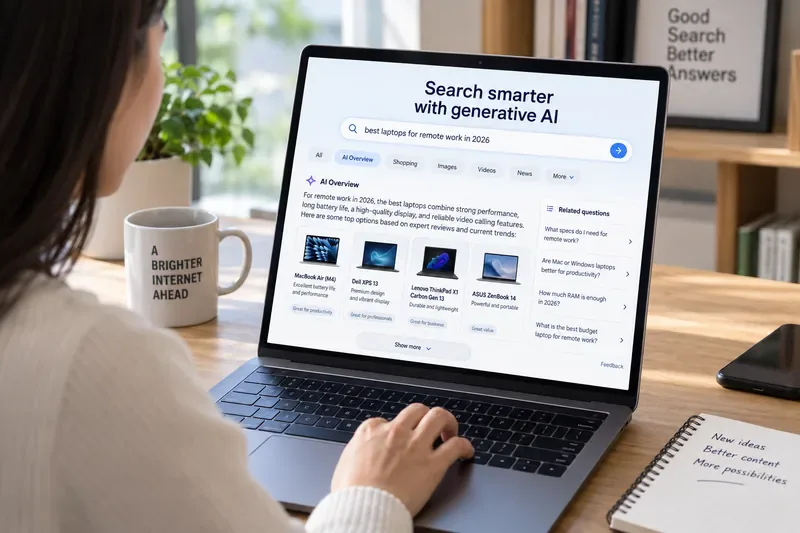
A generative-search interface on a laptop combines a synthesized response with follow-up questions and links to supporting information.
What has already changed by 2026?
Several features that once looked experimental are now part of mainstream search experiences. Google describes AI Mode as an AI-powered search experience that can break a question into subtopics, run multiple searches, combine the results, and support follow-up questions. Google calls this approach “query fan-out.” Its documentation also states that AI Mode can accept text, voice, images, and files. See Google Search Help for AI Mode.
OpenAI’s current search documentation similarly describes a model that can search the web, rewrite a request into one or more targeted queries, return timely answers, and attach inline citations or a Sources panel. See OpenAI’s ChatGPT Search documentation.
Microsoft is moving in the same broad direction. Bing has long mixed direct answers with ordinary search results, and Microsoft now exposes AI citation data to site owners through Bing Webmaster Tools. In February 2026, Microsoft introduced an AI Performance report in public preview that shows when publisher URLs are cited across Microsoft Copilot, AI-generated summaries in Bing, and selected partner experiences. See Microsoft’s Bing Webmaster announcement.
Why generative search feels different from classic search
1. One request can replace several separate searches
Classic search encourages users to break a problem into keywords. Generative search can accept the whole problem at once. Instead of searching “laptop battery life,” then “lightweight laptop,” then “video call webcam,” a user can ask for a lightweight laptop for frequent travel, long battery life, and daily video meetings under a specific budget.
This works because modern systems often use retrieval-augmented generation (RAG). RAG is a method in which a language model generates an answer using information retrieved from external sources at query time. Google explicitly describes generative Search features as relying on retrieval and grounding from its core Search index. See Google’s guide to optimizing for generative AI features.
2. Search is becoming conversational
A search session no longer has to restart with every query. Users can ask a broad question, narrow the answer, change constraints, and request comparisons without repeating all the context. This is especially useful for planning, learning, product research, and troubleshooting.
For example, someone planning a trip might begin with “Which neighborhoods in Kyoto are quiet but still convenient?” and then ask, “Which of those is best if I want to reach Kyoto Station before 7 a.m.?” The second question depends on the first. Conversational search preserves that thread in a way that a list of disconnected keyword searches does not.
3. Search is becoming multimodal
Text is no longer the only useful input. Search products increasingly accept images, voice, documents, and other files. A user can photograph an object, attach a PDF, or speak a question instead of describing everything in keywords. That matters when the information need is difficult to express, such as identifying a device, comparing a chart, or asking questions about a long document.
4. The result can include an action, not just information
The direction of travel is from “find a page” toward “understand, compare, and sometimes act.” Search experiences can already surface local availability, maps, product choices, reservations, shopping information, and other structured actions in selected contexts. The exact capabilities depend on product, region, account, and supported partners, so users should not assume every query can be completed inside the search interface.
When should you trust an AI answer, and when should you open the sources?
Generative search is useful for synthesis, but it is not a replacement for source checking. Google’s own AI Mode help page warns that AI responses can make mistakes and recommends checking important information in more than one place. OpenAI likewise advises users to review cited sources because search results and citations can be incomplete, outdated, or incorrect.
Task
Best starting point
Why
Quick explanation of a familiar topic
Generative search
A synthesized answer can save time and provide useful follow-up paths.
Current prices, schedules, local availability, or breaking events
Generative search plus source verification
Freshness matters, and the underlying source should be checked before acting.
Medical, legal, financial, or safety-critical decisions
Authoritative primary sources and qualified professionals
The cost of a wrong or incomplete answer is high.
Research that depends on exact wording, methods, or evidence
Original papers, official documents, and cited sources
A summary can omit limitations or important context.
Exploratory comparison with many constraints
Generative search first
Conversation and query expansion can help organize the decision space.
A good rule is simple: use the synthesized answer to orient yourself, then open the source when the claim is important enough to influence money, health, safety, compliance, or a major decision.
What does this mean for websites, publishers, and SEO?
The biggest mistake is assuming that generative search makes conventional SEO irrelevant. Google’s current guidance says the opposite: the same technical and content foundations still apply. Pages generally need to be crawlable, indexed, and eligible to appear with a snippet before they can serve as supporting links in Google’s generative Search features. Google also says there are no special technical requirements just for AI Overviews or AI Mode. See Google Search Central’s AI features documentation.
The emphasis, however, is shifting. Content that merely rewrites common information is easier for an answer engine to compress. Content with original reporting, first-party data, expert analysis, clear product details, current documentation, unique images, or direct experience gives the system—and the reader—something that cannot be reproduced as easily from generic summaries.
Google’s 2026 guidance explicitly recommends unique, valuable, non-commodity content and cautions site owners against chasing superficial “AEO” or “GEO” tricks. It also says that foundational SEO remains relevant to visibility in generative AI experiences. In practice, that means publishers should still prioritize crawlability, canonical URLs, accurate titles, useful page structure, internal linking, fast pages, and people-first content rather than inventing a separate technical stack for AI search.
Visibility is becoming measurable in new ways
One of the most important 2026 developments is that site owners are getting direct reporting for generative search exposure. Google announced dedicated Search Generative AI performance reporting in Search Console, including visibility in features such as AI Overviews and AI Mode. Google’s update states that these insights were rolled out to all websites worldwide by August 31, 2026. The reports include impressions, pages, countries, devices, and dates. See Google’s Search Console announcement.
Bing’s AI Performance report takes a citation-focused approach, showing total citations and the URLs that appear as sources in supported AI experiences. That changes the measurement question from only “What rank was my blue link?” to also “Was my page used or cited in an AI answer?”
For publishers, the useful metrics will therefore broaden. Organic sessions still matter, but so do AI citations, impressions in generative features, branded searches, assisted conversions, returning visitors, subscriptions, leads, and the quality of traffic that arrives after an AI summary.
What is likely to come next?
Search will become more task-oriented
This is a strong direction, not a guarantee that every task will move inside a search engine. AI systems are increasingly able to compare options, reason over multiple sources, and connect users to actions. Over time, the distinction between searching, researching, planning, and executing is likely to blur for supported tasks.
Personalization will become more useful—and more sensitive
A search system can provide better answers if it knows your location, preferences, previous questions, calendar, or purchase constraints. That same context creates privacy and control questions. Users should pay attention to what history, location, connected apps, and memory settings are enabled rather than assuming every personalized result is based only on the words typed into the current query.
Citations and provenance will become part of the product
In classic search, the source is the result. In generative search, the answer may come first, which makes provenance—the ability to see where information came from—more important. Current products already emphasize citations, source panels, and publisher links. The quality of those mechanisms will be central to trust because a fluent answer is not the same thing as a verified answer.
The web will have to serve both people and agents
Search is beginning to overlap with AI agents: systems that can interpret pages and perform steps for users. Google’s 2026 guidance now discusses preparing sites for browser agents and emerging agentic experiences. For website owners, this adds a new reason to keep pages technically clear, accessible, and structured around real user tasks rather than only around keyword targeting.
How to navigate the generative AI search era
For users, the best approach is neither blind trust nor blanket rejection. Use AI search when it saves time, but inspect primary sources when accuracy matters. Ask for dates, constraints, disagreements, and source links. If an answer feels too neat for a complicated topic, verify it.
For publishers, build for durable value. Make pages easy to crawl and understand, publish information that adds something original, keep important facts current, and give readers a reason to visit the source after seeing a summary. Then measure both traditional search performance and emerging AI visibility instead of treating them as separate worlds.
The future of search is not simply “AI instead of links.” It is a layered system: retrieval finds relevant material, generative models organize it, citations provide a path back to evidence, and actions increasingly sit beside the answer. The organizations and users that adapt best will be the ones that preserve the most important habit from the old search era: knowing when an answer is enough, and when it is time to inspect the source.