Home
» PC Tips
»
Turn off these visual effects to make Windows run smoother!
Turn off these visual effects to make Windows run smoother!
Windows 11 and 10 have a lot of effects and animations to make them look better. However, if you find the effects jerky and not perfect, you can turn them off to make Windows run smoother.
Turn off animation effects
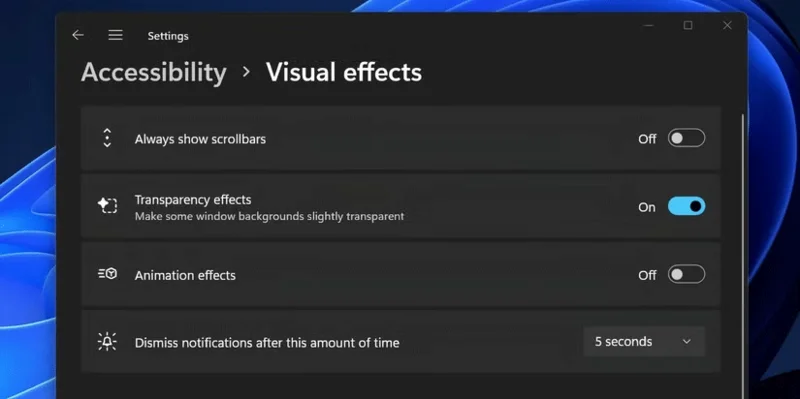
The Settings app is the easiest way to manage animations on your Windows 11 PC. Turning it off removes all icon, element, action center, and window-related animations. This eliminates delays when launching and opening windows, making your PC feel faster.
To turn off animation effects, open the Settings app and navigate to Accessibility settings . Open the Visual Effects section and toggle Animation effects to off.
Another way to disable it is to use Control Panel. Navigate to Control Panel > Ease of Access > Ease of Access Center > Make the computer easier to see .
Uncheck the Turn off all unnecessary animations (when possible) checkbox and click Apply .
Turn off visual effects using Advanced System Properties
Animation effects are just one aspect of visual effects settings in Windows 11 and 10. Turning off animation effects gives you a faster experience but doesn't address other elements like thumbnails, Peeks, slide effects, etc.
You must use the Advanced System Settings utility to control all visual effects. Here's how:
Switch to the Advanced tab and click the Settings button under the Performance section.
Select the Adjust for best performance option .
Click Apply > OK .
Visual Effect utility page in Windows 11 with Adjust for best performance option
You will notice that all animation effects are gone, there is no sliding effect, and even the fonts look thin and unclear. Since this is a performance-focused setting, you will lose all visual effects.
Fine-tune visual effects
While you should be willing to sacrifice everything for better performance, the “Adjust for best performance” setting is a bit too harsh. You may not need the animations and other stuff, but making Windows fonts blurry and pixelated makes the OS difficult to use.
You can also choose to stop a certain type of animation or visual effect instead of turning them all off.
So use a custom plan and only turn off visual effects that don't make much sense or get in the way. Here's how to do it:
Press Win + R to open the Run dialog box. Type sysdm.cpl and press Enter.
Switch to the Advanced tab and click the Settings button under the Performance section .
Select the Custom option .
Now you can experiment with all the visual effects settings. Here are some of the settings that reduce performance the most:
Animate controls and elements inside windows : This setting controls the animation effects of buttons, dialog boxes, etc.
Animate Windows when Minimizing and Maximizing in Windows : The operating system displays a sliding and fading effect for each open application during the maximize and minimize action. Turning this off will cause the application to minimize or maximize immediately.
Animations in the taskbar : Jumplist on the Taskbar and icon movement action effects can be controlled through this option.
Enable Peek : This feature creates a live preview of open applications on the Taskbar and is responsible for the desktop preview. Windows 11 removed this feature from the Show desktop button, but the Win + shortcut still works.
Fade or slide menus into view : A slow fade and slide effect appears for windows and other elements such as menus and jump lists.
Show thumbnails instead of icons : Loading thumbnails of each folder and file inside File Explorer is a pain. Turning this feature off will prevent Windows from creating and storing thumbnails for each file and will speed up the File Explorer folder viewing experience.
There are a few other settings, but they have little impact on improving the visual experience on Windows. Many people often turn off animation effects that make any application window launch or minimize faster.
However, you'll be disappointed if you expect a significant performance improvement after turning off visual effects in Windows 11. Modern Windows 11 and 10 PCs can handle animations without any trouble. You should only turn off visual effects if you find them slow and annoying.
If you want to boost performance, there are a number of ways to improve Windows PC performance instead of living without visual effects.