Couples Costume Ideas for 2026: Iconic Pairs and Clever Tropes

Find a couples costume that fits your style, budget, and comfort level, from Addams Family classics to original inside-joke duos.
Data can be overwhelming, but Excel's CORREL function helps you cut through the noise. Calculating the correlation coefficient is the secret weapon for uncovering hidden trends and making smarter decisions.
What is the CORREL function in Excel?
CORREL is a statistical function in Excel that measures the relationship between two data sets. It calculates the correlation coefficient - a value between -1 and 1 that indicates the degree of linear relationship between two variables. Here is the syntax for the CORREL function in Excel:
=CORREL(array1, array2)Array1 and array2 are the two data ranges you want to analyze.
A correlation coefficient of 1 means a perfect positive correlation, while -1 means a perfect negative correlation. A value of 0 indicates no linear relationship. In this way, CORREL helps you quantify the strength and direction of these relationships in your data.
How to use the CORREL function in Excel
Now that you understand what the CORREL function does and how to prepare your data, let's go through an example to see how the CORREL function works.
Let's say you're a sales manager analyzing data from the previous year. You have three data sets: Monthly sales, TV ad spend, and radio ad spend, each with 200 data points.
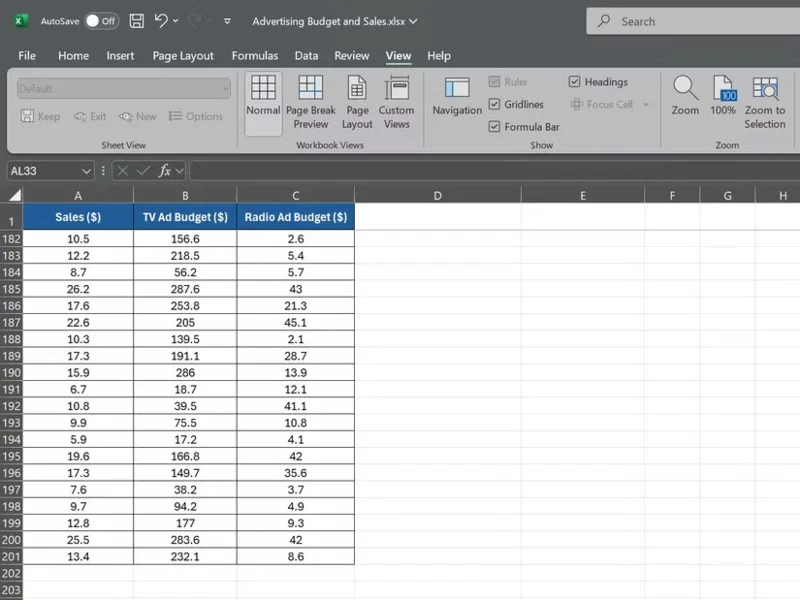
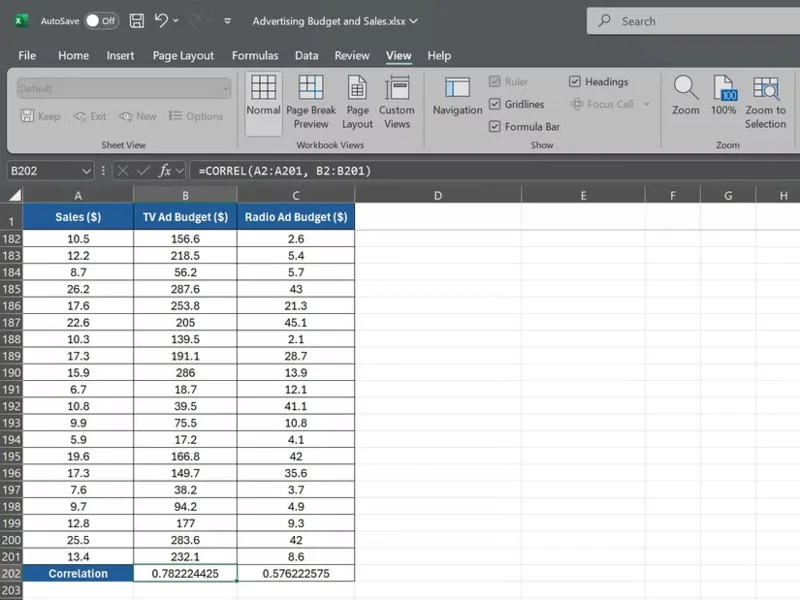
To calculate the correlation between sales revenue and TV ad spend, select an empty cell and enter:
=CORREL(A2:A201, B2:B201)This formula tells Excel to calculate the correlation between the sales revenue data in A2:A201 and the TV ad spending data in B2:B201 . Next, to calculate the correlation between sales revenue and radio ad spending, use the following formula:
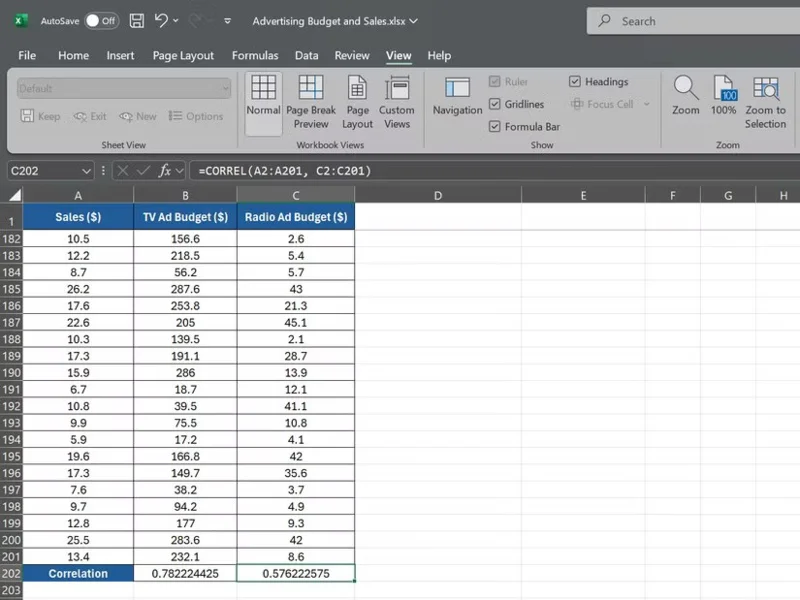
=CORREL(A2:A201, C2:C201)This formula will give you the correlation coefficient between the sales revenue data in A2:A201 and the radio ad spend in C2:C201.
Suppose the first formula returns a correlation coefficient of 0.78, indicating a strong positive correlation between TV ad spending and sales. The second formula returns a correlation coefficient of 0.576, indicating a weaker positive correlation between radio ad spending and sales.
Visualize correlation with scatter plots
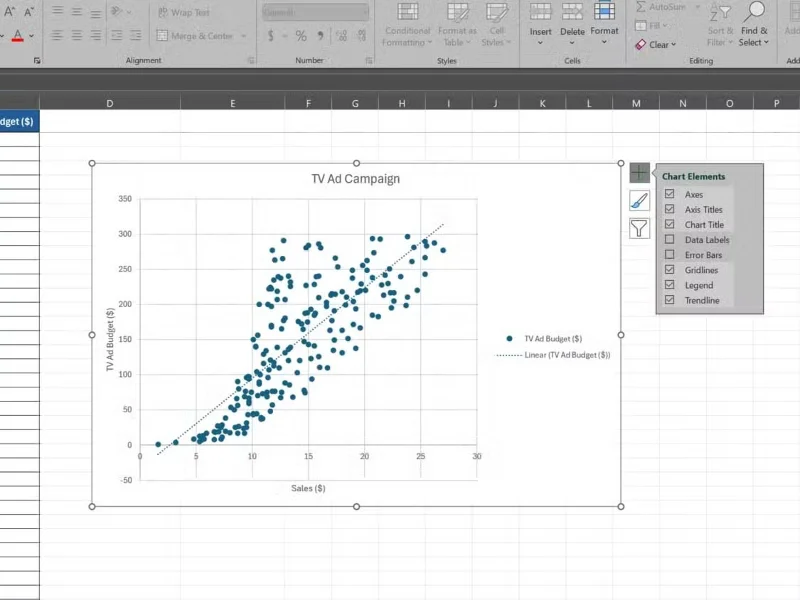
While the CORREL function will give you a numerical value for the correlation coefficient, sometimes a visual representation can be more impactful. Create a scatter plot to visualize the relationship between variables.
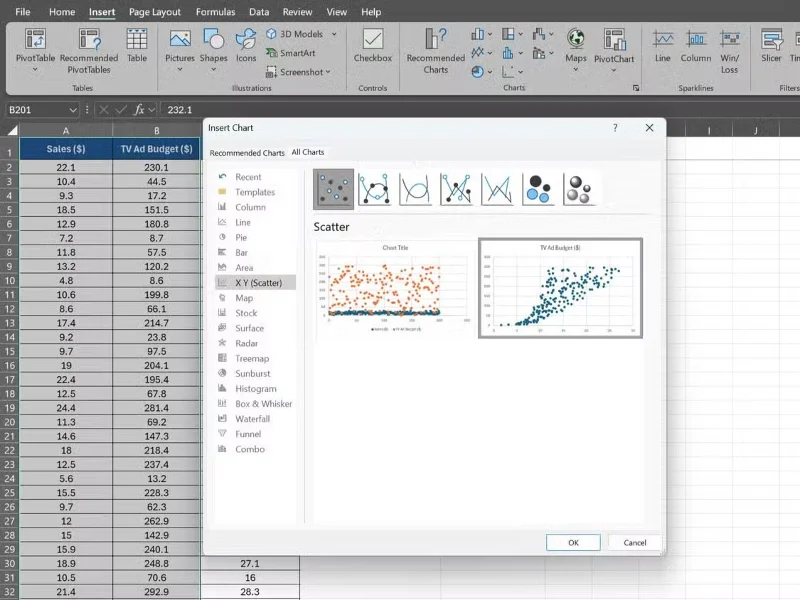
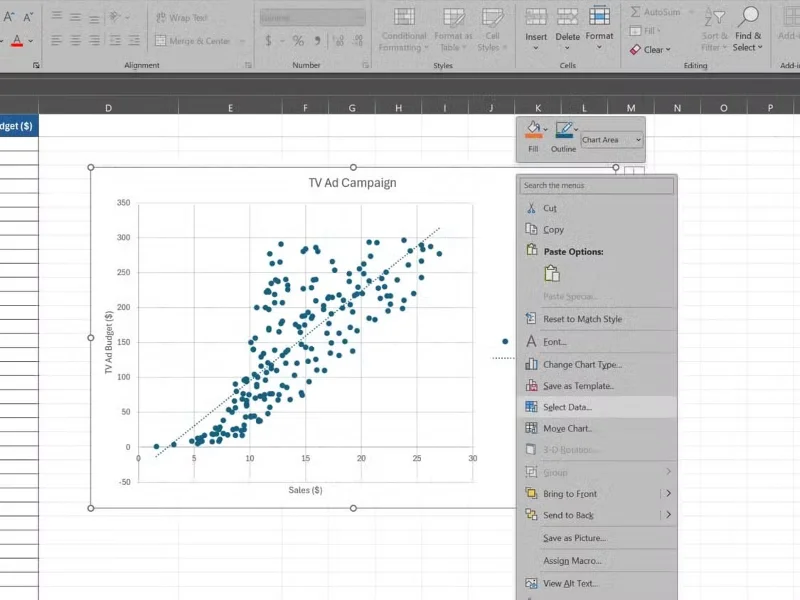
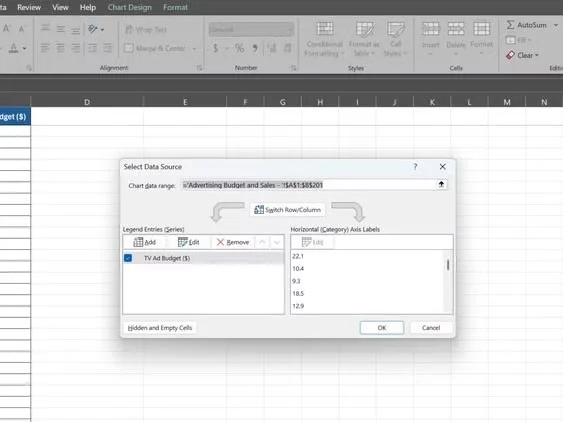
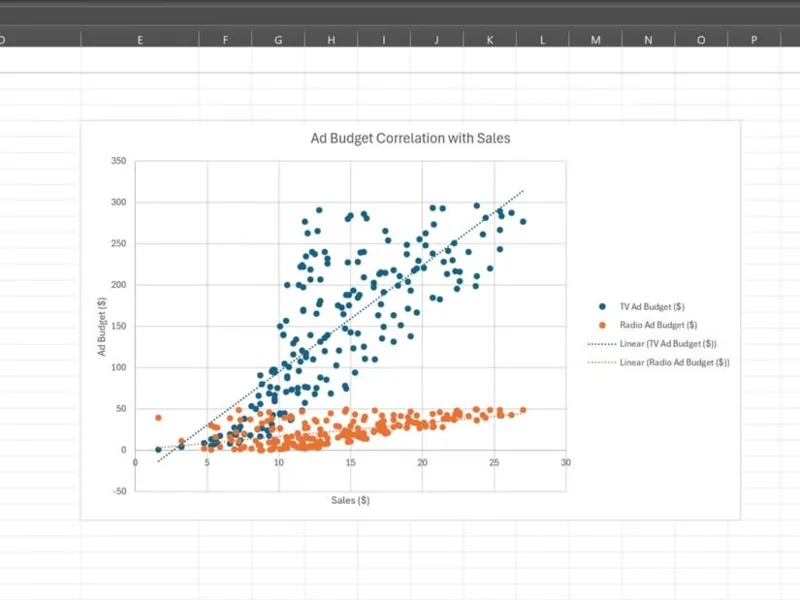
Again, consider the previous example of a sales manager analyzing data from last year with 3 data sets: TV Advertising Budget ($), Radio Advertising Budget ($), and Sales ($). To create a scatter plot for this example:
Your scatter chart will show two series: One series for the relationship between TV ad budget and sales, and another series for the relationship between radio ad budget and sales. This allows you to visually compare the correlations and determine which advertising medium has a more significant impact on sales.
Scatter charts make it easy to spot outliers, clusters, and trends in your data. Combining a scatter chart with the CORREL function gives you a quick overview of your data, saving you a lot of work in Excel.
Combining the CORREL function with other Excel tools
The CORREL function is a powerful tool, but when combined with other Excel features, it becomes even more powerful. Two key tools that can enhance your correlation analysis are PivotTables and the XLMiner Analysis ToolPak.
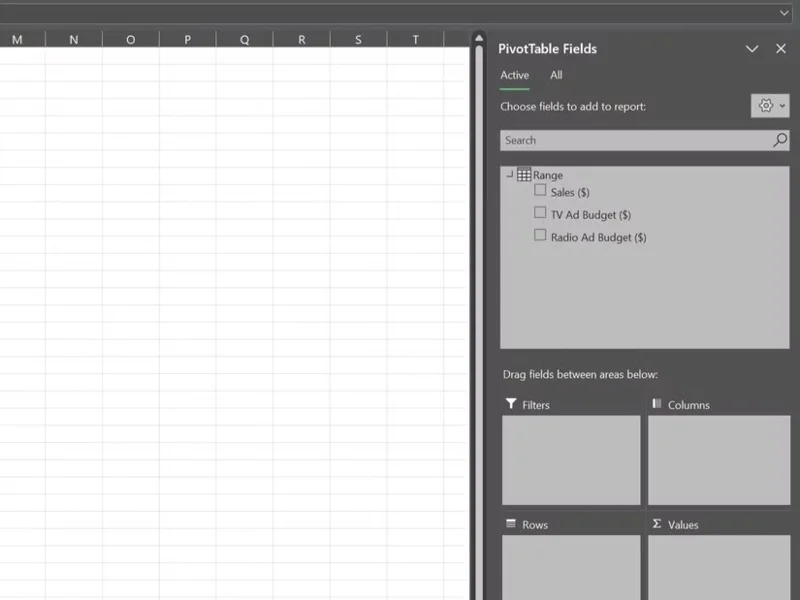
PivotTables in Excel allow you to quickly summarize and analyze large data sets. Using PivotTables , you can easily calculate correlations between variables and detect trends across multiple dimensions.
For example, suppose you have sales data broken down by region and product category; you can use a PivotTable to correlate sales and various factors such as price, advertising spend, or customer demographics for each combination of region and category.
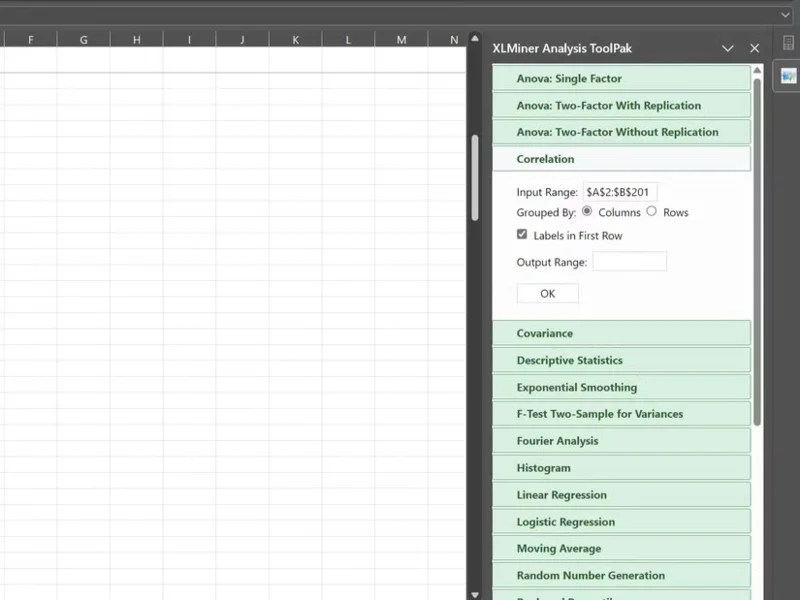
XLMiner Analysis ToolPak is an add-in that provides advanced statistical functions, including correlation. While the CORREL function calculates the correlation between two variables, the Correlation tool in XLMiner Analysis ToolPak can calculate correlation for an entire data set in one go.
The CORREL function is a powerful tool for analyzing relationships in data, helping you gain deeper insights. However, if you want to analyze your data over time, the TREND function in Excel is another great tool to explore.
Find a couples costume that fits your style, budget, and comfort level, from Addams Family classics to original inside-joke duos.
Need a last-minute high school Halloween costume? Compare 10 easy closet-based ideas by prep time, comfort, school-day practicality, and simple safety checks.
Use a simple 2026 Halloween decorating timeline for indoor décor, outdoor displays, and fresh pumpkins, with practical adjustments for weather and events.
Mix five vivid, approachable Halloween cocktails with measured recipes, simple prep tips, and an alcohol-free option for your party guests.
Find 15 office-friendly Halloween costume ideas for 2026, with practical checks for dress codes, respectful themes, comfort, and workplace safety.
Plan a fun elementary school Halloween party with easy crafts, games, inclusive treats, costume tips, and a sample 75-minute classroom schedule.
Compare realistic side hustles for 2026 by startup cost, fees, flexibility, and income control, with current tax and scam guidance from official sources.
Upgrade your home office ergonomics with current OSHA and NIOSH guidance on chair fit, monitor height, laptop setup, lighting, and movement.
Learn why emotional intelligence matters in leadership, where it helps most, how to strengthen it, and how to tell whether your approach is working.
A practical roadmap for moving into tech without a degree: choose an accessible role, build job-ready skills, prove them with projects, and use hiring feedback to improve.