Home
» Technology
»
Where Should You Study Biopharmaceuticals and Precision Gene Engineering? A Practical Program Guide
Where Should You Study Biopharmaceuticals and Precision Gene Engineering? A Practical Program Guide
Choosing where to study biopharmaceuticals and precision gene engineering is not mainly a question of prestige. It is a question of what you want to be able to do when you graduate. A student aiming to develop monoclonal antibodies or scale a biologics process needs a different curriculum from someone who wants to build CRISPR systems, engineer therapeutic cells, or pursue a research doctorate.
The most useful way to compare programs is therefore to start with the job or research problem you want to own, then work backward to the courses, laboratory access, thesis structure, and industry exposure that will get you there. The programs below are examples with clearly documented strengths, not a universal ranking. Program information was checked against official university and U.S. Food and Drug Administration pages on September 13, 2026; applicants should still verify the latest curriculum, faculty availability, tuition, visa rules, and deadlines before applying.
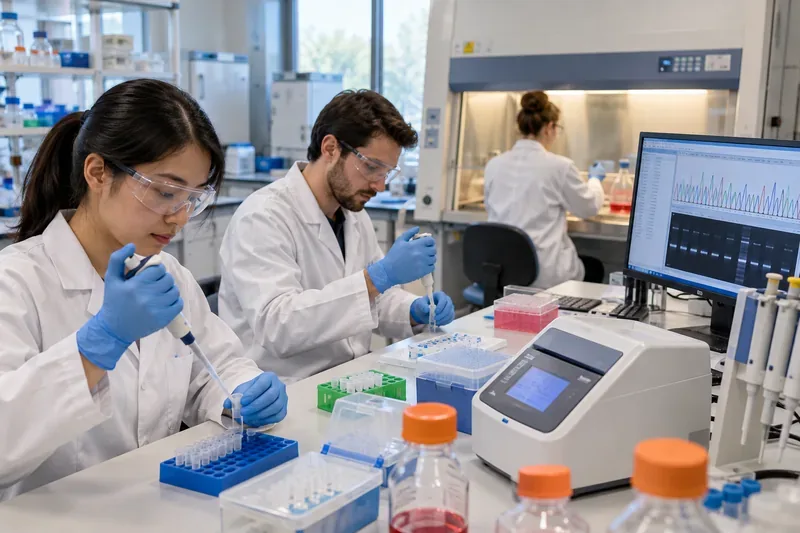
Hands-on molecular biology, analytical methods, cell culture, and data interpretation are central to many biopharmaceutical and genome-engineering career paths.
What do you actually want to engineer: a medicine, a manufacturing process, or a genome?
If your target is biopharmaceutical development, prioritize programs that teach protein therapeutics, cell-based production, purification, formulation, analytical characterization, quality systems, and chemistry, manufacturing, and controls (CMC). You should be able to connect a biological molecule to a reproducible product and a regulated manufacturing process.
If your target is precision gene engineering, look for deeper training in molecular genetics, CRISPR and other editing platforms, sequencing, functional genomics, delivery, cell engineering, bioinformatics, and experimental design. For therapeutic applications, the strongest preparation also connects editing technology to safety, manufacturing, and clinical translation.
That distinction matters because “biotechnology” can mean very different things across universities. A program may be excellent for drug discovery but offer little hands-on genome editing, or it may be excellent for synthetic biology while offering limited exposure to biopharmaceutical manufacturing.
Which programs are worth shortlisting?
Program
Best fit
What stands out
Important tradeoff
University of Pennsylvania — Master of Biotechnology
Students who want a taught master’s spanning biopharma and genome engineering
The 2026–2027 catalog lists both a Biopharmaceutical and Engineering Biotechnology track and explicit genome-engineering courses, including Principles of Genome Engineering and Advancements and Applications in Genome Editing and Engineering.
A professional master’s is broader than a lab-centered PhD, so students should verify access to the specific research experiences they want.
Leiden University — MSc Bio-Pharmaceutical Sciences
Research-oriented drug discovery and biopharmaceutical science
A two-year, research-centered program covering areas such as analytical biosciences, biopharmaceutics, drug delivery, medicinal chemistry, pharmacology, and toxicology.
Its center of gravity is drug research rather than genome-editing tool development.
ETH Zurich — MSc Biotechnology
Systems biology, synthetic biology, cellular engineering, and research training
A 120-ECTS, two-year program in Basel with flexible course selection, project work, and an eight-month master’s thesis; the official program describes training in systems biology and synthetic biology.
Students focused narrowly on regulated biopharmaceutical manufacturing should inspect electives and thesis labs carefully.
Dublin City University — MSc Biotherapeutics
Biotherapeutics R&D and manufacturing
The program emphasizes hands-on biotherapeutics development and manufacturing and points to training opportunities using National Institute for Bioprocessing Research and Training facilities.
It is more directly aligned with biotherapeutics than with advanced genome-editing platform development.
Northeastern University — MS Biotechnology, Boston
Industry-oriented students who value co-op experience
The Boston program documents wet-lab coursework across concentrations and a graduate co-op; its Biopharmaceutical Technologies and Analytics concentration covers biological products, analytical characterization, formulation, and manufacturing processes.
It is a nonthesis professional master’s, so applicants targeting a research doctorate should compare it with thesis-heavy alternatives.
Stanford University — MS or PhD in Bioengineering
Students targeting genome-engineering research and therapeutic engineering
Bioengineering offers MS and PhD pathways, and faculty research includes CRISPR genome engineering, synthetic biology, and gene and cell therapeutics.
The MS is broad; the best fit depends heavily on electives, faculty mentorship, and actual research access.
MIT — PhD in Biological Engineering
Research-intensive doctoral training in biological engineering
MIT Biological Engineering emphasizes advanced research at the engineering–biology interface, while the wider MIT ecosystem includes CRISPR screening, genome engineering, synthetic biology, and gene-delivery research.
External applicants should note that MIT’s MEng in Biomedical Engineering is restricted to MIT undergraduates; the main external graduate route in Biological Engineering is the PhD.
Choose a professional or coursework-heavy master’s when your goal is to move into industry relatively quickly, add a new technical specialization, or gain structured exposure to manufacturing, analytics, regulatory science, or business. Penn and Northeastern are particularly easy to evaluate for this path because their official curricula make the professional orientation explicit.
Choose a research master’s when you want substantial laboratory work before deciding on a PhD, or when you want a research role that values an independent thesis. Leiden and ETH Zurich are strong examples of programs where research training is central to the degree structure.
Choose a PhD when your goal is to invent editing technologies, lead preclinical research, build new delivery systems, or become an independent research scientist. At that level, the advisor and lab matter more than the degree title. Stanford, for example, lists faculty laboratories working directly on CRISPR genome engineering and gene and cell therapeutics. MIT’s Biological Engineering PhD similarly sits inside a broader research ecosystem that includes genome engineering and CRISPR-enabled functional genomics.
How much wet-lab access should you insist on?
For experimental careers, laboratory access should be treated as a requirement, not a bonus. A course description that mentions CRISPR is not equivalent to designing guides, editing cells, validating edits, sequencing targets, measuring phenotype, and troubleshooting failed experiments.
For precision gene engineering, look for experience with:
mammalian or relevant model-system cell culture;
CRISPR guide design and editing strategy selection;
delivery methods such as electroporation, viral vectors, or nonviral systems;
PCR, quantitative PCR, sequencing, and edit validation;
functional genomics and perturbation screens;
off-target assessment, controls, and reproducibility;
bioinformatics or computational analysis of genomic data.
For biopharmaceutical development, look for experience with:
cell-line development and upstream processing;
downstream purification and protein characterization;
formulation and stability;
assay development and analytical methods;
quality systems and process validation concepts;
bioprocess scale-up and manufacturing constraints.
Northeastern’s official Boston program page is unusually clear on this point: it states that all concentrations include wet-lab coursework and a co-op, while its Biopharmaceutical Technologies and Analytics concentration covers formulation, analytical characterization, and drug-product manufacturing. DCU likewise highlights hands-on biotherapeutics R&D and manufacturing. For a research-oriented genome-engineering path, faculty laboratories and thesis placement become the more important evidence.
Should regulation and manufacturing influence a gene-engineering degree choice?
Yes—especially if you want to work on human therapeutics. Precision editing is not only a molecular-design problem. A therapeutic product must also be manufactured consistently, tested for quality, evaluated for safety, and supported by appropriate preclinical and clinical evidence.
The U.S. FDA’s January 2024 final guidance on human gene-therapy products incorporating genome editing explicitly addresses product design, manufacturing and testing, nonclinical safety assessment, and clinical-trial design. FDA’s cellular and gene-therapy guidance collection was also updated repeatedly in 2026, including new guidance and draft guidance touching CMC, safety assessment, and development questions. These documents are useful signals for curriculum selection even if you do not plan to work in the United States.
Location matters when it creates access to internships, co-ops, research hospitals, contract development and manufacturing organizations, or biotechnology companies. It should not replace curriculum quality, but it can change how easily you gain experience before graduation.
Northeastern makes industry experience part of the degree through a graduate co-op. Penn’s program describes itself as positioned within a major U.S. pharmaceutical and biotechnology corridor. ETH Zurich’s biotechnology program is based in Basel, which the program itself describes as being in the heart of a major pharmaceutical environment. These ecosystem advantages are most valuable when the degree gives you a realistic way to enter them through projects, placements, or collaborations.
For international students, verify work authorization and internship eligibility directly with the university. Do not assume that a co-op, internship, or part-time option is available under every visa or residence status.
What if you are choosing between drug discovery and gene engineering?
If you are still undecided, prefer a program that lets you sample both without sacrificing laboratory depth. Penn is a particularly relevant example because its current biotechnology curriculum combines biopharmaceutical training with named genome-engineering courses. ETH Zurich can be attractive if you want a more research-centered bridge through systems biology and synthetic biology. Leiden is a stronger fit if your interest leans toward drug discovery, pharmacology, delivery, and personalized medicine rather than editing-tool development.
The University of Copenhagen’s MSc in Pharmaceutical Sciences is another useful comparison point for students leaning toward the drug side of the field: its official program description lets students specialize around drug discovery, development, production, or use. It is less directly targeted at precision genome engineering, which illustrates why a well-known pharmaceutical program is not automatically the best gene-engineering choice.
What should you check before submitting an application?
Use the current course catalog rather than relying only on marketing language. A program can change rapidly as faculty move, courses rotate, or specializations are redesigned.
Course depth: Are genome engineering, cell engineering, bioprocessing, analytical methods, and regulatory topics actual courses or only occasional seminar themes?
Research access: Can master’s students join the labs you care about, and are those labs accepting new students?
Thesis or capstone: Is independent research required, optional, or unavailable?
Wet-lab time: How much hands-on work is built into the degree?
Sequencing and computational skills: Will you learn to analyze the data produced by modern editing experiments?
Manufacturing exposure: If you want biopharma, does the program cover upstream/downstream processing, formulation, analytics, quality, or CMC?
Industry experience: Is a co-op or internship structured into the program, or must you find one independently?
Faculty fit: Can you identify at least two or three active labs whose work matches your intended specialization?
Career evidence: Ask where recent graduates actually went, not only what careers the program says are possible.
Practical constraints: Compare total cost, funding, duration, visa rules, and the opportunity cost of time away from work.
Which choice makes the most sense for different goals?
If you want to become a biopharmaceutical process or analytical scientist
Start with Northeastern, DCU, Penn, and other programs that clearly document biopharmaceutical analytics, manufacturing, quality, or process training. Your best program is the one that combines the relevant science with enough laboratory or industry experience to show that you can work with real products and processes.
If you want to engineer genomes or therapeutic cells
Prioritize explicit genome-engineering coursework and active research labs. Penn gives master’s students a notably direct curricular route because genome engineering appears by name in the current catalog. For deeper research specialization, Stanford’s Bioengineering environment is attractive because official lab pages document active work in CRISPR genome engineering, gene regulation, and gene and cell therapeutics. Review Stanford Bioengineering’s faculty-run labs before assuming that a broad Bioengineering degree matches your specific interests.
If you want to invent new gene-editing technologies
A PhD is usually the more appropriate route because the goal is original research rather than simply learning an existing platform. Compare advisors, recent publications, technical infrastructure, funding, and the freedom to build new methods. MIT is one example where the graduate program is explicitly research intensive and the surrounding ecosystem includes genome-engineering facilities and investigators, but external applicants should understand the degree structure before applying. The official MIT graduate-program listing explains that the MEng is for MIT undergraduates, while the PhD is the externally accessible doctoral path.
A simple way to make the final decision
Give each program a score from 0 to 2 on five dimensions: relevant coursework, access to your target labs, hands-on experimental training, translational or industry exposure, and financial/practical fit. A program that scores 8 or 9 out of 10 for your specific goal is usually a better decision than a more famous school that scores 5 because its strengths are in a different part of biotechnology.
Then contact the program with two or three precise questions you cannot answer from the website. For example: “Can MS students conduct thesis research in CRISPR-focused labs?”, “How many students in the biopharmaceutical concentration complete an industry co-op?”, or “Which courses cover cell- and gene-therapy manufacturing and CMC?” Specific answers are far more useful than a generic claim that a curriculum is interdisciplinary.
There is no single best place to study biopharmaceuticals and precision gene engineering. The right choice is the program whose training model matches the work you want to perform: drug discovery, biologics manufacturing, analytical development, gene editing, cell therapy, or research tool invention. Define that target first, and the shortlist becomes much easier to defend.