Home
» PC Tips
»
Windows 11 24H2 can silently reduce system performance when you dont notice
Windows 11 24H2 can silently reduce system performance when you dont notice
Recently, a number of independent reviewers have begun testing the performance of Windows 11 24H2 versus version 23H2. They initially tested an in-place upgrade and then followed it up with a clean installation to see if there were any differences. The results were a bit surprising, but for the most part, the test data showed that the differences were small.
However, not everyone is so lucky. Some recent Windows updates (KB5050094 / KB5051987) can cause a variety of compatibility issues, such as game crashes. But game crashes are probably just one of the minor issues. A report from Borncity discusses a case where a Windows 11 version 24H2 user encountered a serious bug that reduced system performance, and this bug can go unnoticed if left unchecked.
Specifically, this user noted an issue on a system using an ASRock Intel Ultra 9 285K CPU, where Windows 11 would enter power-saving mode when tasks like applications were minimized, causing the CPU to fall into a low-utility state and throttle sharply. The user confirmed this on both Prime95 (a synthetic stress test) and the 7-Zip benchmark (a real-world application for compressing and decompressing files).
Notably, Microsoft does list the Intel Ultra 9 285K CPU in the list of officially supported processors on Windows 11 24H2.
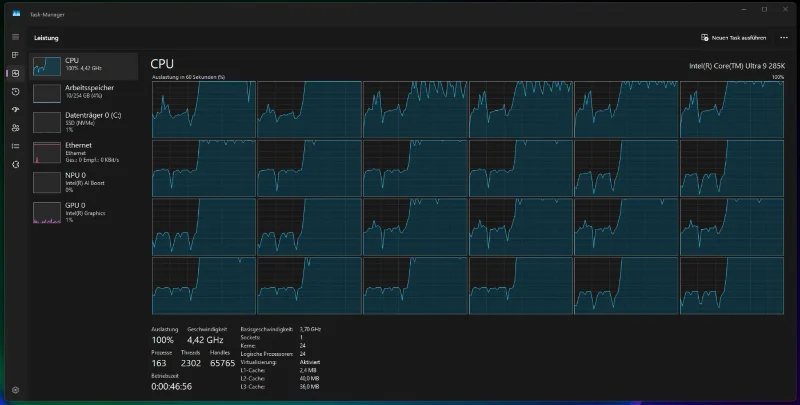
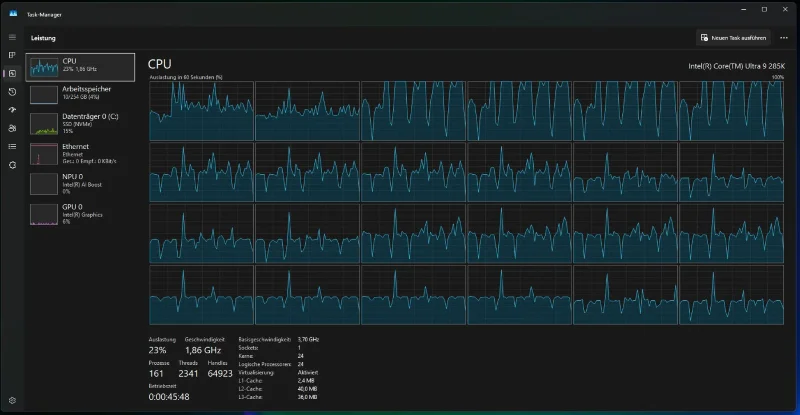
The image below shows the CPU usage and clock speed in Task Manager when the application is minimized or not focused. As you can see, the image above shows much higher clock speeds and usage when there is no throttling.
Affected users also reported that the same issue did not occur on the previous-generation Intel i9-12900K CPU and the AMD Ryzen 9 9950X, although this AMD CPU is not yet on Microsoft's Windows 11 24H2 support list.
This could explain why some previous tests didn't encounter the same error, as the 14700K chip has a similar architectural design to the 12900K, and the 14th generation still supports hyperthreading (SMT).