Math Type is a tool to help us write mathematical formulas familiar to us and it is available for Google Docs. With MathType, creating and editing a math or chemical equation is extremely simple and effective.
Install Math Type into Google Docs
For personal computers PC
Install the MathType/ChemType add-on for Google Docs just like you would install any other add-on.
Step 1: From the Add-ons menu, select Get Add-ons .
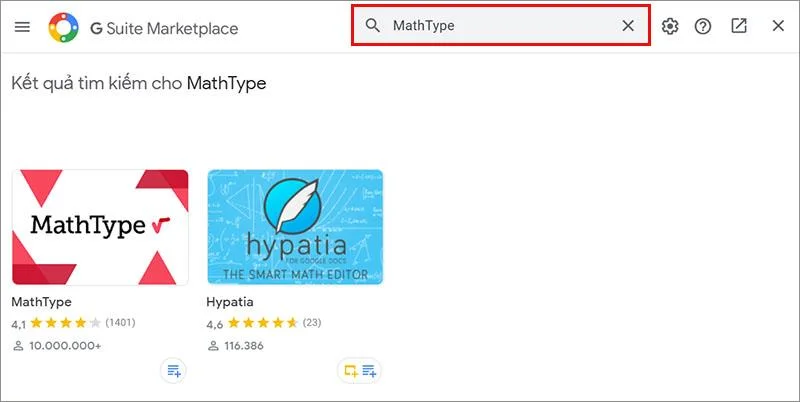
Step 2 : Search for MathType and click INSTALL. Or, go directly to the MathType page in the Gsuite Marketplace and click INSTALL.

Step 3: Mathtype asks for permission to install, click CONTINUE .

Step 4 : You will have to sign in with your Google account and grant MathType access to your Google documents. After you click Allow on the first popup and DONE then Mathtype is ready for you to use

For the entire domain
There are two parts to installing the Math Type / Chem Type add-in for Google Docs if you are installing it for an entire domain.
- Follow the steps outlined on the Google support page for Marketplace apps .
- Write a support email from support@wiris.com to let wiris know the domain where you are installing the add-on and also provide the Key for your MathType.
MathType license for Google Docs
You need a subscription to use MathType for Google. If you are an individual user, you can purchase a MathType subscription in the WIRIS store . If you are looking for an educational or corporate subscription, please contact WIRIS . Please refer to the MathType FAQ if you have any further questions.
30 days free trial period
The first time you install the MathType for Google add-on, Mathtype gives you a free 30-day trial to test all the features. When this period expires, you will need to purchase a subscription to continue using your MathType for Google.
Writing a Math Equation: The Classical Interface
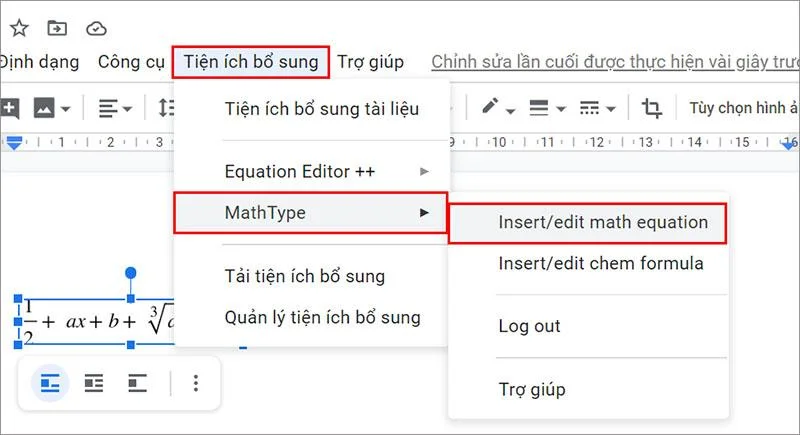
Once MathType is installed, it will be in the Google Docs Add-ons menu. To open MathType to write equations, select Add- ons >> Math Type >> Insert/ Edit Equation Math and use the equation formats you want to use

Math Type equation inside table
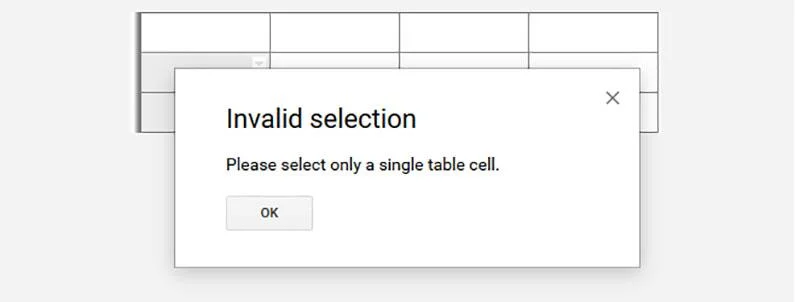
When using the add-on in tables, you may get the following error: “Invalid selection: Please select only a single cell / Invalid selection – Please select only a single table cell”

This happens because you have selected multiple table cells or rows, or your selection is outside the table. To avoid this message, please select only one cell in the table or place the cursor at the exact location where you want your equation to be inserted.
Write an equation: Handwritten interface
If you like, you can import handwritten equations into MathType for Google.

To switch from “Classic” input to handwritten input, click  on the right side of the MathType window.
- You can write an equation on the touch screen with your hand or a stylus
- As you write, MathType will continuously update the equation preview in the lower right corner.
- You can switch to the Classic view at any time and continue editing with the keyboard.
- When you're ready to insert the equation, click or tap Insert no matter what input mode you're in.
Editing an equation
Select a math formula that you want to edit. Click on Add-ons >> Math type >> Insert / Edit Math Equation


Above are some short instructions for you to edit math formulas on Google Docs, hopefully it will be a useful reference for you. Good luck.
See also: Translate documents into other languages on Google Docs




 on the right side of the MathType window.