Golang can be easily installed on Windows. Here is a step by step guide to install Golang on Windows .

Go, also known as Golang, is a powerful and efficient programming language developed by Google. The language is known for its fast compilation times, efficient memory management, and built-in concurrency features that make it ideal for building scalable and reliable applications. Windows users can take advantage of Go's features to build high-performance applications, network and cloud systems, and distribute tasks efficiently.
Installing Go on your Windows computer opens up a world of possibilities for developing high-performance applications. In this guide, let's walk through the step-by-step process of installing Go on Windows.
System requirements for installing Go on Windows
Minimum system requirements
- Operating System: Windows 7 or later (Windows 10 recommended)
- Architecture: x86 or x64 processor
- Disk Space: At least 200MB free space
Best system requirements
- Processor: Multi-core processor with clock speed of 2GHz or higher
- RAM: 4GB or more
- Disk space: 1GB or more, preferably on an SSD
Install Go on Windows
Step 1: Download Go directly from the developer's homepage: https://go.dev/dl/.
Step 2: Run the installer.
Once the download is complete, go to the folder where you downloaded the file. Double-click the MSI file to launch the Go installation wizard.
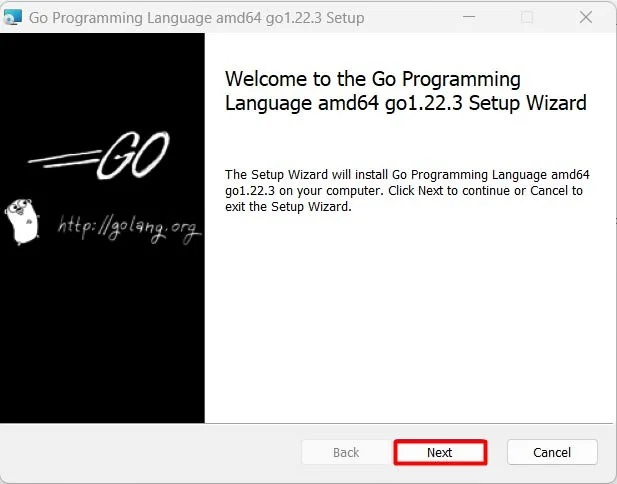
Step 3: This is the first screen welcoming you to the Go software. Click Next to continue.

Step 4: Accept the license agreement when using Go .
On the next screen, you will see the Go license agreement. Take some time to read it carefully. If you agree to the terms and conditions outlined in the license agreement, check the box next to “ I accept the terms in the License Agreement .” Once you have accepted the terms, click the “ Next ” button to continue:
Step 5: Select installation folder
The next screen allows you to select the directory where Go will be installed on your system. By default, Go is installed in the “ C:\Go ” directory. If you want to install Golang in a different location, click the “Browse” button and navigate to your desired directory. It is recommended to leave the default installation directory unless you have a specific reason to change it. Once you have selected the installation directory, click “ Next ” to continue.
Step 6: Ready to install
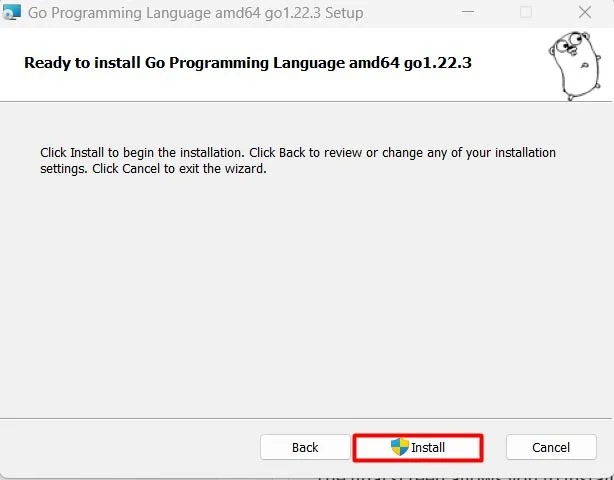
At this point, you have completed all the necessary configuration steps and the installer is ready to install your Go Windows machine. Review the installation settings displayed on the screen to make sure everything is correct. If you need to make any changes, click the " Back " button to go back to the previous steps. If you are satisfied with the settings, click the " Install " button to begin the installation process.

The installer will now copy the necessary files and set up Go on your system. This may take a few minutes, depending on the speed of your system. Be patient and let the installer complete the installation without interruption.
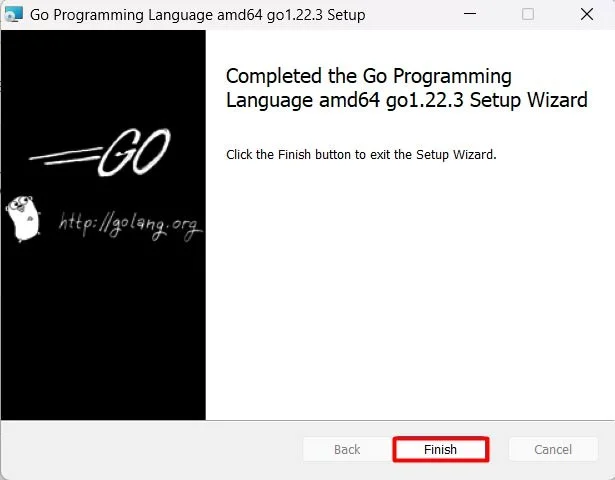
Once the installation is complete, you will see the following screen:

Step 7: Verify Go
Once the installation is complete, it is important to verify that Go has been installed correctly and is working as expected. You can do this using the command prompt and to open the command prompt, press Windows key + R to open Run. Type “ cmd ” > press Enter to open the Command Prompt.
In Command Prompt, type the following command and press Enter :
go version
If Go is installed correctly, you will see the Go version number displayed in the Command Prompt. Viewing the Go version information confirms that Go was successfully installed on your Windows machine. The following image verifies the Go installation in the environment variables section.
Setting up a programming environment for Go
Now that you have Go installed on your Windows machine, it's time to set up your development environment. Here are some essential tools you'll need to get started:
Text editor or IDE
You will need a text editor or Integrated Development Environment (IDE) to write and edit Go code. Some popular choices include Visual Studio Code, IntelliJ IDEA, and Sublime Text.
GoLand
GoLand is a popular IDE designed specifically for Go development. It offers features like code completion, debugging, and project management.
Git
Git is a version control system that helps you manage changes to your code. You'll need Git to collaborate with other developers and track changes to your code.
As you can see, installing Go on your computer is a simple process. Just follow the steps above and you will have Golang on Windows ready to start your programming work.