Home
» Technology
»
Solving the UTM Puzzle: How AI Can Deconflict Low-Altitude Airspace
Solving the UTM Puzzle: How AI Can Deconflict Low-Altitude Airspace
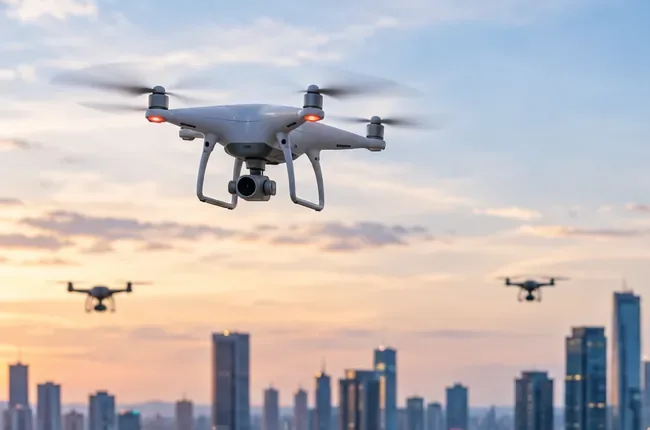
A delivery drone is flying a routine route across a city when an inspection drone launches from a nearby rooftop, a public-safety mission receives priority access, and a temporary airspace restriction appears ahead. None of those flights is inherently unsafe. The problem is that their plans can intersect in space and time, and the picture can change after takeoff.
This is the practical UAS Traffic Management, or UTM, puzzle: how do many operators share low-altitude airspace without turning every interaction into a voice-coordination problem or a last-second evasive maneuver? The most credible answer today is not “let AI fly everything.” It is a layered system in which interoperable data, strategic deconfliction, conformance monitoring, tactical services, and onboard safety functions each handle a different part of the risk. Artificial intelligence can improve several of those layers, but it still needs explicit constraints, verification, and fallback behavior.
The distinction matters because UTM is moving from research toward operational use. The FAA's current UTM program describes a distributed, highly automated ecosystem in which operators and service providers exchange data through APIs, and the agency says it has begun issuing Letters of Acceptance for strategic deconfliction services supporting commercial beyond-visual-line-of-sight operations. At the same time, the broader U.S. Part 108/Part 146 BVLOS framework remains a proposed rule rather than a completed final rule as of September 2026. That means operational capability is advancing, but the regulatory architecture is still evolving.
Dense low-altitude operations become a coordination problem long before they become a last-second collision-avoidance problem.
Why Low-Altitude Deconfliction Is Harder Than Drawing Separate Routes
The first cause is dimensionality. A conflict is not just two lines crossing on a map. Each operation occupies a four-dimensional volume: latitude, longitude, altitude, and time, with margins for uncertainty. A route that looks identical in two dimensions may be conflict-free if the aircraft use different heights or time windows.
The second cause is uncertainty. Wind, navigation error, delayed departures, command-and-control latency, vehicle performance, weather, temporary restrictions, and emergency missions can all move an aircraft away from its original plan. A system that checks routes only once before departure can therefore become stale during the flight.
The third cause is participation. Strategic coordination works best when the relevant operators share intent and follow common rules. FAA-sponsored research cited in the agency's 2025 BVLOS proposed rule reported that simulations with universal strategic deconfliction produced roughly a 100-fold reduction in UAS-to-UAS midair collisions compared with simulations without it. The same discussion notes a representative ASTM analysis showing a 97.9% reduction. Those are simulation and safety-analysis results, not guarantees for every real deployment, but they show why shared participation matters.
Practical action: before adding sophisticated AI, make sure every participating system can describe operational intent in a common time-and-space reference and exchange it reliably with other service providers.
Step 1: Solve Predictable Conflicts Before Takeoff
Strategic deconfliction is the easiest conflict to solve because it happens while there is still time to change the plan. NASA's UTM strategic deconfliction work demonstrated the use of discoverable four-dimensional operation volumes so operators can identify overlaps and plan conflict-free operations. In Europe, the EASA U-space rules describe UAS flight authorization as a strategic deconfliction mechanism and require checking whether a proposed flight intersects another notified authorization in space and time.
A baseline deconfliction engine can be deterministic. It can compare planned 4D volumes, apply priority rules, respect restricted areas, and propose alternatives such as a different departure time, altitude band, or route. That is important because “AI-driven” should not become a synonym for “opaque.” Many safety-critical conflicts can be handled with explicit geometry and rules.
Practical action: implement deterministic conflict detection first. Treat machine learning as an optimizer on top of a clearly defined safety envelope, not as the only mechanism that decides whether two operations are compatible.
Step 2: Monitor Whether Aircraft Stay Inside Their Intent
A conflict-free plan only remains useful if the aircraft actually conforms to it. Conformance monitoring compares the reported aircraft state with the authorized or declared operation volume and raises an alert when a vehicle approaches or exceeds its bounds.
This is not a minor add-on. FAA's proposed BVLOS framework explicitly discusses strategic deconfliction together with conformance monitoring, and NASA's 2025 collision-risk study found in simulation that combining pre-departure strategic deconfliction with conformance monitoring can manage mixed traffic more safely than strategic deconfliction alone when some aircraft become contingent or non-conforming.
For an AI-assisted system, this is where prediction can become useful. A model may estimate whether a deviation is likely to grow into a conflict before a hard threshold is crossed. But prediction should complement, not replace, deterministic conformance limits.
Practical action: separate “prediction” from “violation.” Let AI estimate future risk, while a traceable rules engine determines when an operation is formally out of conformance.
Step 3: Replan When the Airspace Changes
Some conflicts emerge after departure: a weather cell moves, a priority mission appears, a drone slows unexpectedly, or an airspace restriction changes. At that point the system needs more than preflight scheduling. It needs rolling-horizon replanning: repeatedly evaluating the next portion of each trajectory and proposing safe alternatives before the situation becomes urgent.
EASA guidance allows an active authorization to be updated when doing so creates no new conflicts, and it describes alerting or updating an authorization when dynamic restrictions or traffic conditions put a flight at risk. That is a useful architectural pattern even outside Europe: distinguish planned intent from active constraints, and make every mid-flight update explicit and synchronized across participants.
Optimization methods can help here because there may be many valid resolutions. One route may minimize delay, another energy use, another ground risk, and another disruption to higher-priority traffic. AI techniques such as heuristic search, multi-agent planning, or learned policies can rank those choices faster than a human dispatcher could evaluate them one by one.
Practical action: define the objective function before choosing the algorithm. A deconfliction system should know whether it is optimizing safety margin, mission completion, delay, battery reserve, fairness, or some weighted combination. Otherwise “optimal route” has no operational meaning.
Step 4: Keep Tactical Separation Distinct from Collision Avoidance
A common misconception is that tactical deconfliction and collision avoidance are the same thing. They are not. ICAO's UTM guidance treats strategic deconfliction, tactical separation, and collision avoidance as distinct layers. Strategic mechanisms reduce the probability that aircraft will meet in the first place. Tactical separation responds to developing conflicts in flight. Collision avoidance is the final protective barrier when earlier layers have failed or an unexpected hazard appears.
This separation of responsibilities matters for AI. A machine-learning model that recommends a route change several minutes before a potential conflict is fundamentally different from an onboard system executing a last-second evasive maneuver. They have different latency, assurance, sensing, and certification needs.
Practical action: document which layer owns each decision. Do not let a ground-based route optimizer silently become a collision-avoidance system simply because it can issue fast recommendations.
Where AI Can Add Real Value
AI is most useful where the search space becomes too large for simple rules but the solution can still be constrained by hard safety requirements. Four areas stand out.
UTM problem
Useful AI role
Required guardrail
Many simultaneous flight requests
Rank or generate low-cost conflict-free alternatives
Every candidate must pass deterministic separation checks
Changing weather or traffic
Predict likely conflicts and trigger earlier replanning
Prediction confidence and data age must be visible
Dense multi-operator traffic
Optimize route, time, altitude, and priority tradeoffs
Common fairness and priority rules must remain auditable
Contingencies
Recommend recovery plans based on current state and constraints
Fallback procedures and human/automation roles must be predefined
There is active research behind this direction, but maturity varies. NASA's 2025 technical memorandum on deep reinforcement learning presents a simulation framework for tactical separation assurance and reports preliminary learning improvements in pairwise conflict scenarios. That is promising research, not evidence that an unconstrained reinforcement-learning agent is ready to control production UTM traffic.
Similarly, the SESAR Joint Undertaking's Autonomous Flight Plan Approval Service is described as AI-driven, but its current maturity is listed as V1/TRL2 and ongoing. SESAR's BUBBLES project has also investigated how AI could dynamically manage separation minima while accounting for risks introduced by AI itself.
Practical action: label AI capabilities by maturity. Separate research prototypes, operational decision support, and safety-credit-bearing functions instead of presenting them as one category.
The Hard Part Is Assurance, Not Route Generation
Generating a conflict-free path is computationally interesting. Proving that the whole system behaves safely across bad data, outages, inconsistent clocks, cyber incidents, multiple service providers, and non-cooperative traffic is harder.
FAA's current UTM program emphasizes interoperable service providers, shared data, governance, and automated testing. Those system properties are as important as the algorithm itself. If two service providers receive the same intent and one resolves it differently because of hidden model behavior, operators need to know why. If a model depends on stale weather data, the system needs a bounded response. If network connectivity degrades, it needs a pre-agreed fallback rather than improvisation.
NASA's Contingency Planning Toolkit project, updated in January 2026, makes a related point: future UTM and advanced-air-mobility concepts anticipate increasing autonomy, AI, and machine learning, but coordinated contingency handling will still require deliberate human-automation teaming.
Practical action: design the failure modes before optimizing the happy path. Define what happens when telemetry is late, a service provider is unreachable, a prediction confidence collapses, or an aircraft stops conforming.
A Practical Architecture from Easy to Hard
Normalize data. Use common coordinate, altitude, time, identity, and uncertainty conventions.
Share operational intent. Make 4D volumes discoverable to authorized participants.
Run deterministic strategic checks. Eliminate obvious intersections before departure.
Monitor conformance. Detect when real flight behavior diverges from intent.
Add rolling-horizon replanning. Recalculate safe options as constraints change.
Use AI for ranking and prediction. Accelerate decisions without removing hard safety constraints.
Maintain tactical and onboard barriers. Keep tactical separation and collision avoidance available when earlier layers are insufficient.
Assure the network. Test interoperability, degraded modes, cybersecurity, fairness, explainability, and recovery procedures.
This progression prevents a common engineering mistake: starting with an impressive model before the system has reliable intent data, shared rules, and safety boundaries.
Self-Check: Is Your Deconfliction System Actually Ready?
Before calling a platform “AI-driven UTM,” test it against questions that expose architectural gaps:
Can every planned operation be represented as a time-bounded 4D volume with uncertainty margins?
Can the system detect conflicts without machine learning if the AI component is unavailable?
Are priority and fairness rules explicit, consistent, and inspectable across service providers?
Does conformance monitoring distinguish normal navigation error from a true operational deviation?
Can dynamic restrictions, weather changes, and emergency missions trigger synchronized replanning?
Are strategic deconfliction, tactical separation, and collision avoidance treated as separate safety layers?
Can an operator understand why a route was rejected, delayed, or rerouted?
Has the system been tested with stale data, lost connectivity, non-conforming aircraft, and conflicting service-provider states?
Are AI models evaluated for failure behavior, not only average optimization performance?
Is there a defined safe state when the network or prediction layer cannot be trusted?
If several answers are “no,” the next investment should probably be in data quality, interoperability, conformance monitoring, or assurance rather than a more sophisticated AI model.
The Bottom Line
The UTM puzzle is not solved by one algorithm. Dense low-altitude airspace needs a stack of defenses: shared intent to make traffic visible, strategic deconfliction to remove predictable conflicts, conformance monitoring to detect deviations, tactical services to react to changing conditions, and collision avoidance as a final barrier. AI can make that stack faster and more adaptive by predicting conflicts and searching a large set of alternative trajectories, but it should operate inside verifiable constraints.
That is the most useful way to think about AI-driven deconfliction today: not as an autonomous air traffic controller replacing everything beneath it, but as a decision layer that becomes valuable only after the underlying UTM ecosystem is interoperable, observable, and safe when the AI is wrong or unavailable.