Home
» Technology
»
The Evolution of Autonomous Vehicles: Safety, Edge Computing, and AI Integration
The Evolution of Autonomous Vehicles: Safety, Edge Computing, and AI Integration
Autonomous vehicles have not advanced along a single straight line from “driver assistance” to “driverless.” The more useful way to understand their evolution is as the convergence of three systems: a safety case that defines where automation is allowed to operate, an edge-computing platform that can process sensor data in real time, and an AI stack that turns that data into driving decisions.
As of September 2026, most consumer vehicles still rely on Level 0–2 driver assistance, while Level 4 automation is operating mainly in constrained commercial services rather than as a universally capable private car. The U.S. National Highway Traffic Safety Administration (NHTSA) continues to distinguish clearly between driver-assistance systems that require human supervision and automated driving systems that take over the driving task within defined conditions.
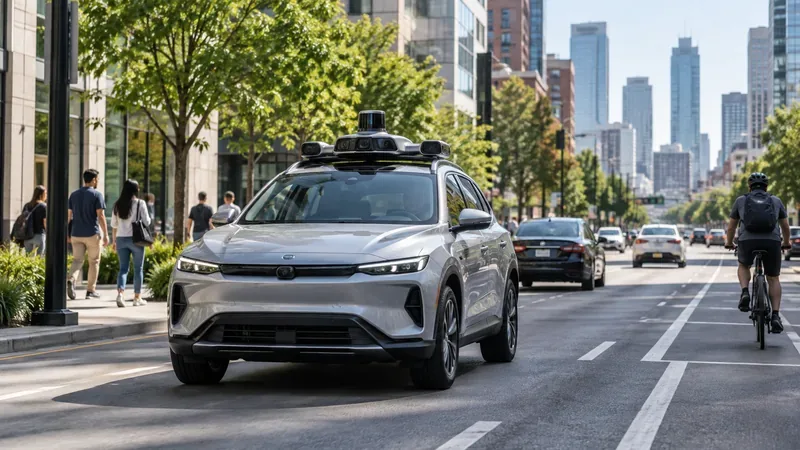
A sensor-equipped autonomous vehicle moves through mixed urban traffic, illustrating why perception, on-vehicle computing, and safety validation must work together around cars, cyclists, and pedestrians.
Quick reference: where vehicle automation stands
Automation level
Who performs the driving task?
Practical interpretation
Level 0
Human
Warnings or brief interventions may assist, but the driver drives.
Level 1
Human with one continuous assistance function
Steering or acceleration/braking assistance, not both as a sustained combined function.
Level 2
Human with combined assistance
The system can continuously control steering and speed, but the driver must supervise.
Level 3
System within a defined operating domain
The system drives when engaged, but the human must be available to take over when requested.
Level 4
System within a defined operating domain
No human driver is needed while the system is operating inside its approved conditions or service area.
Level 5
System everywhere the vehicle can reasonably operate
Full automation without a human driver across road and environmental conditions remains a future target.
NHTSA’s terminology is useful because it prevents a common mistake: treating a highly capable Level 2 feature as if it were an autonomous driver. A practical evaluation should always ask two questions: Who is responsible for monitoring the road? and What is the operational design domain? The operational design domain, or ODD, is the set of road types, speeds, locations, weather conditions, and other circumstances in which an automated system is intended to function.
How the architecture evolved
1. From isolated driver-assistance functions to fused perception
Early advanced driver-assistance systems were relatively narrow: adaptive cruise control, lane-departure warning, automatic emergency braking, and parking assistance. These functions could be built around a small number of sensors and dedicated electronic control units.
More capable systems combine cameras, radar, lidar in some designs, ultrasonic sensors, inertial measurements, localization, and map or route information. The important shift is not simply “more sensors.” It is the move toward a unified model of the environment in which the system must detect objects, estimate free space, understand lanes and signals, track motion, predict other road users, and plan a safe trajectory.
Modern reference platforms illustrate that trend. NVIDIA DRIVE Hyperion combines an automotive compute platform with cameras, radar, lidar, ultrasonics, and a software stack for higher levels of automation. Qualcomm Snapdragon Ride similarly describes scalable on-vehicle compute for sensor fusion, computer vision, driver assistance, and automated driving. These are vendor platforms rather than universal specifications, but they show the direction of vehicle architecture: centralized, heterogeneous compute rather than many isolated controllers.
2. Edge computing became part of the safety architecture
In autonomous driving, “edge computing” means that the time-critical perception and control workload runs in or very near the vehicle rather than depending on a distant cloud service. That matters because braking, steering, object detection, and path planning must continue even when cellular connectivity is delayed, congested, or unavailable.
A useful engineering split is:
On-vehicle edge: sensor ingestion, perception, localization, prediction, planning, control, health monitoring, and immediate fallback behavior.
Cloud or data center: large-scale model training, fleet analytics, simulation, log processing, software distribution, map generation, and long-horizon learning.
Connectivity layer: useful for updates, fleet operations, traffic information, and some remote-support workflows, but it should not be treated as a guaranteed low-latency control channel for the basic driving task.
This division is visible in current automotive stacks. NVIDIA’s in-vehicle computing architecture explicitly separates vehicle compute from systems used for training and simulation. Qualcomm’s automotive platform also emphasizes on-device machine learning and heterogeneous compute, where CPUs, GPUs, neural-processing units, vision accelerators, and safety-oriented processing blocks handle different workloads.
Why safety is broader than “the AI is accurate”
An autonomous-driving system can have strong object-detection accuracy and still be unsafe. Safety engineering covers failures in hardware, software, intended behavior, human interaction, cybersecurity, updates, operations, and the system’s ability to recognize when it has reached its limits.
Functional safety
ISO 26262 provides the established functional-safety framework for safety-related electrical and electronic vehicle systems. It addresses hazards arising from faults and structures safety work across concept, system, hardware, software, production, operation, and service. The currently published second edition dates from 2018; ISO was developing a third edition during 2026.
Safety of the intended functionality
Fault-free hardware does not guarantee safe behavior. A camera may be working exactly as designed but still fail to provide enough information in glare, heavy rain, unusual construction, or an ambiguous scene. ISO 21448:2022, Safety of the Intended Functionality (SOTIF), addresses risks caused by functional insufficiencies and foreseeable misuse, especially in systems whose situational awareness depends on complex sensors and algorithms.
Cybersecurity and software updates
Connected vehicles also need lifecycle security. ISO/SAE 21434:2021 defines a vehicle cybersecurity engineering framework, while UN Regulation No. 156 addresses software-update management. This becomes increasingly important as automated-driving behavior changes through software releases rather than only through new vehicle hardware.
Operational safety and real-world evidence
Pre-deployment testing is necessary but not sufficient. Post-deployment monitoring matters because rare interactions can appear only after large amounts of real-world driving. In the United States, NHTSA’s third amended Standing General Order requires reporting of certain crashes involving Level 2 ADAS and automated driving systems. The agency’s public crash-reporting page also warns that the dataset has limitations such as incomplete fields and possible duplicate reporting, so raw counts should not be treated as a simple ranking of system safety.
Commercial Level 4 fleets provide another source of evidence. Waymo’s Safety Impact data hub publishes rider-only mileage and crash comparisons for its operating areas. As of data through March 2026, the company reported 220.6 million rider-only miles. Those results are useful, but they should be interpreted inside the specific geographies, vehicle fleet, operating conditions, benchmark methodology, and ODD represented by the data—not as proof that every autonomous system is safer in every environment.
How AI integration is changing the driving stack
Perception remains foundational
Neural networks are widely used to recognize vehicles, pedestrians, cyclists, road boundaries, traffic lights, signs, and drivable space. Multi-sensor fusion can reduce dependence on any single sensing modality, but it also increases synchronization, calibration, compute, and validation requirements.
Prediction and planning are becoming more learned
Traditional autonomous-driving stacks often separate perception, prediction, planning, and control into modular components. That separation can make interfaces and failure modes easier to inspect, but errors may accumulate across modules. Newer systems increasingly introduce learned planning or end-to-end models that map a richer set of sensor inputs toward driving actions.
The key limitation is validation. A model that performs well on an aggregate benchmark can still fail on a safety-critical tail scenario. Engineering teams therefore need scenario-based testing, simulation, closed-course testing, public-road evidence, uncertainty handling, fallback behavior, and release governance rather than relying on a single accuracy metric.
A practical checklist for evaluating an autonomous-vehicle stack
Define the automation level correctly. State whether the human must supervise and take over.
Specify the ODD. Include geography, road type, speed, weather, lighting, and other environmental limits.
Keep safety-critical inference on the vehicle. Identify which functions can continue safely if network access disappears.
Document redundancy. Check compute, power, braking, steering, sensing, and communication failure paths.
Separate functional safety, SOTIF, and cybersecurity. They address different categories of risk.
Validate the data pipeline. Track sensor calibration, dataset provenance, labeling quality, long-tail coverage, and distribution shift.
Measure behavior, not only perception. Include collision risk, traffic-rule compliance, ride behavior, minimal-risk maneuvers, and interactions with vulnerable road users.
Test updates as safety-relevant releases. A software improvement in one scenario can create a regression in another.
Use real-world monitoring after deployment. Maintain incident review, near-miss analysis, and a process for feeding evidence back into development.
Avoid unsupported safety claims. Compare systems only when exposure, geography, operating conditions, crash definitions, and statistical methods are comparable.
Regulation is moving from broad guidance toward measurable assurance
The regulatory picture remains uneven. In the United States, the Department of Transportation introduced a new automated-vehicle framework in April 2025. On July 30, 2026, NHTSA announced that it was accelerating development of its first AV performance standards. That wording matters: the announcement described standards under development, not a completed universal certification regime.
The European Union already has a more explicit type-approval structure. The European Commission’s vehicle safety and automated/connected vehicles overview explains that the General Safety Regulation establishes a framework for automated and driverless vehicles, including technical rules covering testing, cybersecurity, data recording, safety monitoring, and incident reporting. The EU updated parts of the fully automated vehicle approval framework again in 2026.
At the UN level, UN Regulation No. 157 established requirements for Automated Lane Keeping Systems, while UNECE work in 2026 continued toward broader automated-driving-system regulation. The practical consequence for engineering teams is that an AV architecture has to be designed not just for a demo, but for traceability, software configuration control, incident evidence, cybersecurity, and repeatable safety arguments.
What the next phase is likely to look like
The strongest near-term trend is not a sudden jump to unrestricted Level 5. It is the gradual expansion of constrained automation: better Level 2 systems, limited Level 3 functions, and Level 4 services expanding their ODD city by city and condition by condition. At the same time, vehicle hardware is consolidating around higher-performance central compute, while AI models become larger, more integrated, and more data-driven.
That creates a productive tension. AI can increase capability, but increased capability expands the number of scenarios that must be validated. Edge computing can reduce latency and network dependence, but more compute raises power, thermal, redundancy, and cost challenges. Software-defined vehicles make improvement after sale possible, but they also turn release engineering, cybersecurity, and rollback into safety concerns.
The most credible autonomous-vehicle programs therefore treat safety, edge computing, and AI integration as one system. The goal is not simply to make the vehicle “smarter.” It is to make its capabilities bounded, observable, testable, resilient to failure, and supported by evidence that remains valid as the software, hardware, and operating domain evolve.