Home
» Technology
»
The Rise of Embodied AI: Bridging the Gap Between Code and Physical Reality
The Rise of Embodied AI: Bridging the Gap Between Code and Physical Reality
The most important thing to know about embodied AI is that it is not simply an AI model placed inside a robot. It is a full system that must connect perception, reasoning, motor control, feedback, safety, and recovery quickly enough to work in the physical world. That is why embodied AI is becoming useful first in tasks that are bounded, measurable, repetitive enough to justify automation, but variable enough that traditional fixed programming becomes expensive or brittle.
A major 2026 shift is that leading robotics models are expanding beyond tabletop pick-and-place demonstrations. In July 2026, Google DeepMind introduced Gemini Robotics 2 with whole-body humanoid control, multi-robot collaboration, and an on-device model designed to adapt to new robot embodiments. NVIDIA followed the same broader direction with Isaac GR00T 1.7, an open vision-language-action model integrated into a development workflow covering data collection, simulation, post-training, evaluation, and deployment. These are meaningful advances, but they do not mean general-purpose robots are already reliable in every factory, warehouse, or home.
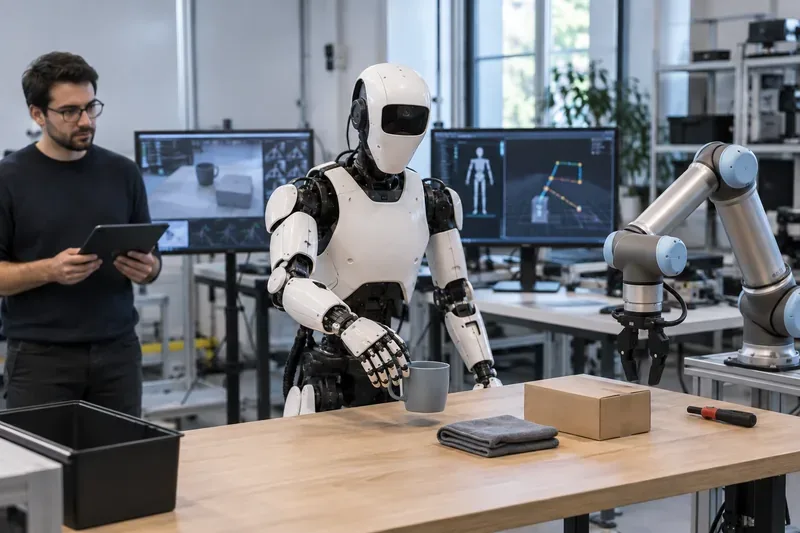
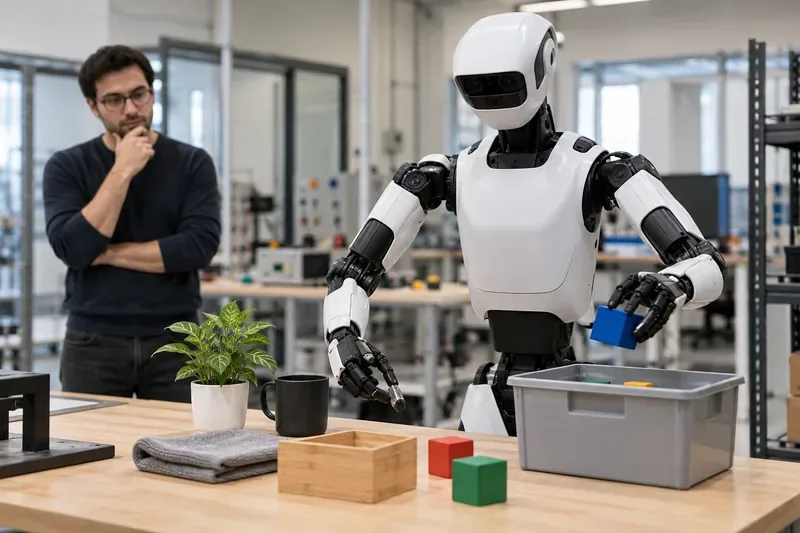
A humanoid robot performs a physical manipulation task while an engineer monitors the system. Embodied AI has to connect visual perception, task reasoning, motor control, and real-time feedback rather than stopping at a software prediction.
What is embodied AI, in practical terms?
Embodied AI is artificial intelligence that receives information from a physical environment and uses a physical body to act on that environment. The body might be a humanoid robot, a mobile manipulator, an industrial arm, a quadruped, a drone, or another autonomous machine. The defining feature is the closed loop:
Perceive: cameras, depth sensors, tactile sensors, joint encoders, microphones, force sensors, or other inputs describe the world and the robot's state.
Understand and plan: software interprets the scene, the instruction, constraints, and the sequence of actions needed.
Act: a control policy converts the plan into motor commands.
Observe the result: the robot checks whether the object moved, the drawer opened, the part was inserted, or the task failed.
Recover or continue: the system adjusts instead of blindly replaying the original motion.
That last step is where embodied AI differs most from a simple chatbot or a fixed automation script. In software, a wrong answer may be inconvenient. In the physical world, a wrong movement can drop a part, damage equipment, block a production line, or create a safety hazard. Physical intelligence therefore needs both broader AI reasoning and traditional robotics engineering.
Why is embodied AI advancing now?
Several technologies that matured separately are beginning to work together. Large multimodal models have become better at understanding language and images. Robot learning has improved at turning demonstrations into actions. Simulation can generate and evaluate large quantities of training data. Faster onboard processors reduce control latency. Better cameras, tactile sensors, actuators, and batteries improve what the hardware can perceive and physically execute.
One of the clearest technical trends is the rise of vision-language-action models, usually shortened to VLA models. Instead of producing only text, a VLA accepts visual information, language instructions, and robot state, then produces actions or action representations. Google DeepMind describes Gemini Robotics 2 as a VLA that converts vision and language into motor control and can operate full humanoids as well as bi-arm systems. DeepMind's current release also separates high-level embodied reasoning from lower-level action, which allows the reasoning layer to plan multi-step tasks while the action model handles execution. See the official Gemini Robotics 2 announcement.
NVIDIA is approaching the same problem as a development stack. Its July 2026 Isaac GR00T workflow connects simulation, teleoperation data, post-training, policy evaluation, and deployment. NVIDIA says GR00T 1.7 is released under Apache 2.0 and can export through ONNX and TensorRT, making it relevant to teams that want to customize and deploy a VLA rather than use only a closed hosted model. See NVIDIA's official GR00T 1.7 development overview.
The real breakthrough is not “smarter robots.” It is reducing task-specific programming.
Traditional industrial automation works extremely well when the world is controlled. A robot arm welding the same seam on the same fixture can be fast, accurate, and reliable. But traditional programming becomes harder when parts arrive in different positions, product variants change, instructions are semantic rather than geometric, or the robot has to work in spaces designed for people.
Embodied AI is valuable when it can replace some of that hand-engineered branching with learned perception and adaptable behavior. For example, instead of programming exact coordinates for every item in a mixed bin, a system can identify the requested object, estimate how to grasp it, move it, and verify the result. Instead of writing a separate state machine for every drawer and tool configuration, an embodied model can potentially generalize across related situations.
That does not mean conventional robotics disappears. Low-level force control, collision avoidance, joint limits, emergency stops, certified safety functions, and deterministic motion planning still matter. The most practical systems are often hybrid: learned models handle ambiguity and generalization while traditional controllers enforce hard physical constraints.
Which architecture is right for a real project?
Approach
Best fit
Advantage
Main tradeoff
Traditional programmed automation
Highly repeatable, structured tasks
Predictable, fast, easier to validate
Expensive to adapt when products or environments change
Modular AI + robotics stack
Tasks needing AI perception but strict control
Components can be tested and replaced independently
Integration and error propagation between modules can be complex
End-to-end VLA policy
Variable manipulation and natural-language tasks
Can generalize across objects and behaviors with less explicit programming
Harder to interpret, validate, and guarantee under unfamiliar conditions
Hierarchical embodied AI
Longer, multi-step tasks
High-level reasoning can plan while fast controllers execute locally
More system components and more failure interfaces to manage
On-device embodied model
Latency-sensitive or connectivity-limited applications
Lower network dependence and faster local response
Compute, memory, thermal, and power limits constrain model size
Where is embodied AI useful today?
1. Material handling and flexible manufacturing
This is one of the strongest near-term fits because factories and distribution centers already have measurable tasks, controlled operating zones, known objects, and clear productivity metrics. A robot may need to move totes, sort components, load fixtures, stage material, or handle product variants that change often enough to make rigid automation costly.
Boston Dynamics says its production version of Atlas entered manufacturing in 2026, with deployments scheduled at Hyundai and Google DeepMind. The company's stated initial focus is industrial work, beginning with automotive applications. That is important because it moves humanoid robotics closer to actual deployment, but prospective buyers should still distinguish a scheduled deployment from proven fleet economics across thousands of sites. See the official Boston Dynamics Atlas announcement.
Good fit if: the task has repeated physical value, reasonable object variation, a controlled work cell or route, and a human can intervene when the robot encounters an unusual case.
2. Inspection and instrument reading
Embodied reasoning can also add value to robots that are already good at mobility and sensing. Instead of asking a mobile robot only to capture images at fixed waypoints, an AI layer can reason about what it sees, decide which instrument matters, or select an appropriate existing tool.
Boston Dynamics has demonstrated experimental integration between Spot and Gemini Robotics for tool selection and task execution, while explicitly describing the work as experimental rather than a hardened application. That distinction is useful: foundation models can expand a mature robot's capabilities without replacing the robust navigation and manipulation stack that already works. See Boston Dynamics' official Spot and Gemini Robotics technical demonstration.
Good fit if: you already have a reliable robot platform and want AI to add semantic interpretation, task planning, or flexible tool use on top of proven mobility and sensing.
3. Warehouse picking, sorting, and kitting
These tasks are harder than they look because packaging changes, objects overlap, bins become cluttered, labels rotate, and grasp points vary. Embodied AI can help generalize across these variations, especially when the robot can learn from demonstrations rather than requiring a separate hand-coded program for every SKU.
The strongest deployment strategy is usually to narrow the initial scope. Start with one family of objects, one workstation, clear exception handling, and measurable success criteria. Expanding from 20 predictable items to 20,000 arbitrary items should be treated as a new engineering problem, not a simple software configuration change.
4. General-purpose household tasks
Home robotics receives enormous attention because houses are built for human bodies and contain thousands of object types. It is also one of the hardest deployment environments. Lighting changes, clutter moves, pets and children enter the workspace, soft objects deform, drawers differ, glass can break, and a task that sounds simple may require dozens of coordinated actions.
Figure's Helix 02 announcement in January 2026 demonstrated full-body humanoid control for multi-minute household tasks, including a four-minute dishwasher sequence. The company describes the system as a unified hierarchy combining semantic reasoning, visuomotor control, and whole-body control. These demonstrations show real progress in long-horizon autonomy, but they are company demonstrations, not evidence that an unsupervised home robot is ready for every household. See the official Figure Helix 02 technical announcement.
Good fit today: research, controlled pilots, and narrowly scoped household tasks. Weak fit today: safety-critical unsupervised care, arbitrary home maintenance, or jobs where a rare failure could seriously injure someone.
Why simulation and synthetic data matter so much
Robots learn more slowly and expensively than text models because every physical demonstration consumes real time, equipment, space, maintenance, and human labor. A language model can train on billions of existing documents. A manipulation policy may need physical examples of a gripper contacting an object at different angles, with different friction, lighting, clutter, and robot states.
Simulation helps by creating parallel environments where policies can practice many variants without damaging hardware. Synthetic data can also expose the model to situations that are rare in real logs. The challenge is the sim-to-real gap: a simulator never perfectly reproduces friction, cable flex, tactile response, camera artifacts, backlash, lighting, and human behavior.
The practical answer is not to choose simulation or real data. It is to combine them. Use simulation for scale and controlled testing; use real robot data for grounding; then evaluate on real hardware under conditions that were not represented exactly in training.
Cross-embodiment learning could change robot economics
One expensive part of robotics is that skills are often tied to a particular body. A grasping policy trained for one arm may not transfer cleanly to a humanoid with different hands, joint limits, sensors, and reach. Recent foundation models are explicitly trying to reduce that dependency.
Google DeepMind says Gemini Robotics On-Device 2 can be adapted to new bi-arm embodiments with a few hours of data and typically fewer than 200 examples. NVIDIA describes GR00T 1.7 as cross-embodiment as well. If these capabilities continue to improve, companies may be able to reuse more learned behavior across hardware generations rather than rebuilding the intelligence stack every time the mechanics change.
For buyers, however, cross-embodiment capability should be tested on your hardware and task. A model that transfers between research platforms does not automatically guarantee acceptable cycle time or reliability on a heavy payload, unusual gripper, dusty factory, or safety-certified cell.
The hardest problem is still reliability in the long tail
Robotic demonstrations tend to show the successful sequence. Commercial deployment lives in the exceptions: a part is upside down, a box is crushed, a human leaves a tool in the workspace, a reflective surface confuses perception, a drawer sticks, a gripper slips, the battery is low, or the network disappears.
A system can achieve a high average task-success rate and still be uneconomical if it needs frequent human rescue. For many industrial projects, the most important metrics are therefore not benchmark scores but:
successful task completions per hour;
human interventions per shift;
mean time between recoverable and unrecoverable failures;
cycle-time variability;
automatic recovery rate after a failed grasp or blocked path;
performance on unseen objects and changed layouts;
near misses and safety stops;
robot uptime and maintenance burden;
energy use and battery-swapping overhead;
total cost per completed unit of work.
Figure's 2026 production update provides a useful reminder that embodied AI is as much a hardware and operations problem as a model problem. The company reported expanding Figure 03 manufacturing and using larger fleets to discover failures that were not visible at smaller scale. Those figures are company-reported and should be evaluated accordingly, but the underlying engineering lesson is broadly applicable: fleet scale exposes reliability problems that a polished lab demo may never reveal. See the official Figure 03 production update.
How should safety be designed?
Do not ask a foundation model to be the only safety layer. Physical systems need layered protection. The learned model may decide what task to attempt, but separate mechanisms should enforce limits on speed, torque, contact force, workspace boundaries, human proximity, battery state, and emergency stopping where appropriate.
Google DeepMind's current robotics work explicitly describes this layered approach, combining semantic safety with traditional physical safety mechanisms. The important principle for deployers is architectural independence: if the high-level AI misinterprets a command, lower-level safeguards should still prevent an unsafe motion from exceeding defined limits.
For applications near people, safety validation should include unusual behavior, ambiguous instructions, dropped objects, sensor failure, communication loss, unexpected human entry, and failed grasps—not only the nominal task sequence.
Is embodied AI right for your project?
It is worth serious evaluation when most of the following are true:
The task creates enough labor, ergonomic, safety, or throughput value to justify robotics.
The environment is variable enough that fixed automation is costly to maintain.
The task can be bounded with clear start and success conditions.
Failures are detectable and recoverable.
The workspace can be engineered to reduce unnecessary ambiguity.
You can collect representative demonstrations, logs, or simulation data.
You can measure intervention rate and cost, not just demo success.
A human-supervised pilot is acceptable before full autonomy.
Embodied AI is a weaker fit when the task happens only occasionally, every case is radically different, failure has severe consequences, the environment cannot be controlled at all, or the expected labor savings are too small to support hardware maintenance and integration.
What should teams build first?
Start with one bounded workflow rather than “a general-purpose robot.” Define the objects, workspace, expected variations, cycle-time target, safety rules, and what counts as success. Build a baseline using the simplest reliable approach. If traditional automation solves the problem cheaply, use it. If the variability is what makes the baseline brittle, embodied AI becomes a stronger candidate.
Then measure performance under controlled perturbations: move objects, change lighting, introduce clutter, swap product variants, interrupt the sequence, or deliberately create recoverable failures. A good embodied system should not only succeed when everything is perfect; it should know when it is uncertain, stop safely, retry intelligently, or ask for help.
The bridge from code to reality is getting shorter—but it is not gone
Embodied AI is advancing because foundation models are beginning to supply robots with something traditional automation lacked: broad semantic understanding and reusable learned behavior. The 2026 generation of robotics systems is showing more whole-body control, longer action sequences, cross-robot transfer, local inference, simulation-driven training, and integration with production-oriented hardware.
The important conclusion is not that humanoid robots have suddenly become general-purpose workers. It is that the cost of teaching a robot a new physical behavior may be starting to fall. When perception, reasoning, control, and learning can be reused across tasks and bodies, robotics becomes more adaptable.
For organizations deciding whether to invest now, the best question is not “How intelligent is the model?” It is “Can this system complete our specific physical job safely, repeatedly, recover from the failures we actually see, and produce better economics than the alternatives?” Embodied AI becomes real technology when the answer can be measured on the floor, not only demonstrated in a video.
Product announcements, model availability, and deployment information in this article were checked on September 12, 2026. Robotics capabilities are evolving quickly, and vendor demonstrations do not guarantee performance in a different environment. Verify current model documentation, hardware specifications, safety requirements, and commercial availability before deployment.