Home
» Technology
»
UAV Engineering: How Modern Drone Architecture Is Transforming Logistics
UAV Engineering: How Modern Drone Architecture Is Transforming Logistics
Modern drone logistics is not being transformed by a single breakthrough in motors, batteries, or artificial intelligence. The important change is architectural: aircraft design, autonomy, communications, payload handling, ground infrastructure, and fleet software are increasingly engineered as one delivery system.
That distinction matters because a logistics UAV should be judged by what it accomplishes in routine service, not by an isolated specification such as top speed or maximum range. A useful architecture delivers the intended package safely and repeatably, uses energy and infrastructure efficiently, recovers gracefully from faults, fits the surrounding airspace, and can be maintained without turning every flight into a special engineering exercise.
What “UAV architecture” means in logistics
A UAV, or unmanned aircraft system, includes more than the aircraft itself. In logistics, the practical architecture usually spans several tightly coupled layers:
Airframe and propulsion: the structure, wings, rotors, motors, control surfaces, and landing or hover configuration.
Energy system: batteries, power electronics, charging hardware, thermal management, and the software that protects useful reserve energy.
Flight control and navigation: autopilot computers, inertial sensors, satellite navigation, altitude sensing, route planning, and contingency logic.
Perception and detect-and-avoid: cameras, radar, other sensors, and algorithms used to recognize obstacles or conflicting traffic.
Command, control, and connectivity: the links that allow the vehicle, remote operations team, and fleet services to exchange status and instructions.
Payload interface: the bay, tether, winch, release mechanism, package restraints, or other hardware that physically turns a flight into a delivery.
Ground and fleet systems: launch sites, charging points, maintenance workflows, dispatch software, weather services, airspace data, and operator consoles.
This system-level view is consistent with the direction of low-altitude airspace research. NASA’s UAS Traffic Management work treats scalable drone operations as a distributed information problem in which operators and service suppliers exchange flight and airspace data rather than relying on the same control model used for conventional crewed aviation. See NASA’s overview of UAS Traffic Management.
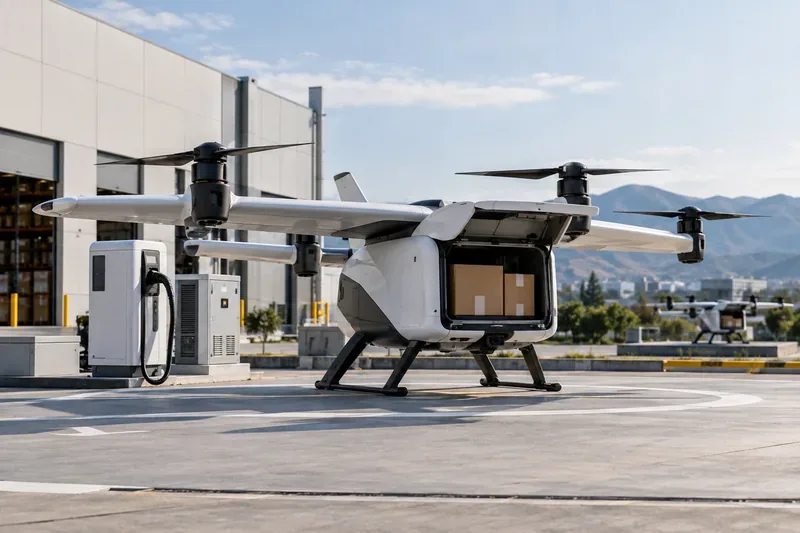
A modern logistics UAV architecture brings the aircraft, parcel interface, electric power system, sensors, and ground charging infrastructure into one operating environment.
Hybrid flight architectures are reducing the old trade-off between hover and cruise
Pure multirotors are mechanically straightforward and excellent at vertical takeoff, landing, and low-speed positioning, but hovering requires continuous lift power. Fixed-wing aircraft can be much more efficient in forward flight, yet they normally need a runway, launcher, recovery system, or another way to handle low-speed operations.
One response is a hybrid vertical-takeoff-and-landing architecture. Wing, for example, describes a dual-propulsion design that uses dedicated lift motors for takeoff, delivery, and landing, while separate cruise motors support efficient forward flight. Its current technical page also describes automated route selection and centralized fleet oversight. Those details are available on Wing’s official technology page. Amazon describes its MK30 as taking off vertically before transitioning to wing-borne horizontal flight; Amazon also emphasizes onboard perception and sense-and-avoid capabilities in its official MK30 overview.
The logistics effect is not simply “longer range.” A hybrid layout can let one vehicle operate from a compact site while spending more of the mission in an aerodynamically efficient cruise condition. The result is most valuable when the route contains enough forward-flight distance to justify the extra motors, controls, structure, and transition logic. For very short missions or heavy hover requirements, a simpler multirotor may still be the better engineering choice.
Autonomy is moving the bottleneck from piloting to fleet supervision
Early commercial drone concepts often looked like remote-controlled aircraft with a parcel attached. Modern systems increasingly automate aircraft selection, route generation, flight execution, delivery-zone checks, and coordination between vehicles. That changes the scaling equation: the key question becomes how many safe, predictable operations the overall system can supervise, rather than how many joysticks it can staff.
Good autonomy is not measured by how little a human touches the controls during an ideal flight. It is measured by how well the system handles ordinary uncertainty. A mature design should make its state visible, recognize when conditions have moved outside its operating limits, enter a defined contingency mode, and give operators enough information to make a safe decision without reconstructing the situation from incomplete telemetry.
That is also why communications architecture matters. A delivery network needs to distinguish between functions that must remain safe onboard when a link is degraded and functions that can depend on a ground service. A vehicle that becomes unsafe when connectivity is imperfect is not truly autonomous in the operational sense.
Payload handling is now part of aircraft design, not an accessory
The parcel mechanism affects center of gravity, drag, takeoff mass, delivery-zone size, turnaround time, and what happens when a recipient’s property is obstructed. A package carried inside the fuselage may be protected from weather and aerodynamic loads, but requires a bay sized around the expected order mix. A tethered delivery can avoid landing the aircraft near people or pets, but adds a winch, cable management, and obstacle-detection problem.
This is why a high-quality logistics architecture starts with the demand profile. Engineers need the distribution of real package masses and dimensions, not only the heaviest theoretical item. Wing has publicly discussed matching aircraft size to the load instead of using one oversized aircraft for every task; its Aircraft Library engineering note explains the reasoning behind multiple vehicle configurations built around common capabilities.
How to judge whether the architecture is actually working
No single benchmark proves a drone logistics system is good. The strongest evaluation combines safety, service quality, utilization, maintainability, and community impact. Exact thresholds should be set for the intended operation; they are not universal across aircraft sizes, climates, routes, or regulatory environments.
Measure
Healthy sign
Reason to investigate or redesign
Successful delivery completion
Most dispatched missions finish without manual intervention outside normal supervision
Repeated returns, diversions, or aborted deliveries for the same technical cause
Energy per successful delivery
Energy use is stable for comparable payloads, weather, and route classes
Large energy penalties from prolonged hover, excessive reserve, poor routing, or oversized aircraft
Payload utilization
The aircraft’s useful carrying capability matches the actual order mix
Most flights carry a small fraction of the vehicle’s practical payload capability
Fleet availability
Aircraft spend a predictable share of time mission-ready
Maintenance, charging, calibration, or software issues routinely remove too many vehicles from service
Turnaround time
Loading, battery recovery, checks, and relaunch fit the required demand cycle
The ground process is slower than the aircraft and creates queues at the hub
Weather dispatchability
The operating envelope covers the weather conditions that matter commercially
The service becomes unavailable during common local wind, temperature, or precipitation conditions
Communications and navigation resilience
Loss or degradation of one service leads to a safe, defined response
Small link disturbances cause unsafe behavior or excessive mission failure
Noise and community impact
Measured operations fit the site’s acceptable operating plan
Noise, route concentration, or operating hours create persistent community or permitting friction
For comparisons between designs, normalize the data. A lighter package on a calm day should not be compared directly with a heavier mission in strong wind. Segment performance by payload class, route length, temperature, wind, precipitation, and delivery method. Otherwise, an apparently better aircraft may simply be flying easier missions.
When the engineering approach should change
Change the propulsion or airframe when hover dominates energy use
If logs show that takeoff, delivery hover, or landing consumes an unexpectedly large share of mission energy, the answer may be better trajectory control, a different delivery mechanism, or a different vehicle architecture. Adding battery capacity is not always the best response because extra battery mass can increase the energy required to carry itself.
Change the payload architecture when the package mix does not fit the aircraft
If small orders routinely fly in a vehicle sized for much larger loads, or if a significant share of orders cannot be accepted because of dimensions rather than mass, the design point is wrong for the commercial workload. A family of vehicles or a different parcel interface may be more efficient than stretching one airframe across every use case.
Change the ground system when aircraft wait more than they fly
Charging, loading, inspection, and dispatch are part of throughput. A fast aircraft can still produce a slow logistics system when the hub has too few charging positions, too much manual handling, or poor integration with warehouse order flow. The correct remedy may be ground automation rather than another generation of aircraft.
Change the autonomy stack when nuisance interventions become routine
Frequent operator takeovers, unnecessary obstacle responses, route rejections, or overly conservative aborts can destroy throughput even when every flight is technically safe. The goal is not to remove conservatism blindly; it is to identify whether sensing, state estimation, planning, or operating rules are creating avoidable interruptions.
Regulatory architecture is part of logistics architecture
In the United States, commercial package delivery is not just a vehicle certification problem. The FAA’s package-delivery guidance says operators conducting small-package delivery for compensation beyond visual line of sight use the Part 135 air-carrier framework together with the required exemptions, waivers, operations specifications, and airspace approvals. The FAA page was updated September 3, 2026 and lists multiple approved UAS package-delivery operators. See the FAA Package Delivery by Drone page.
The regulatory model is also evolving. The FAA’s Drone Integration Concept of Operations describes the agency’s planned framework for more routine BVLOS operations and third-party services such as UAS Traffic Management. Engineers should therefore avoid designing a business case around an assumed future approval path. The safer approach is to separate what the current authorization supports from what a future rule may enable.
Environmental review is another system constraint at scale. The FAA’s current drone environmental-review page includes 2026 reviews for proposed operations involving hundreds to as many as 1,000 delivery flights per day at some sites. Those are proposed operating levels, not proof that every site actually flies that volume, but they show why noise, operating hours, hub placement, and community exposure must be considered before a fleet reaches high utilization.
Where drone logistics still has clear limits
Modern UAV engineering does not make drones the best carrier for every parcel. Payload mass and volume remain constrained. Weather can reduce dispatchability. Batteries impose an energy budget that becomes less forgiving as distance, reserve requirements, and payload increase. Dense urban environments can complicate communications, navigation, landing-zone assessment, and community acceptance. Aviation approval and local infrastructure can also take longer to scale than aircraft production.
That leads to a practical conclusion: drone logistics is strongest as part of a multimodal network. Small, urgent, time-sensitive, or geographically awkward deliveries may justify an aircraft. Heavy, bulky, consolidated, or low-urgency shipments may still be better served by vans, trucks, cargo bikes, or conventional air freight.
The engineering takeaway
The architecture that transforms logistics is not necessarily the aircraft with the highest speed, longest range, or most sophisticated sensor suite. It is the architecture that turns real orders into reliable completed deliveries with a defensible safety case, manageable operating cost, acceptable community impact, and enough operational flexibility to cope with weather, faults, demand peaks, and regulation.
For teams evaluating a UAV program, the most useful next step is to build the scorecard before selecting the aircraft. Define the package distribution, service radius, weather envelope, required completion rate, turnaround target, maintenance assumptions, communications environment, and acceptable noise exposure. Then test whether the proposed airframe, autonomy, payload system, and ground network work together. If one layer repeatedly limits the result, improve that layer instead of optimizing a headline specification that is no longer the bottleneck.