Home
» Technology
»
What Causes Widespread Cloud Platform Downtime? The Failure Patterns Behind Major Outages
What Causes Widespread Cloud Platform Downtime? The Failure Patterns Behind Major Outages
Widespread cloud platform downtime rarely comes from a single server simply “going down.” The most disruptive incidents usually begin with one technical fault—a bad configuration, a software defect, a DNS problem, a network failure, or an infrastructure event—and then spread because many services depend on the same control planes, databases, identity systems, load balancers, or regional resources.
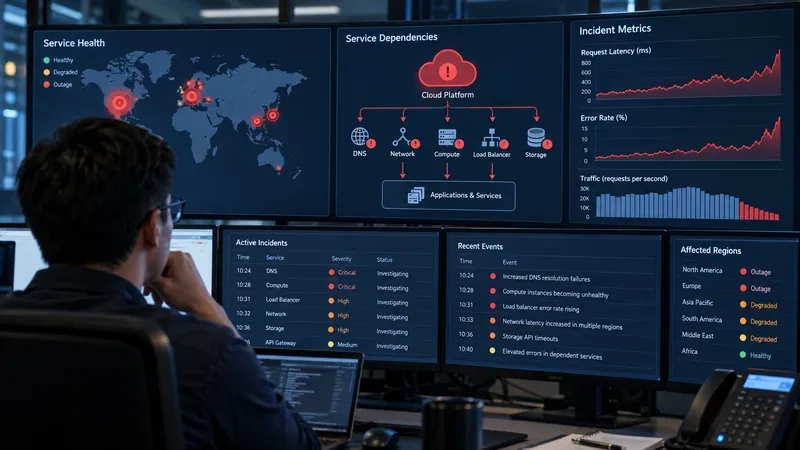
Illustrative scenario: imagine a fictional cloud provider called Northstar Cloud. At 10:05 a.m., an automated networking change is applied to a regional service. Within minutes, customers begin reporting failed API calls. At 10:12, new virtual machines stop launching. At 10:20, load balancers start marking healthy backends as unavailable. By 10:35, dozens of unrelated-looking products are degraded. This scenario is hypothetical, not a description of a real outage. It is useful because it shows why a small initiating fault can become a large platform event.
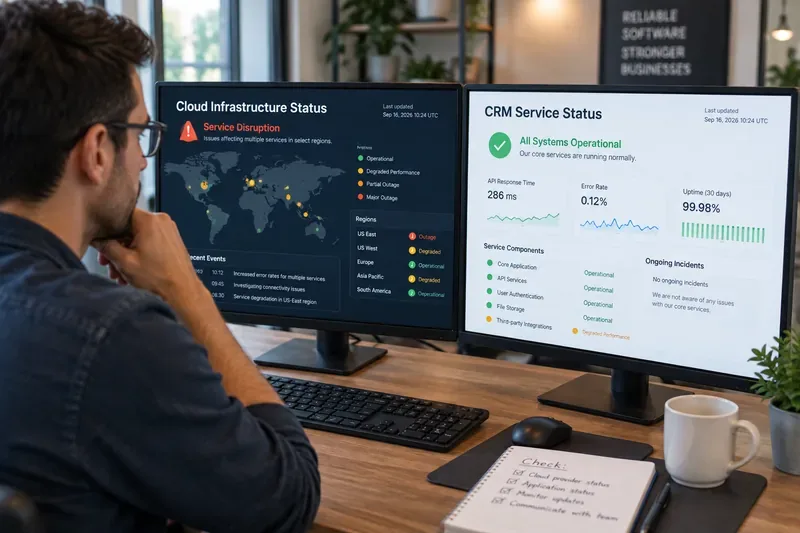
Cloud operations teams often need to trace an outage from the first failing dependency through DNS, networking, compute, load balancing, storage, and downstream applications.
The short answer: major cloud outages are usually cascading failures
The main causes behind widespread cloud platform downtime are configuration and deployment mistakes, latent software defects, DNS and routing failures, shared-service dependencies, capacity exhaustion during failure or recovery, control-plane problems, and physical failures affecting a datacenter or availability zone. The scale of the outage depends less on the first error than on how widely the affected component is shared.
A useful real-world example comes from AWS. In its official post-event summary for the October 2025 disruption in Northern Virginia, AWS said a latent race condition in DynamoDB's automated DNS management system produced an incorrect empty DNS record for the regional endpoint. That DNS failure affected customers and internal AWS services that depended on DynamoDB, and later recovery work contributed to problems involving EC2 launches and Network Load Balancers. The incident is documented in the AWS post-event summary for the October 2025 DynamoDB disruption.
1. Configuration changes can create an unexpectedly large blast radius
Configuration errors are among the most common patterns in large distributed-system incidents because modern platforms are controlled through automation. A single change can be pushed to thousands of hosts, routers, DNS records, or service endpoints faster than a human operator could touch them manually.
Return to the Northstar Cloud scenario. Suppose the 10:05 networking change was intended for ten machines but was applied to several regions. The change does not need to destroy hardware. It may simply remove usable network capacity, alter routing, or cause systems to reject otherwise healthy traffic. Once shared capacity falls below demand, customers see timeouts and retries, which create even more load.
Google described a similar mechanism in its official account of a 2019 disruption: a configuration change intended for a small number of servers in one region was incorrectly applied much more broadly, causing multiple regions to stop using more than half of their available network capacity. Traffic then congested the remaining capacity. See Google's official update on the 2019 service disruption.
This is why mature cloud operators use staged rollouts, validation, automated rollback, change-rate limits, and “blast radius” controls. Those safeguards do not eliminate incidents, but they can prevent one bad change from becoming a platform-wide event.
2. Software defects can stay hidden until rare timing conditions occur
Large cloud platforms run enormous fleets of distributed software. Some defects remain dormant for months or years because they require a rare sequence of events: two controllers updating the same state, an unusual delay, stale metadata, or a recovery process running at the same time as a cleanup process.
In the fictional Northstar incident, imagine that two independent automation workers update the same DNS plan. One is delayed, the other completes a newer update, and a cleanup routine then removes data that the delayed worker has just made active. Each individual component may appear to be functioning as designed, but their interaction creates an invalid state.
The 2025 AWS DynamoDB event illustrates this category clearly. AWS attributed the initiating failure to a latent race condition between redundant DNS-management components. The significance is broader than one vendor: redundancy only improves reliability when redundant components cannot corrupt shared state through the same logic or synchronization failure.
3. DNS and networking failures can make healthy systems unreachable
A service can be fully powered on and still be effectively unavailable if customers cannot resolve its hostname or packets cannot reach it. DNS, routing, load balancing, and network configuration therefore sit on the critical path for almost every cloud product.
In our Northstar example, customers might assume the compute service itself has failed because API calls time out. But the actual compute servers could be healthy while DNS returns no usable endpoint, a route is missing, or a load balancer has removed healthy targets.
AWS has documented this failure mode more than once. In a 2018 Seoul-region incident, AWS said a configuration update incorrectly removed a setting that specified the minimum number of healthy hosts for the EC2 DNS resolver fleet. Reduced resolver capacity then caused DNS queries from EC2 instances to fail. The details are in the AWS summary of the 2018 EC2 DNS resolution issue in Seoul.
Networking failures also amplify quickly because applications retry failed connections. Aggressive retry behavior can turn a partial network impairment into a much larger traffic surge.
4. Shared dependencies make unrelated services fail together
Cloud services are not isolated products. A managed database may depend on identity services, internal DNS, storage, networking, scheduling systems, certificate services, and telemetry. A serverless platform may depend on compute capacity, networking, queueing, and control-plane databases. If one shared dependency fails, many products can degrade at the same time.
This explains one of the most confusing outage symptoms: customers see errors in several services and assume several independent failures occurred. In reality, the visible failures may all have the same upstream cause.
In the Northstar scenario, the virtual machine service, container service, and serverless service could all begin failing because they rely on the same internal resource database. The customer-facing products are different; the dependency underneath them is not.
The October 2025 AWS incident showed this type of cascade when internal services that relied on DynamoDB were affected by the original DNS problem, followed by downstream recovery effects across EC2, Network Load Balancer, Lambda, container services, identity-related functions, and other products.
5. Recovery can fail because the backlog is bigger than normal operating load
Restoring the original faulty component does not always end an outage. During downtime, queues grow, leases expire, health checks fail, autoscalers request replacement capacity, clients retry requests, and configuration updates accumulate. When the failed dependency returns, every waiting system may attempt to recover at once.
In the Northstar example, suppose DNS is repaired at 10:45. Thousands of compute hosts now try to renew expired leases. At the same time, customers retry failed deployments and autoscaling systems request replacement instances. The control plane is suddenly processing several times its normal workload. If it has no effective rate limits or recovery prioritization, it can enter a second failure mode even though the original bug is gone.
AWS described a comparable recovery problem in 2025: after DynamoDB access was restored, an EC2 subsystem had to re-establish large numbers of leases. The backlog became difficult to process before timeouts, and AWS said the subsystem entered a state of “congestive collapse.” That detail matters because it shows why outage duration can be much longer than the time required to fix the initial trigger.
6. Health checks and automated failover can sometimes remove good capacity
Health checks are essential, but they are also automated decision makers. If a network is slow or state propagation is delayed, a health-check system may conclude that healthy resources are bad and remove them from service. This can reduce capacity further, producing a feedback loop.
In the fictional scenario, Northstar's load balancers begin checking newly launched instances before network configuration has fully propagated. The checks fail, healthy instances are withdrawn, traffic shifts to fewer remaining nodes, and those nodes become overloaded.
That pattern also appeared during the 2025 AWS event. AWS said Network Load Balancer health checks sometimes failed while network state for new instances was still propagating, which led to capacity being removed from service. This is a reminder that failover logic must be rate-limited and tested under partial failure, not only under clean “healthy/unhealthy” conditions.
7. Datacenter, power, cooling, and availability-zone failures remain possible
Not every outage begins in software. Power, cooling, fiber, network hardware, and other physical infrastructure can fail. Cloud architecture is designed around this reality, which is why major providers divide regions into fault-isolated zones.
Microsoft explains that Azure Availability Zones are separated groups of datacenters with independent power, cooling, and networking. Microsoft also notes that a zonal deployment does not automatically survive a zone outage; customers must use multiple zones or zone-redundant services where supported. See Microsoft's official Azure Availability Zones overview.
In practical terms, a cloud provider can make a zone independent, but a customer workload may still have a single-zone database, a single regional control dependency, or a failover process that has never been exercised.
Why a cloud outage can look global even when the root cause is regional
“Global outage” is often a description of customer impact, not the physical location of the failed equipment. A regional service may support authentication, DNS, metadata, build pipelines, dashboards, or control APIs used from other regions. Applications around the world can therefore fail because they depend on a service concentrated in one location.
The distinction matters when diagnosing an incident. Engineers should ask two different questions: Where did the first failure occur? and Which dependencies allowed that failure to spread? Those answers are frequently different.
How to identify the likely cause during a live incident
For operators, the fastest path is usually to correlate symptoms rather than investigate each product separately. If many services fail at the same minute, look for a shared dependency. If existing workloads stay healthy while new deployments fail, suspect a control-plane, scheduling, capacity, or provisioning problem. If IP connectivity works but service names fail, investigate DNS. If error rates rise after a recovery announcement, look for retry storms, backlogs, expired leases, health-check feedback loops, or insufficient recovery capacity.
Provider status systems can also help distinguish a platform incident from an application-specific fault. Google Cloud, for example, publishes current and historical incidents through its official Service Health dashboard, while AWS publishes major event summaries through its official Post-Event Summaries.
What customers can do to reduce the impact
No architecture can guarantee zero downtime, but several design choices reduce exposure. Use multiple availability zones for production workloads when the service supports them. For workloads that cannot tolerate a regional outage, evaluate multi-region designs and understand the data-consistency tradeoffs. Remove hidden single points of failure such as one regional identity service, one DNS path, or one administrative API that every recovery action depends on.
Applications should also fail gracefully. That can mean serving cached content, queueing noncritical writes, limiting retries with exponential backoff and jitter, separating control-plane operations from data-plane traffic, and preserving a reduced “read-only” or “core transaction” mode during partial outages. Recovery procedures should be tested under backlog conditions, because restarting a dependency in an empty test environment is very different from restoring one while millions of requests are waiting.
The key lesson from widespread cloud downtime
Return to the Northstar Cloud scenario. The 10:05 configuration change may be the trigger, but it is not the whole explanation. The outage becomes widespread because networking is shared, automation contains a timing defect, downstream services depend on the same state, health checks remove capacity, retries increase load, and recovery systems must process a huge backlog.
That is the central pattern behind many major cloud incidents: the initiating failure is often small compared with the dependency chain that amplifies it. Understanding cloud downtime therefore means examining both root cause and propagation. The most resilient designs assume that individual components will fail and focus on preventing those failures from becoming system-wide events.