UniKey is a software that supports Vietnamese typing extremely effective and compact, simple installation, does not take up computer resources like other Vietnamese typing software . In particular, compared to similar software such as Vietkey , GoTiengViet or FVIK , Unikey is superior to powerful features such as converting the encoding, checking spelling, abbreviation ...
It sounds like a lot of people really want to try installing and testing this Vietnamese Unikey keyboard, but if you are a little nervous because your ability to use your computer is not really good, you can Refer to the article below and follow.
Steps to download and install Unikey to type Vietnamese
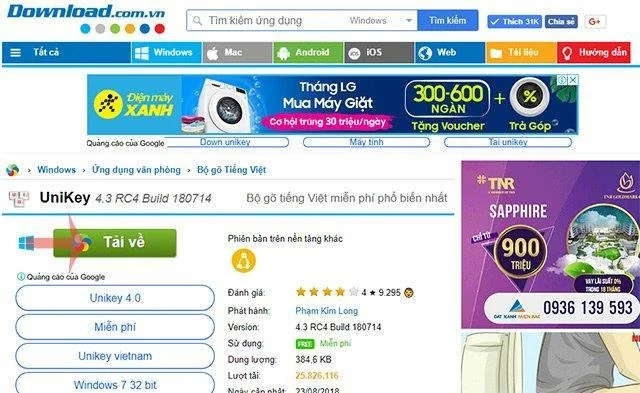
Step 1: Download the latest Unikey 4.3 RC4 to your computer.
Unikey
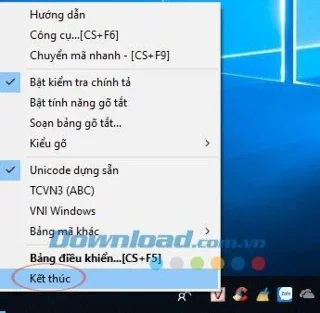
Before installing, you need to check whether your computer is installing the old version of Unikey or not? If so, right-click the Unikey icon in the Taskbar and select Finish .
Step 2: Click the Download button to download Unikey to the computer.

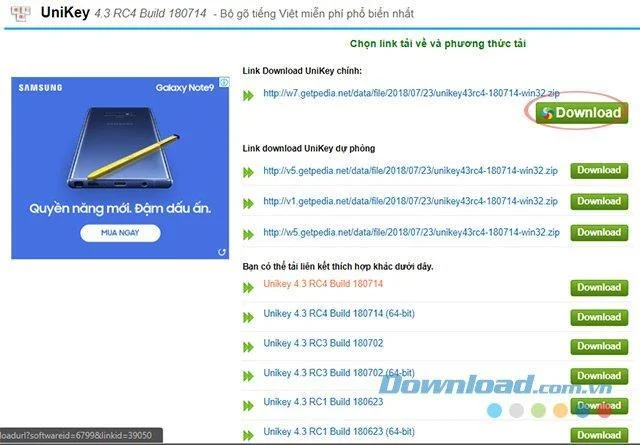
Step 3: At this time, just click the green Download button next to the appropriate version to start downloading to your computer.

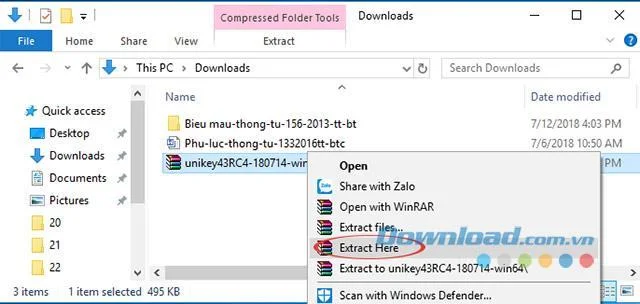
Step 4: After downloading successfully, you have to extract the file. How to do, find the downloaded file, left-click on that line to identify, then right-click and select Extract Here ...

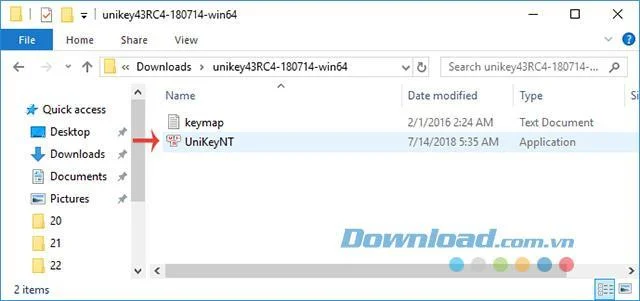
Step 5: After extracting successfully, we have two new files. Double click the left mouse button on the UniKeyNT file to start running the program.

It is done! Although you do not know much about how to use a computer, but this article has detailed instructions on how to download and install Vietnamese Unikey typing tool.

Video tutorial of downloading and installing Unikey to type Vietnamese
How to use Vietnamese keyboard Unikey
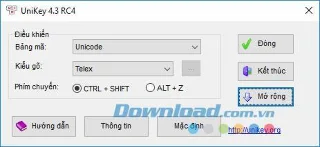
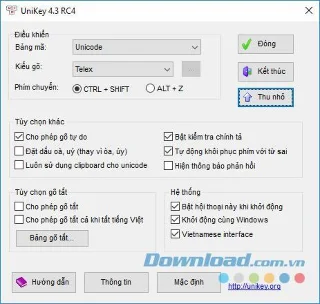
To be able to use Vietnamese Unikey percussion, you just need to launch this software , after seeing a pink V-shaped icon in the taskbar. You can switch from Vietnamese (pink V) to English (blue E) mode easily by clicking the icon in the system tray, so that the Unikey interface appears, Click Expand , then select and use the key combination, the default is CTRL + SHIFT or ALT + Z.

Unikey is the most widely used international standard charset, this tool also supports quite a lot of typing methods with different charsets. The most popular is still Unicode with Telex typing. Here is how you can type Vietnamese signs and letters.
- aa = â
- oo = cell
- ee = ê
- dd = dd
- ow = o
- w or uw = u
- s accent
- f = grave accent
- r = question mark
- x = tilde
- j = heavy accents
- z = delete previously typed accents (tairz = ears; delete question marks)
In addition, you can refer to the Vietnamese way of accented Vietnamese typing:
- A8: ă
- a6: â
- d9: đ
- e6: hey
- o6: umbrella
- o7: eh
- u7: u
- 1: acute
- 2: grave accent
- 3: question mark
- 4: tilde
- 5: heavy accents
- 0: delete the sign
Also in the Extension of Unikey, you can add other features such as: Turn on the spell check mode, allow typing, turn on this dialog when starting, start with Windows ...
UniKey Vietnamese Keyboard
UniKey is the most popular Vietnamese keyboard for Windows. The core UniKey Vietnamese Input Method is also the engine for many Vietnamese keyboards in Linux, macOS and iOS. UniKey is free of charge. Source code for the UniKey Vietnamese Input Method is distributed under the GNU General Public License.
Please note: unikey.org is the only official website of UniKey. The author is not responsible for any other websites providing UniKey software.
News
- October 15, 2020:
- Released UniKey 4.3 RC5, with better support for the new Edge browser.
- July 14, 2018:
- Released UniKey 4.3 RC4, which allows typing Vietnamese in some special kinds of apps (console, game, UWP). Bug fix for Opera browser.
- July 2, 2018:
- Released UniKey 4.3 RC3 with bug fixes for Excel and browsers (Chrome, Edge, Firefox, Internet Explorer).
- Note: This version also fixed a serious bug in 4.3 RC2 released on July 1, 2018.
- June 23, 2018:
- Released UniKey 4.3 RC1
- From version 4.3, all UniKey releases will be digitally signed. See UniKey’s signature.
Overview
UniKey supports:
- Many Vietnamese character sets/encodings:
- TCVN3 (ABC), VN Unicode, VIQR
- VNI, VPS, VISCII, BK HCM1, BK HCM2, etc.
- Unicode UTF-8, Unicode NCR Decimal/Hexadecimal for Web editors.
- All 3 popular input methods: TELEX, VNI and VIQR.
- All Win32 platforms: Windows 10, 8, 7, Vista, 2000, XP, 9x/ME.
UniKey is very small, does not need any additional library. No installation is required.
The installation of Unikey does not require users to be connected to the Internet, so it is quite convenient. And with the instructions above, hope you know how to download and install and use the most popular Vietnamese typing tool today!