Home
» How to
»
Force the browser to use Internet Download Manager to download data
Force the browser to use Internet Download Manager to download data
Video Force the browser to use Internet Download Manager to download data
Internet Download Manager (IDM) is the most popular download acceleration software today. Thanks to this tool, downloading data and files from the Internet to the user's computer becomes simpler, easier and faster. And a pretty cool feature on this download support tool that I personally love, is the ability to set to allow (forcing) browsers to use IDM to download data or not?
Although being highly appreciated and one of the indispensable software when installing a computer, but computer users do not always trust and want to use Internet Download Manager to download their data.
How to allow, do not allow the browser to download files with IDM
If your computer is having Internet Download Manager installed , you will find it will automatically default and be compatible with all browsers to support downloading. However, we can only set it so that we can use or cannot use IDM in the browser, but we can not tell it which link to receive or refuse to download.
In the Internet Download Manager settings section, there is an item that allows users to choose a flexible way of downloading data (possibly using IDM, possibly by browser) without disabling IDM on the program. Browser.
Step 1: From the main interface of Internet Download Manager software, left-click the Downloads tab and select the Options below.
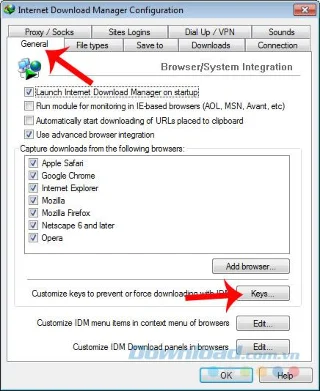
Step 2: The Internet Download Manager Configuration window appears, select the General / Keys tab .
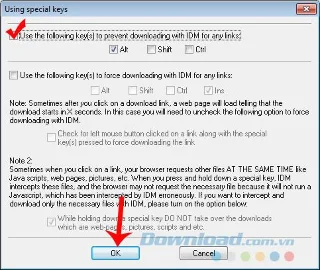
Step 3: There are two options here:
Use the following key (s) to prevent downloading with IDM for any links - Use the following keys to prevent IDM software from downloading any data on the browser: Use in case you do not want to download data using Internet Download Manager.
Use the following key (s) to force downloading with IDM for any links - Use these keys to force the browser to download data using IDM software.
After making your selection, click on OK to confirm the settings.
Set hotkeys to download or not download data with IDM
Browsers such as Opera and Mozilla Firefox (some older versions) can be integrated with IDM through extensions, and they do not support blocking or allowing Internet Download Manager to download. on the browser.
If you want to download data by IDM and the browser "hijacks" the download, you just let the browser do it. After 2 - 3 seconds of downloading, right-click on the file and press Cancel . Then copy the download link again to use it for IDM.