How to Use Google Lens on Chromebook

How to Use Google Lens on Chromebook lets you scan objects, translate text, and solve problems directly from your device. Follow these steps to get started quickly.
You take your retainer out in the morning, give it a quick rinse, and put it back in its case. A few days later it looks cloudy, feels slightly slick, or smells less fresh than it used to. That is a common sign that rinsing alone is not keeping up with the film that forms on an appliance worn in the mouth.
The practical answer is simple: clean a removable retainer thoroughly at least once a day, rinse it whenever you remove it, and use a deeper manufacturer-approved clean about once a week. If you wear the retainer most of the day, cleaning it more than once daily may be reasonable, especially after meals. If you have a fixed or bonded retainer, clean around the wire every day as part of normal brushing and interdental cleaning.
The American Association of Orthodontists (AAO) says retainers need daily attention and advises rinsing them whenever they come out of the mouth. Its current guidance also recommends a retainer-cleaning solution roughly once a week. See the AAO retainer-cleaning guide and its retainer care overview.
| Cleaning task | Useful frequency | Why it matters |
|---|---|---|
| Quick rinse | Every time you remove a removable retainer | Flushes away saliva and loose debris before they dry on the surface |
| Thorough brushing/cleaning | At least once daily | Removes the film that a rinse alone can leave behind |
| Deeper soak with an approved retainer cleaner | About once weekly, or as your product instructions say | Helps with deposits and biofilm that persist despite routine cleaning |
| Fixed retainer hygiene | Every day | Controls plaque around the wire, adhesive, and tooth surfaces |
This schedule is a starting point, not a rigid rule for every appliance. Clear vacuum-formed retainers, Hawley retainers, Vivera retainers, and fixed wires use different materials and designs. Your orthodontist’s instructions and the manufacturer’s cleaning directions should override generic advice when they differ.
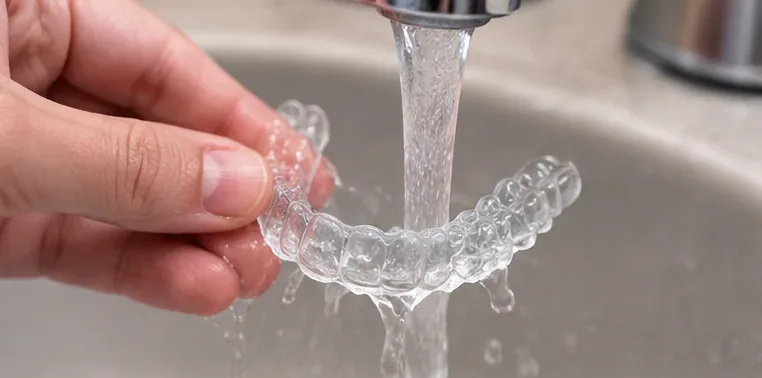
A retainer can look almost clean while still carrying an invisible film. Oral appliances sit in contact with saliva, teeth, and soft tissues for hours at a time, so plaque-forming microorganisms and mineral deposits have plenty of opportunity to collect on their surfaces.
Laboratory and clinical research supports the basic idea that clear retainer materials can support biofilm formation. A prospective crossover study of vacuum-formed retainers also found that cleaning methods combining brushing with either peroxide-based cleanser tablets or vinegar reduced counts of certain bacteria more than brushing alone. That study does not prove that every home soak is safe for every retainer material, but it does show why a purely cosmetic “it looks fine” check can miss hygiene issues. The original study is indexed at PubMed.
What to do: build one thorough cleaning into the same time of day every day, such as after your morning toothbrushing. Consistency is more useful than waiting for visible buildup.
If you only change one habit, make it this one. Rinse a removable retainer promptly under cool or lukewarm running water when you take it out. Doing so before saliva dries makes the later clean easier.
A rinse is not a substitute for brushing. Think of it as the low-effort step that keeps residue from sitting undisturbed until the next cleaning session.
What to do: rinse immediately after removal, shake off excess water, and keep the appliance in its case rather than on a countertop or wrapped in a tissue.
For many removable retainers, a soft toothbrush plus water and a mild soap is a conservative default. The AAO specifically advises a dedicated toothbrush and mild dish soap in its cleaning guidance, and it warns against hot water.
Toothpaste deserves a little nuance. Some orthodontic sources discourage it because abrasive formulas can scratch or cloud plastic. Invisalign, however, says Vivera retainers can be cleaned with a regular or denture toothbrush and non-abrasive toothpaste. In other words, “never use toothpaste” is too broad, but so is “any toothpaste is fine.” For Vivera-specific instructions, see Invisalign’s retainer care guidance.
What to do: unless your manufacturer specifically approves a toothpaste, use a soft brush with water and mild soap. Brush every surface gently, including grooves where saliva and plaque collect, then rinse thoroughly.
If daily brushing keeps the retainer fresh and smooth, a weekly deeper clean is usually enough. The AAO recommends soaking in a retainer-cleaning solution once per week for about 10 to 20 minutes, following the product directions.
More is not automatically better. Leaving a retainer soaking for hours when the product calls for minutes can expose the material to chemicals longer than intended. Homemade recipes are also not universally interchangeable across acrylic, thermoplastic, and branded retainer materials.
What to do: use a cleaner labeled for your retainer type and follow its contact time. If you want to use vinegar, peroxide, denture tablets, or another solution, check your orthodontist’s or manufacturer’s instructions first.
Daily cleaning is the baseline, but your schedule may need to be more frequent if any of the following apply:
If you wear a removable retainer for most of the day, the AAO’s “clean whenever it comes out” advice effectively means you may clean it more than once. A practical compromise is to rinse it at every removal and perform a gentle brush clean after meals when residue is present, while still keeping one consistent full clean each day.
What to do: increase cleaning frequency in response to actual buildup, not by using stronger chemicals.
A bonded retainer is different because you do not remove it. The cleaning target is the plaque trapped around the wire, bonding material, and the spaces between teeth. The AAO recommends brushing and flossing around fixed retainers every day.
Research on bonded wires has shown that retainer design can influence biofilm accumulation, which is one reason meticulous daily cleaning around the wire matters. A study of stainless-steel bonded retainers documented biofilm formation on retainer wires and compared different hygiene regimens; the original paper is available through PubMed.
What to do: brush normally, then use the flossing method or interdental tool recommended by your dental professional to clean beneath and around the wire. If the wire feels loose or catches floss in a new way, have it checked instead of trying to bend it yourself.
Heat can distort many plastic retainers. Even a small change in shape can affect how the appliance fits your teeth.
What to do: use cool or lukewarm water unless your appliance instructions say otherwise.
The AAO advises against products containing bleach or alcohol because they can damage retainer materials and are not intended to be swallowed.
What to do: use a retainer-safe product rather than improvising with household disinfectants.
Abrasive pastes can roughen or cloud some clear retainers, while some manufacturers permit specifically non-abrasive toothpaste. That is a material-specific difference rather than a contradiction that can be solved with one universal rule.
What to do: default to mild soap unless the instructions for your exact retainer approve a toothpaste.
Sometimes the problem is not dirt. A retainer may need professional attention or replacement if it is cracked, warped, rough at the edges, no longer seats fully, or suddenly feels much tighter than usual. Persistent hardened deposits that do not respond to manufacturer-approved cleaning are another reason to ask your orthodontist or dentist for advice.
Do not try to reshape a plastic retainer with heat or scrape mineral deposits with a knife, pin, or other sharp tool. Those fixes can damage the appliance or change its fit.
You do not need laboratory equipment to make a useful everyday check. After cleaning, your removable retainer should meet most of these simple signs:
If odor or film returns within hours despite daily cleaning, review what you are doing after meals and how you store the retainer. If hardened buildup persists, move to a manufacturer-approved weekly cleaner or ask your orthodontist whether professional cleaning or replacement is appropriate.
For most removable retainers, a sustainable routine is more valuable than an elaborate one: rinse every time the retainer comes out, clean it thoroughly once a day, and use an approved deeper clean about once a week. Increase the frequency if visible film or odor develops faster, but do not compensate by using hotter water or harsher chemicals.
Finish by checking the appliance itself. A clean retainer should also remain intact, smooth, and properly fitting. If it is clean but no longer fits correctly, that is not a cleaning problem—it is a reason to contact your orthodontist.
How to Use Google Lens on Chromebook lets you scan objects, translate text, and solve problems directly from your device. Follow these steps to get started quickly.
Learn how to clean a lululemon yoga mat using current care guidance: wipe gently, avoid soaking and bleach, dry fully, and store out of sunlight.
Learn how to remove hot glue from fabric using cooling, gentle scraping, and cautious alcohol treatment, with fabric-safety checks for delicate materials.
Learn how to clean a freezer ice maker safely, remove stale ice and residue, wash and dry the bin, and know when deeper cleaning or service is needed.
Learn how to season gas grill grates safely, when seasoning is actually needed, and how cast iron, stainless, and porcelain grates differ.
Learn how to clean fabric blinds safely: identify the material, remove dust, spot-clean stains, avoid damage, air-dry correctly, and know when to call a pro.
Learn how to clean an Ooni pizza stone safely with dry brushing, high-heat burn-off, and flipping—plus what to avoid and how to know it is clean enough.
Learn how to clean a mechanical keyboard safely, from removing keycaps and dust to washing compatible caps, drying, reassembly, and testing.
Learn how to remove hardened wax from clothes safely: harden, scrape, transfer with low heat, pretreat residue, wash by the care label, and air-dry.
Clean a removable retainer at least daily, rinse it whenever you remove it, and use a deeper manufacturer-approved clean about weekly. Learn what changes the schedule.