Home
» Wiki
»
How to check spelling and grammar errors in Microsoft Word
How to check spelling and grammar errors in Microsoft Word
Video How to check spelling and grammar errors in Microsoft Word
Microsoft Word integrates a spell checking, grammar checker, and actively supports many types of dictionaries. Do you know how to use this feature effectively? Join us to learn how to check spelling and grammar errors in Microsoft Word offline.
In modern society, thousands of digital format content are produced every day. Spelling and grammar mistakes when typing are hard to avoid. Compared to using a pen, this error detection is not easy. Therefore, Microsoft Word - the leading text editor software, has built-in spell checking and grammar extremely useful.
Basically, just opening Microsoft Word, these two features will automatically be activated, however, there are still many ways to customize them. For example, you can use AutoCorrect to speed up typing. In addition, Microsoft Word has a dictionary list that contains many other smart options and features.
How to check spelling and grammar errors in Microsoft Word
Check spelling by line
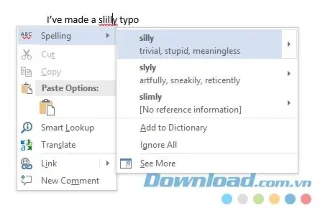
By default, Word checks spelling by line. Missing words will display the red line below. To fix this, right-click on the word and select the word you want to type in the pop-up menu.
Of course, not every word Word knows, especially the names. To have Word ignore the correct "spelling mistake", click Ignore All . If you plan to use the word multiple times, click Add to Dictionary to have Word memorize the word.
Check the grammar by line
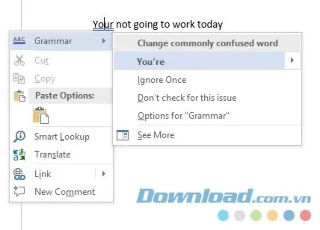
Grammar checking is the same as above but grammatical errors will be marked with a blue line. To manage grammar checking settings, go to File> Options> Proofing .
Manually check spelling and grammar
To check the entire document, click the Review tab , and then click the Manual Spell and Grammar Checking button . In a simpler way, press F7 key and you're done.
Word carefully examines each error and allows you to correct it. This solution is faster than finding each error on the screen itself. Use this method when dealing with long documents.
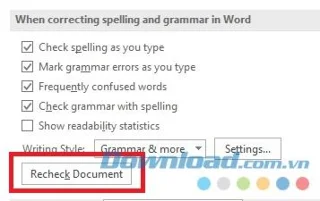
To skip words in the current document, go to File> Options> Proofing> Recheck Document .
Change language
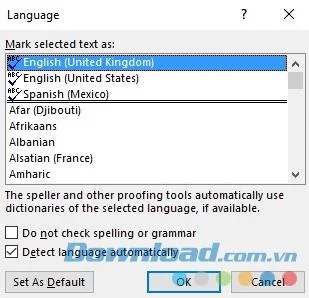
If you want to check the spelling and grammar of many different languages, click the Review tab , select the Language button , click Set Proofing Language .
The languages you have installed will show a small icon to the left of their name so you can convert them immediately. In addition, you can also set the default language for all documents here.
Turn off the spell check feature
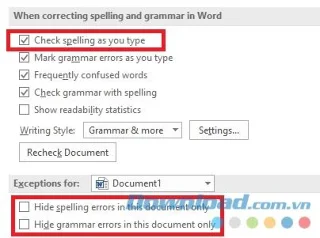
If you want to turn off the spelling checker completely when handling documents from a lot of words Microsoft Word doesn't understand, click File> Options> Proofing . Scroll down to When correcting spelling and grammar , uncheck the Check spelling as you type box . This action will block red and blue lines from appearing as you type. Instead, Word will only check spelling when you click the Spelling & Grammar button .
Alternatively, you can turn off all spelling or grammar checking for working documents by going back to File> Options> Proofing , scrolling down to that window, and checking the box next to Hide spelling errors in. this document only and Hide grammar errors in this document only .
Finally, you can control the spelling on each paragraph. Select some text, click the Set Proofing Language button in Review> Language . Use the options in the box to turn off grammar checking for selected text.
AutoCorrect
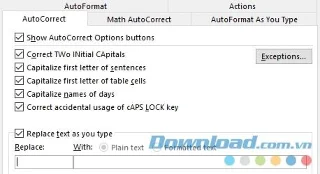
The AutoCorrect feature can automatically replace the letters you type with the correct word. It is enabled by default, replacing common spelling errors like "realyl" with "really." You can turn off AutoCorrect or manage the list of automatically corrected words and add the words you want.
This feature also contributes to increased typing speed. For example, if you frequently type a sentence like "Hello, my name is Bob Smith," you can create a rule for AutoCorrect that extends the abbreviation "hmbs" to "Hello, my name is Bob Smith" when typing it. .
To manage AutoCorrect, click File> Options> Proofing> AutoCorrect Options .
Check spelling, grammar in PowerPoint, Excel and other office applications
PowerPoint also checks spelling by lines and it works similarly to Microsoft Word. However, Microsoft Excel handles a different data type, so the software does not automatically notify users of arising errors.
In Excel, you must enable the spelling check feature by navigating to Review> Spelling on the Ribbon .
Become a professional dictionary user
If you become a professional dictionary user, you can take the spell checking tool to the next level. You don't even need to rely on Cortana anymore. Here are some of the most interesting dictionary features in Microsoft Word:
Delete words from the dictionary
Occasionally, you should take time to clean up the dictionary. Maybe, you accidentally added a few words or lots of words related to a project that are no longer needed.
To remove the word from the custom dictionary, go to File> Options> Proofing , click Custom Dictionaries under When correcting spelling in Microsoft Office programs .
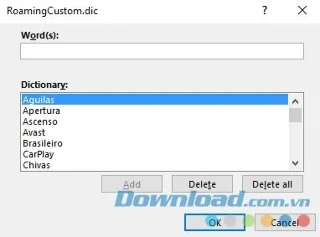
Select the dictionary you want to delete from, click Edit . Next, select Edit word , highlight the word you want to delete, click Delete . To delete the entire dictionary, click Delete all .
Two custom dictionaries
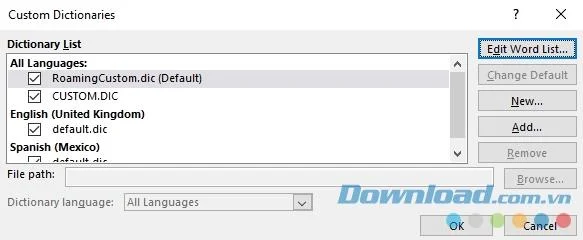
When you navigate to File> Options> Proofing> Custom Dictionaries , you will see two custom dictionaries: CUSTOM.dic and RoamingCustom.dic .
Then, save the word to the cloud if you want to access your dictionary when signing in to other computers. The word in CUSTOM.dic appears only on the dictionary installer.
Add new dictionary
Overall, there are two reasons why people want to add new custom dictionaries. Firstly, you may want to write in another language. Second, you need to add a long list of industry terms (such as medical terminology).
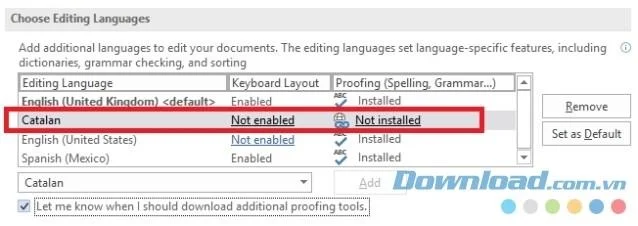
If you just want to add dictionaries for other languages, go to File> Options> Language . In the Add additional editing languages drop-down menu, choose the method you want to use. When that language appears in the box above, click Not installed to download the combined file.
To add a third-party dictionary, go to File> Options> Proofing> Custom Dictionaries , click Add. In the new window, select from the DIC file you want to add. To delete the dictionary, highlight its name and click Remove .
Skip custom dictionary
If you have installed many custom dictionaries, there may be times when you want to skip checking spelling for them.
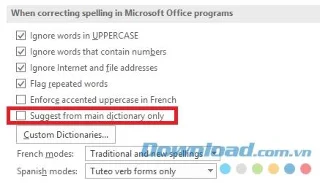
It's easy to use Word to ignore these dictionaries and only correct words. Go to File> Options> Proofing , check the box next to Suggest from main dictionary only .
Exclude words in dictionary
The biggest downside to the spelling checker is that it cannot detect typos if the new word is still in the dictionary. For example, how many times have you accidentally typed "latter" instead of "later" or "suing" instead of "using"? Word doesn't let you pay attention to the error because "latter" and "suing" both mean.
If you make that mistake all the time, you can exclude incorrect words from the dictionary. It forces Word to always mark them as wrong words.
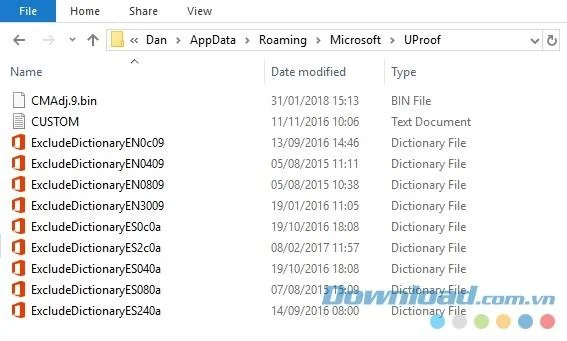
To exclude a word, go to C: \ Users \ [username] \ AppData \ Roaming \ Microsoft \ UProof . This directory contains exclusion lists for each dictionary you have installed.
Find the file related to the dictionary you want to exclude words, right-click the file and go to Open With> Notepad.
In the notepad file, type the word you want to exclude. Put each word on each new line and make sure to include semicolons or any other punctuation. When done, go to File> Save to save the changes.
This article has introduced the most important spell checking features of Microsoft Word and some useful dictionary tips. If you know more about checking spelling and grammar in Microsoft Word, please share with us.