How to Clean a Burnt Iron Without Damaging the Soleplate
Learn how to clean a burnt iron safely, what to avoid, when household remedies can damage coatings, and how to handle stubborn soleplate residue.
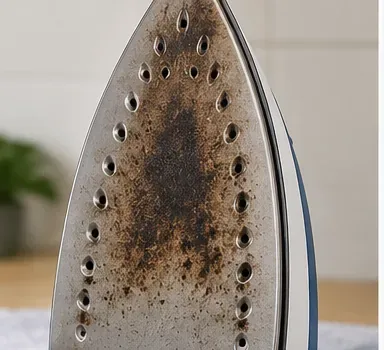
A burnt-looking iron usually has scorched fabric, starch, adhesive, or other residue baked onto the soleplate. The safest way to remove it is not to reach immediately for vinegar, baking soda, salt, toothpaste, or a scouring pad. Soleplates use different metals and coatings, and current manufacturer instructions do not support one universal household remedy.
The most reliable approach is simple: unplug the iron, let it reach the temperature specified by its manufacturer, start with the least abrasive cleaning method, and escalate only to a cleaner that the manual explicitly allows. Philips, for example, tells owners of applicable Steam/Dry Iron models to use a damp cloth on a cooled, unplugged soleplate and specifically says not to use vinegar, scouring pads, or other chemicals. Tefal gives different instructions for Durillium, stainless-steel, and self-cleaning soleplates, which is exactly why identifying your model matters.
If the dark mark is on the metal soleplate and appeared after ironing synthetic fabric, starch, a transfer, or another material, this guide applies. If the iron itself is smoking, sparking, giving off a burning electrical odor, or has a damaged cord or plug, stop using it rather than trying to clean it. The U.S. Consumer Product Safety Commission advises unplugging a handheld appliance that smokes or sparks and having it repaired or replaced.
Action: Unplug the iron. If the problem is residue on the soleplate, continue below. If you see electrical damage, do not power it up for a cleaning test.
| Claim | What is verified | What to do |
|---|---|---|
| “Vinegar is safe for every burnt iron.” | Not verified as a universal method. Philips explicitly says not to use vinegar on the soleplate for the models covered by its support guidance. | Skip vinegar unless your own manual specifically permits it. |
| “You should scrub off the burn.” | Manufacturers consistently warn against damaging the soleplate surface. Philips says no scouring pad; Tefal calls for a damp cloth, nonmetallic pad, or nonabrasive sponge depending on soleplate type. | Use the softest allowed material first and never scrape with metal. |
| “The iron should be hot while you clean it.” | It depends on the model. Philips instructs users of the cited model to cool the iron first, while Tefal recommends a warm soleplate for some Durillium or self-cleaning surfaces and a cool soleplate for stainless steel. | Follow the temperature instruction for your model; do not assume “hotter cleans better.” |
| “Self-cleaning removes burnt-on fabric.” | Self-clean or Calc-Clean functions are primarily designed to flush scale and impurities from steam systems. They are not a substitute for the specified soleplate-cleaning method. | Use Calc-Clean only according to the manual, and treat surface residue separately. |
| “Baking soda is always a safe fallback.” | There is no manufacturer-wide rule confirming it is safe for every soleplate coating. | When the soleplate type is unknown, do not treat baking soda as universally safe; use the manufacturer-approved method instead. |
Find the model number and check the care section of the manual or official support page. The important detail is the soleplate type: stainless steel, ceramic, coated metal, Durillium, self-cleaning coatings, and other proprietary finishes may have different restrictions.
If you cannot find the manual, the conservative starting point is to unplug the iron and let it cool completely. This matches current Philips guidance for its Steam/Dry Iron support article. Do not immerse the iron or hold the appliance under running water.
Action: Confirm the model and cleaning instructions before putting any cleaner on the plate. Official references include Philips' soleplate-cleaning guidance and Tefal's soleplate-specific cleaning guidance.
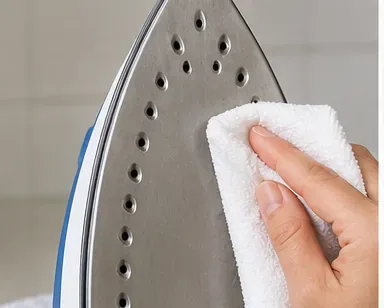
For the least aggressive first pass, dampen a soft cloth with water and wring it out well. Wipe the soleplate in small sections. The goal is to soften and lift residue without scratching the finish or forcing water into the appliance.
Do not use steel wool, a metal scraper, a knife, or another hard object. Philips specifically warns against hard contact with metal objects and against scouring pads. If your iron has a stainless-steel soleplate, Tefal says a damp cloth or nonabrasive sponge can be used when the plate is cool. For some Durillium soleplates, Tefal allows a damp nonmetallic washing-up pad and recommends a purpose-made soleplate stick if dirt remains. For its self-cleaning soleplates, however, Tefal warns that iron cleaner can damage the coating.
Action: Wipe gently first. Stop if you see the finish changing, flaking, or becoming rough.
Stubborn burnt-on material is where generic internet recipes become risky. A method that is acceptable for one bare metal plate can be wrong for a coated or self-cleaning surface. If your manual names a manufacturer-approved soleplate cleaner, cleaning stick, or nonabrasive pad, use that product exactly as directed. If it says not to use chemicals, do not substitute a homemade acid or abrasive paste.
Steam holes also deserve care, but do not poke metal tools into them. If brown flakes or mineral debris are coming from the vents, that points to a scale problem rather than merely a scorched surface. Philips describes Calc-Clean as a process for flushing scale and impurities, and Panasonic likewise provides model-specific self-cleaning steps that send steam, hot water, and mineral debris through the soleplate. Those procedures can involve hot water and steam, so they should not be improvised.
Action: If the burn will not release with the approved surface-cleaning method, stop and check the manual for a named soleplate product or contact the manufacturer. If the problem is scale coming from the vents, use the model's descaling or self-clean procedure instead. See Philips' Calc-Clean instructions and Panasonic's NI-U450/NI-U800 operating manual for examples of model-specific procedures.
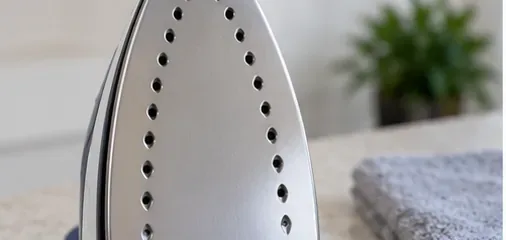
Once the residue is gone, wipe away any remaining approved cleaner with the method specified by the manufacturer. Let the soleplate dry. Check that there is no grit around the steam holes and that the surface is smooth enough to glide without snagging.
If the manual permits powering the iron after cleaning, test it on an old, clean piece of white cotton before returning to shirts or delicate fabrics. This gives you a chance to spot brown water, loosened residue, or transfer from the soleplate. Philips uses a similar old-cloth pass after its Calc-Clean process to remove water stains left on the soleplate.
Action: Stop the test if the cloth picks up dark residue, the iron spits brown water, or the soleplate drags. Repeat only the manufacturer-approved cleaning or descaling process rather than switching to a harsher DIY cleaner.
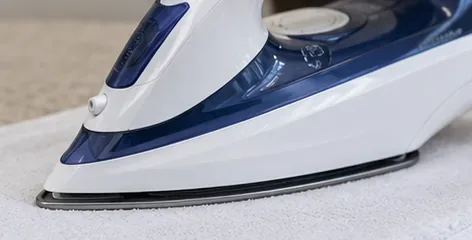
This is a case where advice varies substantially by manufacturer and coating. Do not assume that acetone, solvent, vinegar, salt, or an abrasive paste is safe. Philips' current support guidance for the cited model says to let the appliance cool and wipe flakes and deposits with a damp cloth while avoiding vinegar, chemicals, and scouring pads. Tefal's guidance varies by soleplate and, for some Durillium models, points users to its specific cleaning stick.
Action: Treat the identity of the soleplate as the deciding factor. If the manual does not provide a method for stubborn melted fabric, contact the manufacturer's support team rather than experimenting with solvents.
A stain is one thing; physical damage is another. If the soleplate coating is peeling, deeply scratched, warped, or pitted, cleaning cannot restore the original surface. Likewise, an iron with a damaged cord, plug, smoke, or electrical burning odor should be taken out of service. The U.S. Consumer Product Safety Commission's home wiring safety guide advises unplugging handheld appliances that smoke or spark and having them repaired or replaced.
Action: Replace or professionally service an iron with electrical or structural damage. For ordinary burnt residue, stay with the least aggressive method your exact model allows.
The safest answer to “how do I clean a burnt iron?” is not a single kitchen-ingredient recipe. It is a sequence: identify the soleplate, unplug the appliance, use the approved temperature, begin with a damp soft cloth, and escalate only to methods the manufacturer permits. Vinegar, abrasives, and generic iron cleaners are not universally safe, and self-cleaning functions are mainly for scale rather than burnt-on surface residue. A careful, model-specific approach may take a little longer, but it reduces the chance of turning a removable scorch mark into permanent soleplate damage.
Learn how to clean a burnt iron safely, what to avoid, when household remedies can damage coatings, and how to handle stubborn soleplate residue.
Learn how to clean a washing machine drain-pump filter safely, drain residual water, remove debris, reinstall the filter, and know when your model needs different care.
Learn how to wash HOKA sneakers by hand with cold water, mild soap, gentle brushing, and air drying, plus material-specific care and mistakes to avoid.
Learn how to clean a leather jacket safely in 8 steps, from checking the label and patch testing to air-drying and conditioning without damage.
Learn how to clean a faucet aerator safely, identify threaded and recessed types, remove mineral buildup, reassemble parts, and avoid common mistakes.
Learn how to clean a Nespresso Vertuo machine safely, run the rinse cycle, wash removable parts, avoid common mistakes, and know when descaling is needed.
Learn how to get gum out of sheets with ice, gentle scraping, detergent, and a careful wash—plus what to do with fitted, delicate, or dried-on gum.
Learn how to clean a vacuum filter safely, tell washable from non-washable filters, rinse and dry correctly, and avoid mistakes that can reduce suction.
Learn how to clean a fish tank filter sponge safely, compare tank water with tap water, know when to squeeze or replace foam, and protect filter performance.
Learn how to clean a pool sand filter safely with backwashing and rinsing, plus how to judge pressure, troubleshoot poor flow, and know when deeper service is needed.