How to Get Dry-Erase Marker Off a Wall Without Ruining the Paint
Learn how to remove dry-erase marker from a painted wall safely, from water and mild soap to careful rubbing-alcohol spot treatment.
Cleaning a guitar fretboard is simple once one question is answered first: is the playing surface finished or unfinished? That distinction matters more than whether the instrument is acoustic or electric. Rosewood, ebony, and pau ferro are commonly left unfinished, while many maple fretboards have a lacquer, urethane, polyester, oil, or other finish. The safest cleaner and whether the wood should be conditioned depend on that surface treatment.
Current manufacturer guidance does not support a one-product-for-every-fretboard rule. Fender currently labels its fretboard oil for unfinished rosewood, ebony, and pau ferro. Taylor describes its fingerboards and bridges as unfinished wood and recommends cleaning methods intended for that surface. Ernie Ball Music Man separately notes that some necks have glossy or matte polyester finishes while others use oil-and-wax treatments. The practical takeaway is straightforward: identify the finish before reaching for oil, polish, steel wool, or a household cleaner.
| Question | What is supported | What depends on the instrument | Best action |
|---|---|---|---|
| Does every fretboard need oil? | No. Dedicated fretboard oils are aimed mainly at suitable unfinished wood. | The exact finish, wood, and manufacturer instructions. | Look up the model specification before conditioning. |
| Is “lemon oil” automatically safe or unsafe? | No single rule covers every product sold under that name. | Ingredients and the manufacturer’s approved use. | Use a product explicitly approved for your fretboard rather than relying on the label alone. |
| Should you use 0000 steel wool? | Some manufacturers recommend it in specific situations. | Finish type, pickups, bindings, inlays, and manufacturer guidance. | Use a soft brush or microfiber as the lower-risk default unless your maker says otherwise. |
| How often should you condition? | Conditioner is not a daily cleaner. | Climate, playing time, wood, and how dry the board actually is. | Condition when an approved unfinished board looks dry, not simply on a fixed calendar. |
Check the manufacturer’s model page or owner’s manual for the fretboard material and neck finish. Do not assume that all maple boards are finished the same way, or that every dark fretboard is bare wood. For example, Fender model specifications can list a maple fingerboard alongside a gloss nitrocellulose or urethane neck finish, while other makers use different treatments.
Place the guitar on a stable padded surface. Remove the strings if you are doing a thorough clean or applying conditioner. If you prefer not to remove all strings at once because of a floating bridge or tremolo setup, work in small sections while keeping the hardware stable. Keep liquids away from pickups, controls, the soundhole, and unfinished body surfaces.
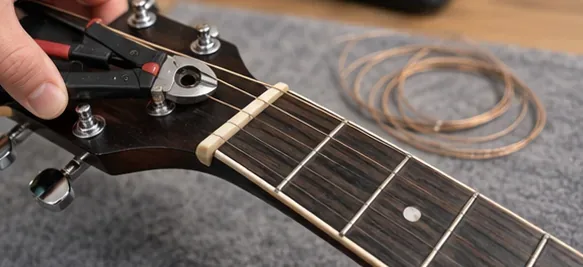
Action: If you cannot verify the finish, stop at gentle dry cleaning until the manufacturer or a qualified repair technician confirms what is safe.
Loose dust, skin residue, and string debris should come off first. Use a clean microfiber cloth and, if needed, a soft brush to work along the grain and beside the frets. Starting dry reduces the chance of turning loose dirt into a paste and often removes more buildup than expected.
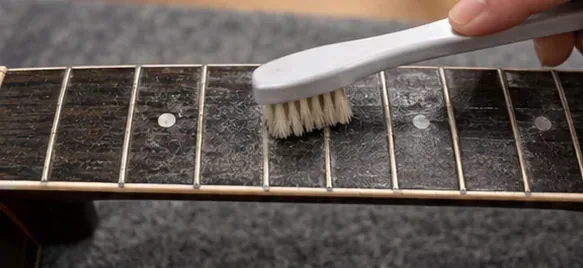
For heavy fret oxidation or stubborn grime, some official guidance becomes more specific. Taylor’s maintenance page recommends 0000 extra-fine steel wool on its unfinished fingerboards and frets, followed by a small amount of approved conditioner if the wood looks dry. That recommendation should not be treated as universal. Seymour Duncan has documented how steel-wool fibers can be attracted to magnetic pickups and become difficult to remove.
Action: Unless your guitar maker specifically recommends steel wool, start with microfiber and a soft nonmetallic brush. If you follow a manufacturer procedure that uses steel wool on an electric guitar, protect magnetic pickups completely and control the debris.
For unfinished rosewood, ebony, or pau ferro: wipe the board with a clean cloth and use only a cleaner or conditioner that the manufacturer approves for unfinished fretboards. Fender’s current Magic Fretboard Oil, for example, is specifically marketed for unfinished rosewood, ebony, and pau ferro. Taylor similarly says its fretboard conditioner works on unfinished wood fingerboards. Use very little product and keep it off adjacent finished surfaces unless the label says it is safe there.
For finished maple or another sealed fretboard: treat the surface as a finish, not as thirsty bare wood. Ernie Ball Music Man says necks with glossy or matte polyester finishes can be cleaned and maintained with a polish cloth in the same general way as the body, while its oil-and-wax-finished necks have a different maintenance procedure. This is why “maple equals no oil” is an oversimplification: the correct rule is to follow the actual finish system.
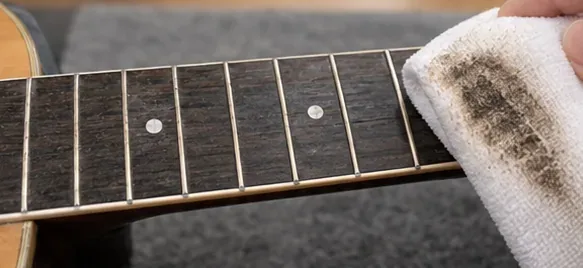
Avoid soaking the fretboard. Do not spray cleaner directly onto the neck. Household glass cleaners, furniture polish, strong solvents, and general-purpose degreasers can contain ingredients that are unsuitable for some guitar finishes or adhesives. When the exact compatibility is unknown, less is safer.
Action: Put any approved liquid on the cloth rather than flooding the wood, clean one or two fret spaces at a time, and immediately wipe the area dry.
An unfinished fretboard does not need to look glossy or feel oily. Conditioner is useful when the manufacturer allows it and the wood looks dry, but more is not better. Taylor advises using only a small amount and removing the excess; its staff guidance also notes that frequency depends on use and environment rather than a rigid schedule. Fender likewise positions its fretboard oil as a cleaner and conditioner for unfinished boards, not as a coating for every neck.
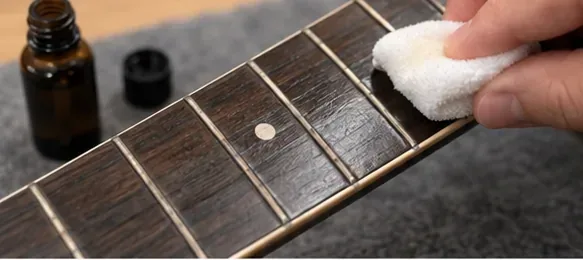
Apply a small amount to a clean cloth or applicator, spread a thin film, allow only the brief contact time recommended by the product, and buff until no liquid remains on the surface. Reinstall fresh strings, tune to pitch, and wipe the fretboard edges and strings with a clean dry cloth.
Action: Stop adding conditioner as soon as the wood has an even appearance and no visible dry patches. If the board still looks cracked, has lifted frets, loose binding, deep discoloration, or rough raised grain, do not keep adding oil—have the instrument inspected.
That is not a manufacturer-wide rule. Climate, playing frequency, and product formulation matter. Over-application can leave a greasy surface that attracts dirt. Taylor’s current staff guidance describes conditioning as something to do as needed, with two or three times per year presented as a typical range for its product rather than a universal requirement.
Action: Clean first. Condition only if the board is approved for it and actually looks dry.
It does not. Product formulations and manufacturer positions differ. Fender’s current fretboard oil specifically excludes lemon-oil extracts and explains why it chose that formulation. Taylor’s published ingredient disclosure for its fretboard conditioner, by contrast, lists white paraffin oil as the main ingredient and lemon extract as a fragrance component. Those official sources are a useful reminder that a marketing name is not enough to judge compatibility.
Action: Read the actual product directions and the guitar maker’s care guidance instead of treating every product called “lemon oil” as interchangeable.
Steel wool is a legitimate tool in some manufacturer procedures, but it is not mandatory. Taylor recommends 0000 extra-fine steel wool for cleaning its unfinished fingerboards and frets. On electric guitars, however, a pickup manufacturer such as Seymour Duncan warns that steel fibers can stick to pickup magnets. Different finishes can also react differently to abrasion.
Action: Use the least aggressive method that works. Reserve abrasives for a procedure explicitly supported for your instrument, and protect pickups and nearby finishes when required.
There is no single interval that fits every player. A useful routine is to wipe the strings and accessible fretboard edges with a dry microfiber cloth after playing, especially if your hands sweat heavily. Do a deeper fretboard clean when changing strings if visible grime has accumulated. Conditioning is separate from cleaning: only approved unfinished wood should receive it, and only when needed.
Humidity control matters too. A dirty-looking board is not always a dry board, and a dry guitar cannot be fixed simply by adding more surface oil. Acoustic instruments in particular can develop structural problems when stored outside the humidity range recommended by their maker.
Action: Treat visible dirt, dryness, and environmental humidity as three different issues instead of trying to solve all of them with one bottle.
Routine cleaning is safe for most owners, but repair work is different. Stop if you see loose or lifted frets, cracked wood, lifting binding, damaged inlays, finish flaking, a warped neck, severe corrosion, or grime that will not release without scraping. Those problems can require fret dressing, structural repair, or finish-specific work.
Action: If you are uncertain about the finish or the neck has existing damage, ask the manufacturer or a qualified guitar repair technician before using solvents, abrasives, or oils.
The simplest rule is also the safest: remove dirt with the gentlest method first, match any cleaner or conditioner to the actual finish, and use less product than you think you need. That approach keeps the fretboard clean without turning routine maintenance into a finish or repair problem.
Learn how to remove dry-erase marker from a painted wall safely, from water and mild soap to careful rubbing-alcohol spot treatment.
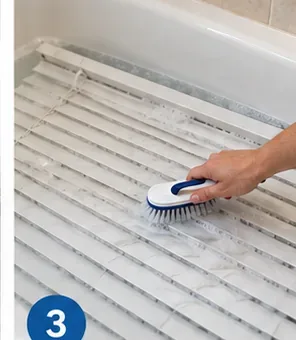
Learn when bathtub cleaning is safe for blinds, which materials should never be soaked, and how to wash, rinse, dry, and rehang approved blinds without damage.
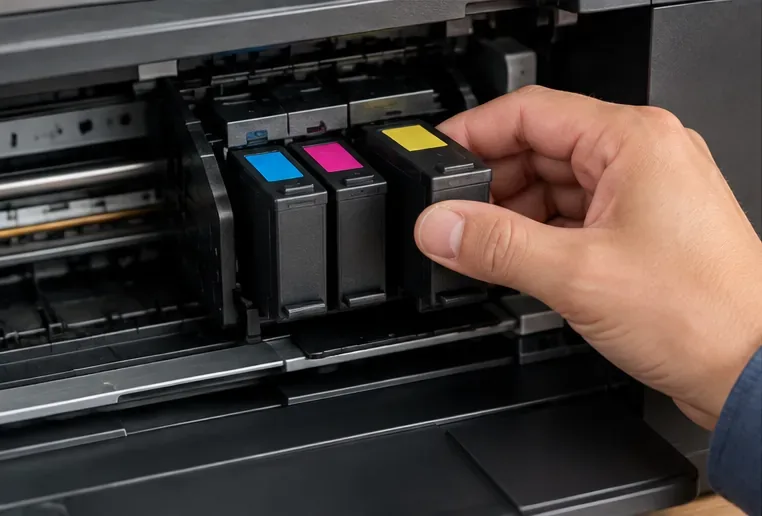
Learn how to clean a printer cartridge safely, when to use built-in cleaning, how to handle inkjet contacts, what to avoid, and how to verify print quality.
Learn how to clean a guitar fretboard safely, choose the right method for finished or unfinished wood, avoid common myths, and condition only when needed.
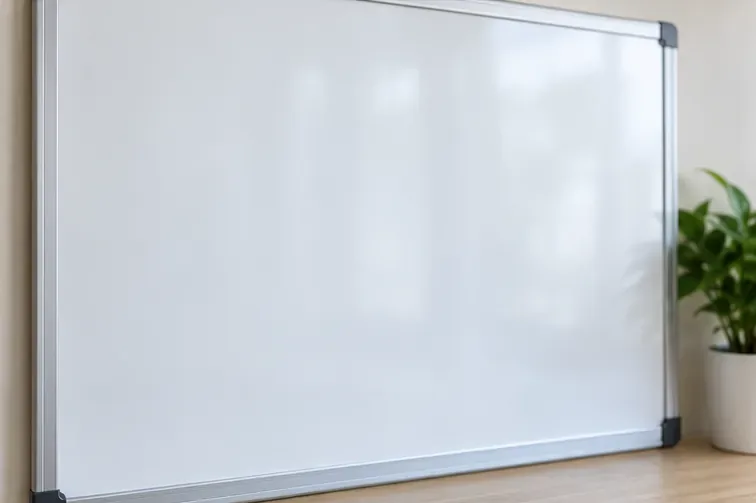
Learn how to clean a stained dry-erase board safely, remove ghosting and stubborn ink, handle permanent marker, and avoid common cleaning mistakes.
Clean PS5 cooling vents without opening the console using PlayStation’s recommended low-powered vacuum method, plus airflow and noise checks.
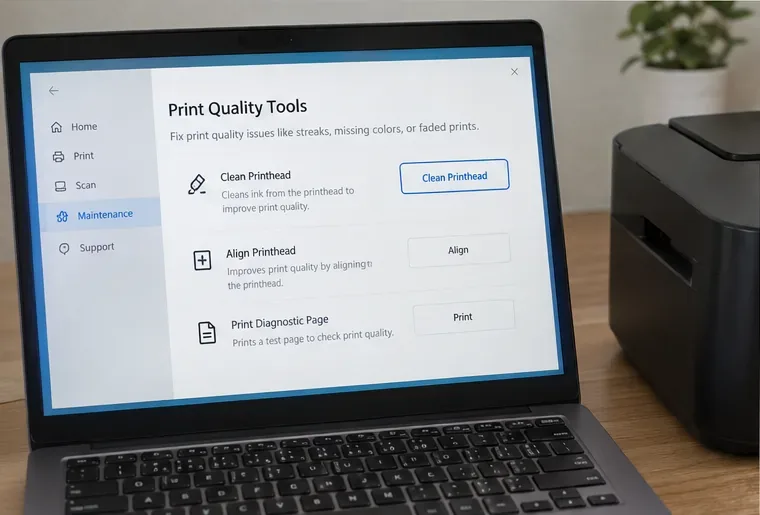
Learn how to clean an HP printer head safely using diagnostic pages, built-in cleaning tools, alignment checks, and model-specific manual care.
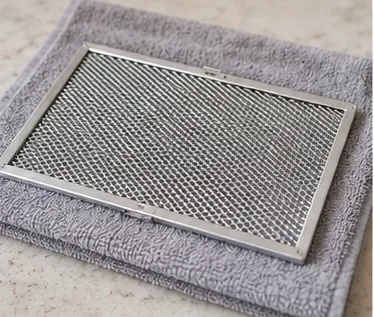
Clean a microwave grease filter safely, know when a charcoal filter must be replaced, and use a quick checklist for model-specific care.
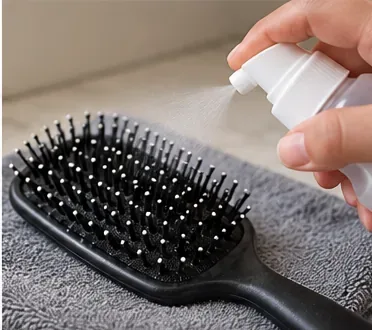
Learn how to disinfect a hairbrush without damaging it, with material-specific steps, CDC head-lice guidance, and a clear cleaning-vs-disinfection decision.
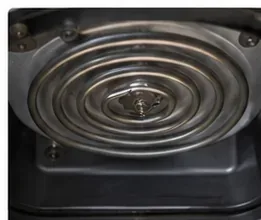
Learn how to clean an air fryer heating element safely, remove grease and stuck food, avoid damaging the coating, and know when to stop and check the manual.