How to Use Google Lens on Chromebook

How to Use Google Lens on Chromebook lets you scan objects, translate text, and solve problems directly from your device. Follow these steps to get started quickly.
A sweaty yoga mat can feel less pleasant under your hands long before it looks dirty. With a lululemon mat, the safest cleaning approach is also fairly restrained: wipe it rather than soaking it, use a damp cloth or a compatible natural cleanser, let it dry completely, and keep it out of direct sunlight.
Hypothetical example: imagine Jordan has just finished a heated class on The Mat 5mm. This is only an illustrative scenario, not a testimonial or a report of a real test. Jordan's mat has visible sweat marks and a little floor dust, but no major spill. We will use that example throughout the guide to show how to make cleaning decisions without going beyond lululemon's published care directions.
Care directions were checked on September 12, 2026. Current product pages for The Mat 5mm, The Mat 3mm, and the Align Yoga Mat 5mm instruct owners to wipe the mat clean, ensure it is dry before rolling, and store it out of direct sunlight. Some current pages also explicitly say not to wash or bleach the mat. See the lululemon The Mat 5mm materials and care page, lululemon The Mat 3mm materials and care page, and lululemon Align Yoga Mat 5mm materials and care page.
Not every lululemon yoga mat uses exactly the same construction. The Mat 5mm, for example, combines natural and synthetic rubber with polyurethane, polyester, and nylon, while The Lightweight Mat 5mm uses a recycled polyvinyl butyral top, polyester middle layer, and thermoplastic elastomer bottom. The care language overlaps, but the materials do not. That is why an aggressive cleaner that seems harmless on one mat should not automatically be assumed safe on another.
For Jordan's hypothetical The Mat 5mm, lululemon says the grippy top layer absorbs moisture and the base contains natural rubber. The page advises wiping the mat after use with a natural cleanser, drying it before rolling, and storing it away from direct sunlight. The lululemon The Lightweight Mat 5mm materials and care page gives similarly conservative care guidance for the Lightweight Mat.
Action: check your product name, original packaging, order history, or the current lululemon product page before treating an older or discontinued mat. If its instructions conflict with this guide, follow the instructions for your specific mat.
Lululemon's cited product pages do not provide a universal DIY recipe or a manufacturer-approved vinegar, alcohol, essential-oil, or dish-soap ratio. That absence matters. A home recipe can change the surface feel or leave residue even when it works well on another type of mat.
Action: if you do not have a cleanser you trust for this mat, start with the simplest manufacturer-backed option: a clean damp cloth.
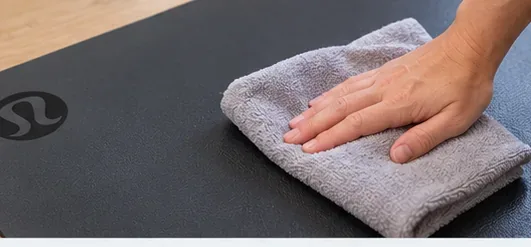
Lay the mat flat on a clean surface. If you have just finished practice, use a lightly damp clean cloth to pick up sweat, dust, hair, and loose particles before they dry into the textured surface.
In our hypothetical example, Jordan first wipes the places where hands and feet spent the most time, then uses a clean section of the cloth on the edge and floor-facing side so grit is not dragged back onto the practice surface.
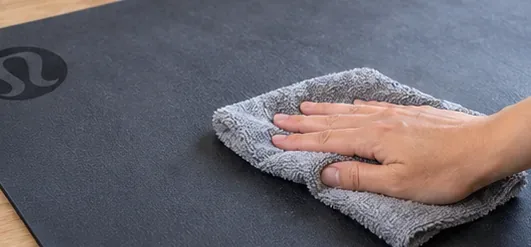
The current The Mat and Align product pages say the mat may be wiped down after practice with a natural cleanser. They do not specify a universal formulation. If you use one, follow that cleaner's directions and keep the application light enough that the mat is wiped, not saturated.
Jordan's hypothetical mat has a few persistent sweaty patches, so Jordan uses a small amount of a compatible natural cleanser rather than soaking the entire mat.
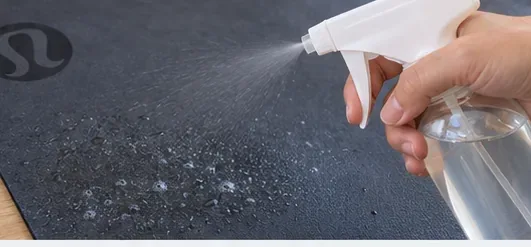
Use broad, overlapping passes with a soft cloth. You are trying to lift surface soil and spread a small amount of moisture evenly, not scrub through the upper layer. Pay extra attention to hand and foot zones, but stop if the surface begins to feel abraded or the color starts transferring unusually to the cloth.
Color can change over time according to lululemon's care notes, so a faint cosmetic mark is not a reason to escalate automatically to stronger chemistry.
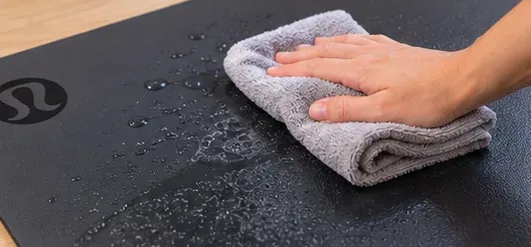
If the cleaner's label calls for a water wipe, or the mat feels filmy after cleaning, use a second cloth dampened with clean water. Wring it well first so it is damp rather than dripping. A second pass is also useful when you have cleaned the floor side and want to avoid transferring residue back to the top.
Action: if the mat still feels slick, do not add more cleaner immediately. Use the clean damp cloth again, then reassess after drying.
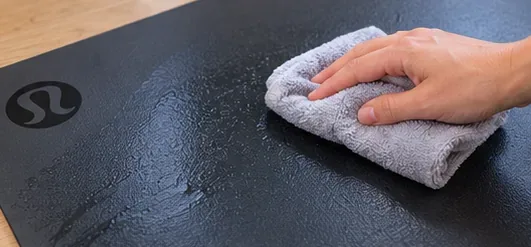
Use a clean dry towel to blot or wipe away moisture that remains on top. This shortens drying time without requiring heat. Avoid twisting, wringing, folding tightly, or treating the mat like a washable textile.
Current lululemon care pages for some versions of The Mat specifically say do not wash and do not bleach. That is a strong reason not to put the mat in a washing machine, immerse it in a bathtub, or reach for chlorine bleach as a shortcut.
Lay the mat flat in a well-ventilated indoor area or another shaded location. Do not roll it while it is damp. Lululemon repeatedly states that the mat should be dry before rolling and stored out of direct sunlight.
For Jordan, the cleaning job is not finished when the visible droplets are gone. The mat remains unrolled until both sides feel dry. This is especially important after a sweaty class because rolling damp material traps moisture between layers.
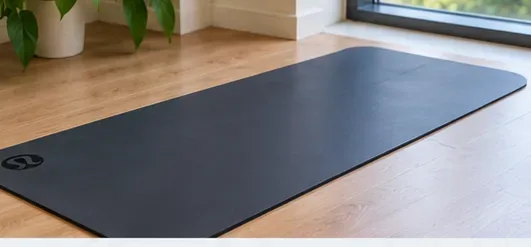
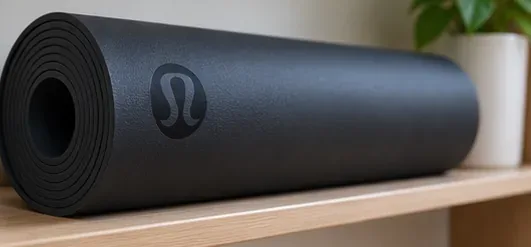
Once the mat is completely dry, roll it without trapping a damp towel or other wet gear inside. Store it in a cool indoor place out of direct sunlight. If your specific mat's product page gives a preferred rolling orientation, follow that instruction.
A clean mat does not need to look brand-new. A better check is functional: it should feel dry, not soapy or slick, and there should be no visible cleaner pooled in the texture. If a dry mat still has a slippery film, wipe it again with a clean damp cloth and let it dry fully before deciding whether more treatment is needed.
In the hypothetical example, Jordan stops here if the mat is dry and the surface feels normal. A stubborn cosmetic stain alone is not a good reason to move to bleach, aggressive solvents, or hard scrubbing.
| Claim | What is supported | What to do |
|---|---|---|
| “A yoga mat should be soaked for a deep clean.” | Current lululemon pages emphasize wiping and, for some mats, explicitly say not to wash. | Use a damp cloth and avoid immersion unless your exact mat's instructions say otherwise. |
| “Bleach is the best way to sanitize it.” | Some current The Mat care instructions explicitly say not to bleach. | Do not use bleach on those mats. |
| “Vinegar, alcohol, or essential oils are always safe.” | The cited lululemon pages do not publish a universal DIY formula using those ingredients. | Do not treat a popular home recipe as manufacturer-approved; check your exact mat and cleaner first. |
| “The antimicrobial additive means the mat cleans itself.” | Lululemon notes an antimicrobial additive on several mats, yet still instructs users to wipe them after practice. | Continue routine wiping and drying; do not use the additive as a substitute for care. |
Lululemon's current care wording for The Mat says to wipe it down after use, and the older Reversible (Un) Mat page similarly says to wipe it clean after every practice. You do not need a complicated schedule: a light wipe after practice is the clearest manufacturer-aligned routine. When a session is especially sweaty, cleaning promptly also makes it easier to remove moisture before the mat is rolled.
Action: keep a clean cloth near your mat so the easy version of the routine is the default. Save extra cleanser for times when water alone is not enough.
New natural-rubber lululemon mats can have a slight smell that the company says fades over time; its product pages suggest unrolling and airing the mat out before class. For a used mat, odor can also be a sign that it was rolled before it fully dried. After cleaning, leave it unrolled in a ventilated shaded place and give it time to dry completely.
What is not established by the cited manufacturer pages is a universal odor-removal recipe. Adding fragrance or essential oil can mask odor without telling you whether the surface is actually clean and dry.
Action: first repeat a damp-cloth wipe, let the mat dry completely, and verify that it was not stored damp. If an unusual odor persists or the material appears to be breaking down, contact lululemon support or follow the care instructions for your exact model rather than escalating to stronger chemicals.
If all six points are true, your cleaning process is aligned with the care principles lululemon currently publishes for its main yoga-mat lines. The most important restraint is simple: when the manufacturer says wipe, dry, and shade, more water and stronger chemicals are not automatically better.
How to Use Google Lens on Chromebook lets you scan objects, translate text, and solve problems directly from your device. Follow these steps to get started quickly.
Learn how to clean a lululemon yoga mat using current care guidance: wipe gently, avoid soaking and bleach, dry fully, and store out of sunlight.
Learn how to remove hot glue from fabric using cooling, gentle scraping, and cautious alcohol treatment, with fabric-safety checks for delicate materials.
Learn how to clean a freezer ice maker safely, remove stale ice and residue, wash and dry the bin, and know when deeper cleaning or service is needed.
Learn how to season gas grill grates safely, when seasoning is actually needed, and how cast iron, stainless, and porcelain grates differ.
Learn how to clean fabric blinds safely: identify the material, remove dust, spot-clean stains, avoid damage, air-dry correctly, and know when to call a pro.
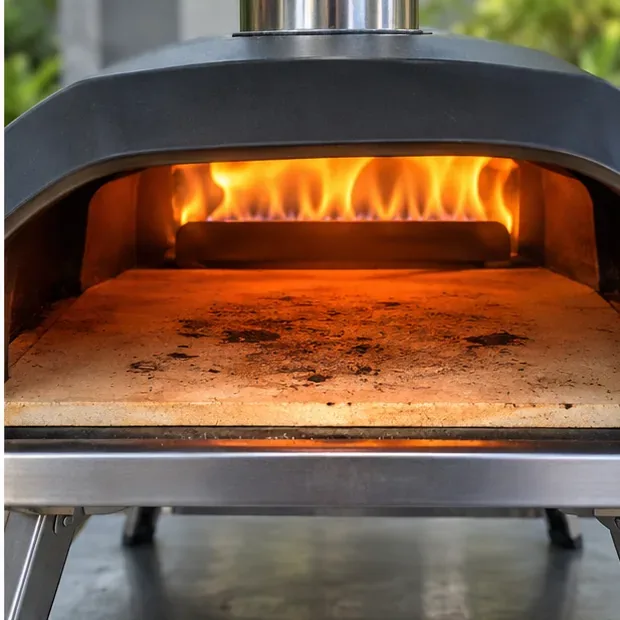
Learn how to clean an Ooni pizza stone safely with dry brushing, high-heat burn-off, and flipping—plus what to avoid and how to know it is clean enough.
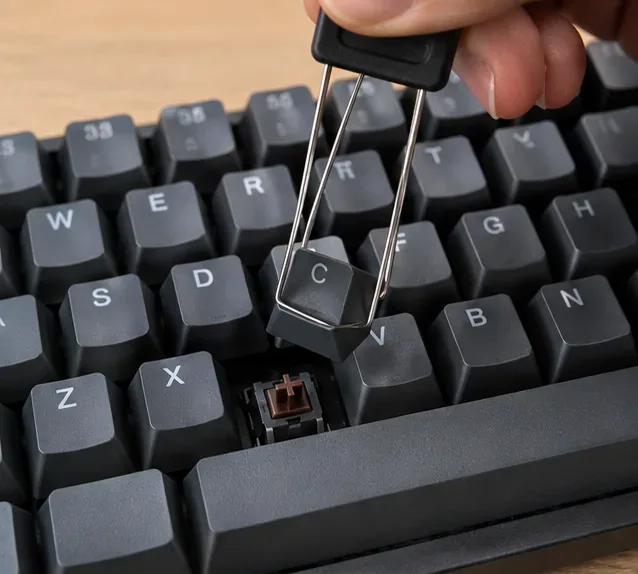
Learn how to clean a mechanical keyboard safely, from removing keycaps and dust to washing compatible caps, drying, reassembly, and testing.
Learn how to remove hardened wax from clothes safely: harden, scrape, transfer with low heat, pretreat residue, wash by the care label, and air-dry.
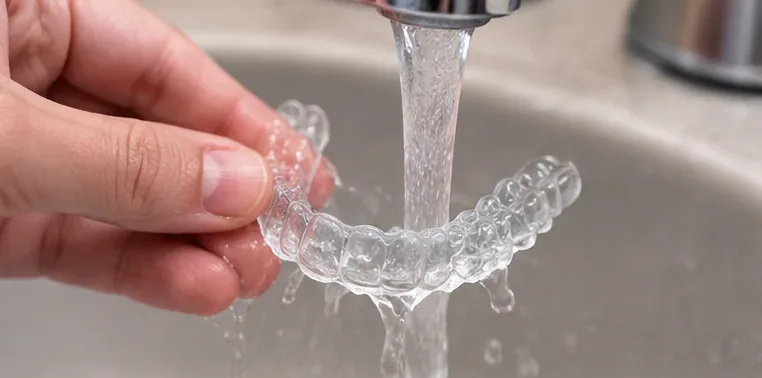
Clean a removable retainer at least daily, rinse it whenever you remove it, and use a deeper manufacturer-approved clean about weekly. Learn what changes the schedule.