Home
» How to
»
How to Clean a Pool Sand Filter: Backwash, Rinse, and Know When to Go Deeper
How to Clean a Pool Sand Filter: Backwash, Rinse, and Know When to Go Deeper
Cleaning a pool sand filter usually does not mean opening the tank or replacing the sand. For most residential systems, routine cleaning means backwashing: reversing water flow through the sand bed so trapped debris is carried out through the waste line, followed by a short rinse cycle that settles the bed before normal filtration resumes.
The exact trigger pressure, valve positions, and run times depend on the filter and valve model, so your owner's manual takes priority over any generic schedule. Two major manufacturers illustrate why: a current Hayward high-rate sand-filter manual says to backwash when pressure rises about 8–10 psi above the clean starting pressure, while a Pentair Sand Dollar/Cristal-Flo II guide gives model-specific backwash and rinse procedures and warns to switch the pump off before changing valve positions. See the Hayward high-rate sand filter owner's manual and the Pentair Sand Dollar and Cristal-Flo II guide.
Illustrative example: a filter that has lost flow
Consider this hypothetical example: Maya has a residential pool with a top-mount sand filter and a multiport valve. After the filter was last cleaned, she wrote down a clean pressure of 12 psi. Several weeks later, return flow feels weaker and the gauge reads 21 psi. Her specific manual says to backwash at an 8–10 psi rise above clean pressure.
This example is only a teaching scenario, not a real test result or a universal pressure target. Maya's 9 psi increase is useful because it falls inside the range stated by her imagined manual. Your filter might use a different trigger, and a pressure gauge can also be inaccurate, so compare your current reading with the clean baseline and your own manufacturer's instructions.
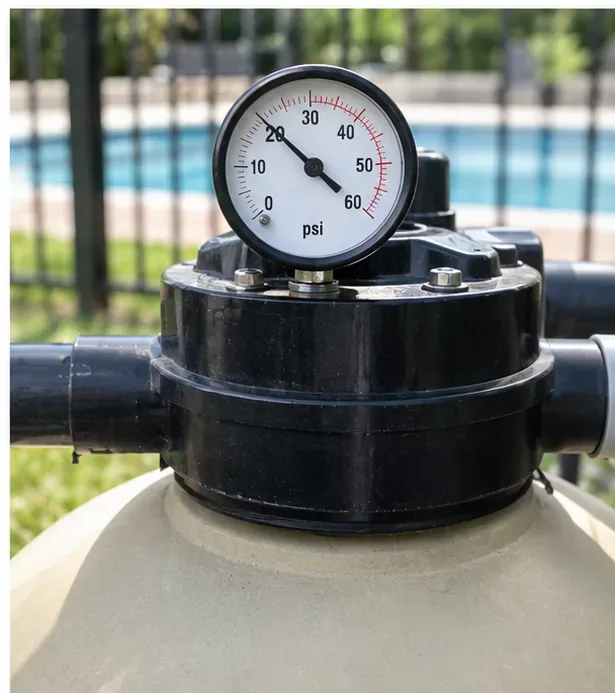
A pressure gauge is most useful when you compare it with the clean baseline recorded for your own system, rather than relying on one universal PSI number.
What should you check before cleaning the sand filter?
Before touching the valve, confirm that the problem is actually consistent with a dirty filter. A rising pressure reading plus reduced return flow is a common sign. If pressure is unusually low instead, look for a clogged skimmer basket, pump basket, suction blockage, low water level, air leak, or another circulation problem before assuming the sand bed needs backwashing.
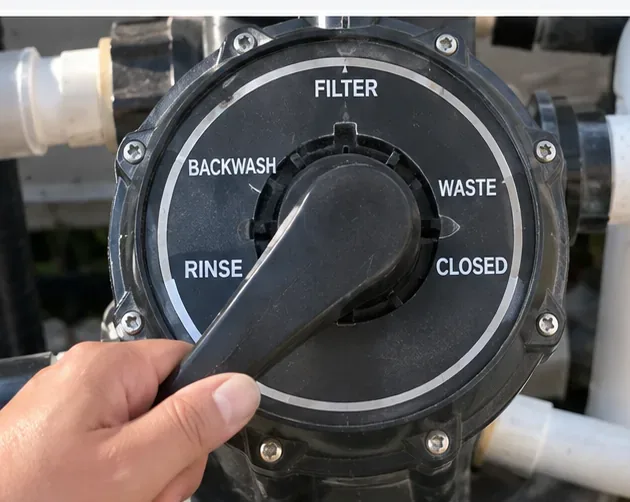
Also identify your valve type and the labels on it. Many residential sand filters use a multiport valve with positions such as Filter, Backwash, Rinse, Waste, Recirculate, and Closed, but layouts vary. Never guess at an unlabeled position.
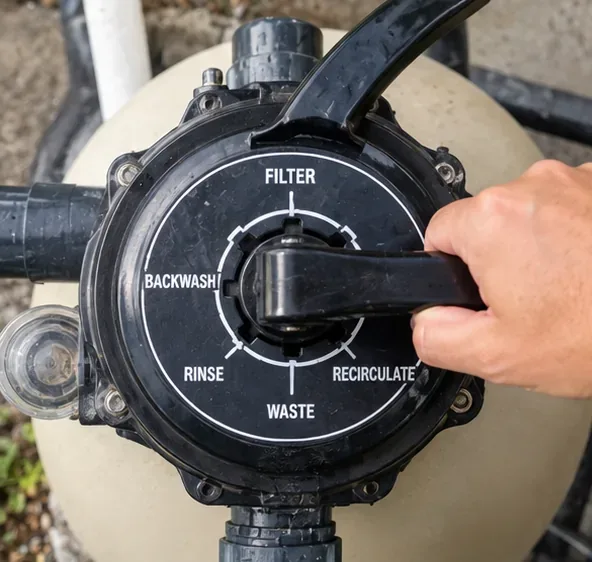
Identify the valve positions on your own filter before starting. The pump should be off whenever you move a multiport valve handle.
How do you backwash a sand filter safely?
Step 1: Turn the pump off completely
Switch the circulation pump off before moving the multiport valve. If the equipment is controlled by a timer or automation system, make sure it cannot restart while you are changing valve positions. Pentair explicitly warns that changing valve positions with the pump running can damage the valve and create an injury or property-damage risk.
Step 2: Prepare the backwash discharge path
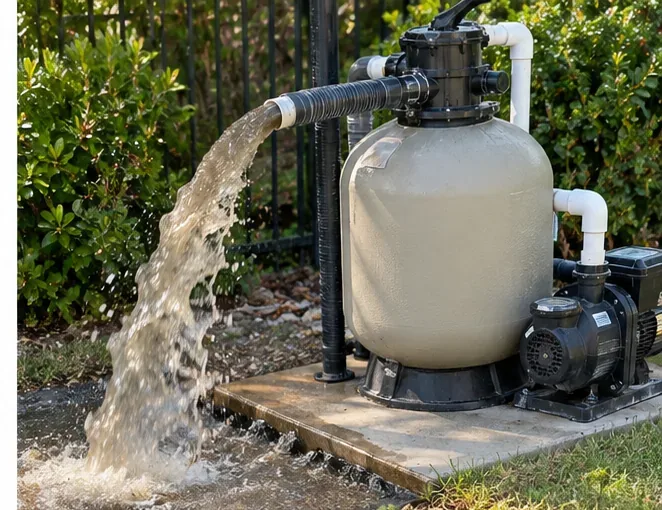
Make sure the waste or backwash line is open, connected, and routed to an allowed discharge location. A backwash cycle can move a substantial amount of water quickly. Do not let the hose kink, detach, or discharge where it can undermine equipment pads, flood a structure, or enter a location prohibited by local rules.
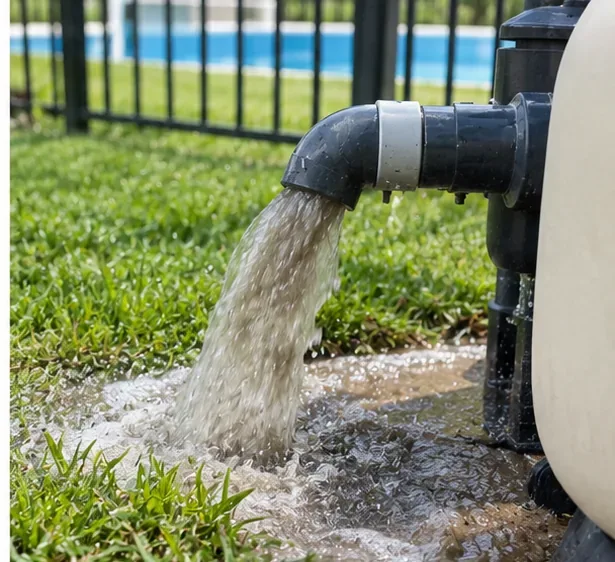
Backwash water carries loosened debris out of the filter, so confirm that the discharge path is secure before starting the pump.
Step 3: With the pump off, set the valve to Backwash
Depress and rotate the multiport handle as your valve requires, then let it lock firmly into the Backwash position. Do not force a stiff handle. If the valve does not move normally, stop and consult the valve manual rather than using extra leverage.
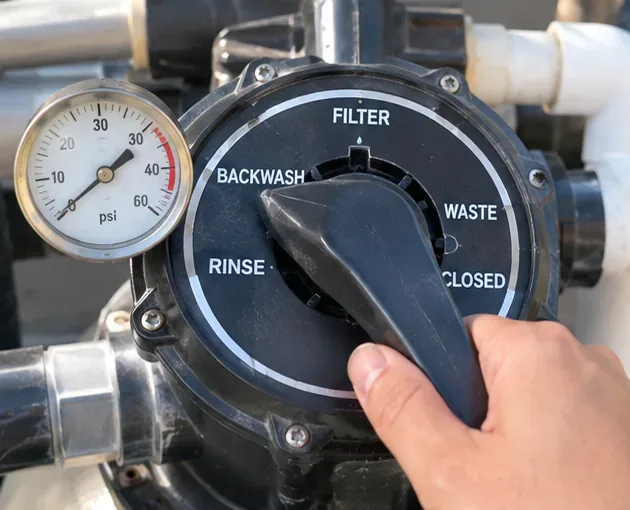
Set the valve to Backwash only while the pump is stopped. Valve graphics differ by model, so follow the markings on your equipment.
Step 4: Start the pump and backwash until the manual's stopping point
Stand clear of the pressurized filter when restarting the pump. Watch the sight glass if your valve has one, or observe the discharge water where it can be done safely. The goal is to carry trapped debris out of the sand bed.
Do not assume every filter should run for the same number of minutes. Hayward's cited manual says to backwash until the sight glass is clear, approximately two minutes or less depending on dirt accumulation. Pentair's cited residential guide gives approximately three minutes or until the backwash water is clean for one procedure. Use your model's instruction, not the longer of two unrelated manuals.
During backwashing, water is sent to waste as debris is lifted from the sand bed. Duration should come from the filter manual or the sight-glass condition specified by the manufacturer.
Step 5: Stop the pump before selecting Rinse
Once the backwash endpoint is reached, switch the pump off again. Move the valve to Rinse. This intermediate cycle sends water through the filter in a way that helps settle the sand bed and flushes remaining dirty water to waste instead of immediately returning it to the pool.
After backwashing, stop the pump and move the valve to Rinse if your multiport system and manual call for that cycle.
Step 6: Run the rinse cycle for the specified time
Restart the pump while standing clear. Rinse times differ by manufacturer. Hayward's manual says roughly 30 seconds to one minute, while the Pentair procedure cited above specifies about 30 seconds for one backwash sequence. Other models can differ, especially during initial startup, so the owner's manual remains the final authority.
Step 7: Stop the pump, return the valve to Filter, and restart correctly
Turn the pump off once more, move the valve to Filter, and make sure the pool return line is open. If your filter has a manual air bleeder and the manual instructs you to use it during startup, follow that sequence while standing clear of the filter. Pentair's residential guide instructs users to close the air bleeder after a steady stream of water emerges.
Step 8: Verify return flow and record the new pressure
Confirm that water is returning normally to the pool and check the gauge. Record the post-cleaning pressure as a new reference only after the system has stabilized. In Maya's hypothetical case, the useful question is not whether the gauge reaches a particular internet-recommended number; it is whether flow improves and pressure returns close to her established clean baseline.
If pressure remains abnormally high after a correct backwash and rinse, do not keep repeating backwash cycles indefinitely. That is a troubleshooting clue.
Do you need to open the filter and hose the sand?
Not for routine cleaning. Opening a sand filter is a deeper service task, and it is model-specific. The tank is a pressure vessel, and removing a valve, clamp, lid, or internal component without fully shutting down and depressurizing the system can be dangerous.
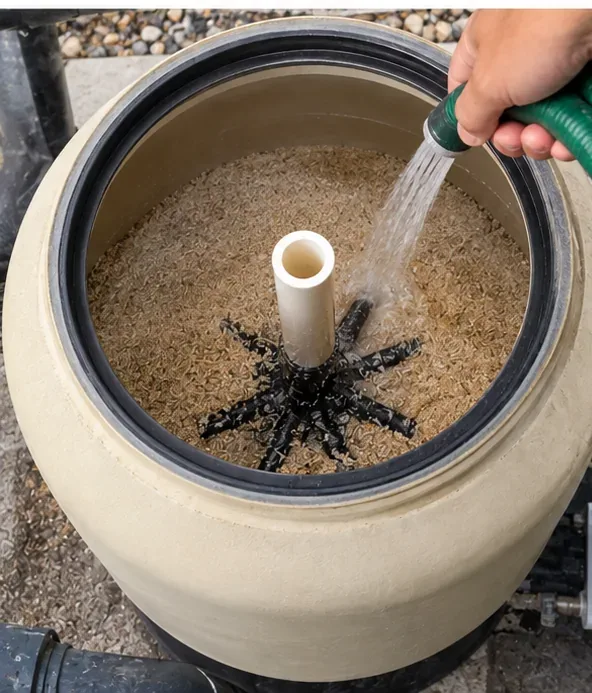
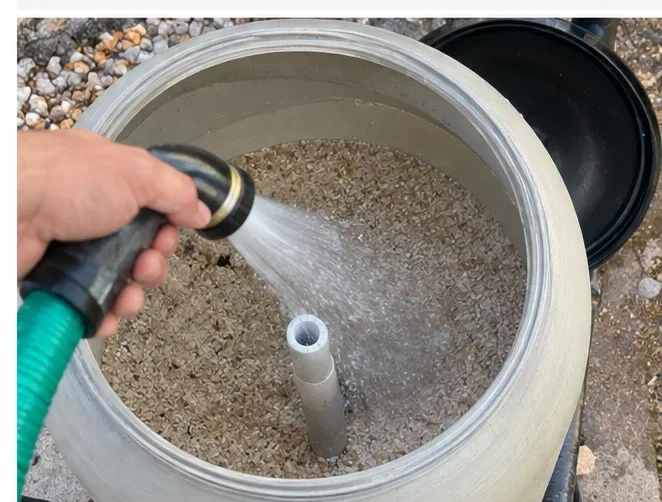
The photo below shows what an opened sand tank can look like during internal service. Treat it as a visual reference, not as an instruction to open your filter during every cleaning.
An opened filter tank represents deeper service, not the normal backwash-and-rinse routine. Only open a filter when the manufacturer service procedure calls for it and the system is fully depressurized.
If a correctly backwashed filter still runs well above its clean pressure, consult the troubleshooting section for your exact model. Pentair's Sand Dollar/Cristal-Flo II guide states that, for the models covered by that procedure, pressure remaining 4–6 psi above the original starting condition after backwashing indicates that chemical cleaning of the sand bed is necessary. That threshold should not be copied to unrelated filters.
When should the sand itself be replaced?
Do not replace sand simply because a calendar says it is old. Replacement can be appropriate when the media is contaminated, when internal repairs require removal, when the wrong media was installed, or when the manufacturer identifies a media problem that backwashing or approved cleaning cannot correct. Commercial and residential designs differ, so there is no responsible one-size-fits-all replacement interval.
Internal access can also expose laterals and standpipes that are easy to damage. Pentair's training material explains that laterals at the bottom of the tank have narrow slots that allow water through while retaining filter sand. Damaged laterals can lead to sand returning to the pool. For background on how these components work, see the Pentair Sta-Rite pool and spa training manual.
Deep internal cleaning or media service should follow the exact filter manual because the standpipe, laterals, seals, and sand specification vary by model.
What if backwashing does not restore normal flow?
Work through the system rather than assuming the sand is bad. Check the skimmer and pump baskets, water level, pump prime, suction and return valves, obvious plumbing restrictions, and the pressure gauge itself. A gauge that does not return to zero when the pump is off may be unreliable.
If the filter pressure remains elevated after a correct cleaning, the sand may be fouled or compacted, or there may be a valve or plumbing issue. If pressure is normal but fine debris repeatedly returns to the pool, damaged laterals or an internal seal problem are possibilities. Those conditions call for model-specific service rather than more frequent backwashing.
How often should you clean a sand filter?
Use pressure rise and flow performance as your primary indicators, not a rigid weekly schedule. Backwashing too often wastes water and can prevent the filter from operating as intended, while waiting too long can reduce circulation. Record the pressure when the filter is genuinely clean, then compare future readings with that baseline and the manufacturer's stated trigger.
For Maya's hypothetical pool, the process is straightforward: she notices weaker flow, confirms a 9 psi rise relative to her recorded baseline, checks that her manual calls for cleaning in that range, turns the pump off before every valve change, backwashes to the specified endpoint, rinses, returns to Filter, and then verifies flow and pressure. The example works because it follows the equipment's instructions rather than treating one set of numbers as universal.
Quick checklist before you finish
The pump was off every time the multiport valve position changed.
The backwash discharge line stayed secure and unobstructed.
You followed your model's endpoint or time for Backwash and Rinse.
The valve is back on Filter before normal operation resumes.
Water is returning to the pool normally with no obvious leaks.
The new operating pressure is close to your known clean baseline.
If pressure or flow is still abnormal, you stop repeating the same cycle and move to model-specific troubleshooting or professional service.
That is the practical way to clean a pool sand filter: treat backwashing and rinsing as the normal maintenance procedure, use pressure as a trend rather than a universal number, and reserve opening the tank for situations where the manufacturer actually calls for deeper service.