Home
» How to
»
How to Clean a Range Hood Filter: A Practical Guide for Metal Grease Filters
How to Clean a Range Hood Filter: A Practical Guide for Metal Grease Filters
A greasy range hood filter can look simple to clean, but the right method depends on what the filter is made of. The safest starting point is to identify the filter type and check the hood's manual before putting anything in a sink or dishwasher. Most removable metal grease filters are designed to be cleaned, while many charcoal or carbon filters are designed to be replaced instead. There are exceptions, which is exactly why model-specific instructions matter.
Illustrative scenario: imagine Jordan cooks stir-fries, pan-seared foods, and bacon several nights a week. The metal mesh filter under the range hood has become visibly greasy, and airflow seems less crisp than usual. Jordan's hood is hypothetical; this is not a report of a real test or a customer result. We will use that situation to show how the cleaning process works and where the advice changes for other filter types.
First, identify the filter you actually have
Range hoods commonly use one or more grease filters to capture airborne grease. These may be aluminum mesh, stainless-steel mesh, hybrid filters, or baffle-style metal filters. Many recirculating hoods also use a charcoal or carbon filter to reduce odors before air is returned to the room.
Official manufacturer guidance shows why you should not treat these filters as interchangeable. Whirlpool's general vent-hood guidance says its removable grease filters can be washed with warm water and detergent, while its standard non-vented charcoal filters are not washable. Bosch likewise tells users to clean grease filters but replace charcoal/carbon filters on the schedule for the specific hood. At the same time, Whirlpool documents some models with charcoal filters that can be washed and heat-reactivated. In other words, "charcoal filters can never be washed" is too broad.
Warm or hot water, within the limits of your sink and filter materials
Mild dishwashing detergent or the cleaner specified by the manufacturer
A soft cleaning brush or nonabrasive sponge
A sink, basin, or tub large enough to hold the filter flat
A clean towel or drying rack
Gloves, if you prefer them for greasy handling
Avoid assuming that stronger chemicals will clean better. GE, for example, specifically tells owners not to use ammonia or ammonia products on its common metal grease filters. Some Broan-NuTone and Zephyr guidance also recommends non-phosphate detergent for dishwasher cleaning because detergent chemistry or local water conditions can discolor metal filters. That discoloration may be cosmetic, but the correct chemistry still depends on the filter.
Action: start with mild detergent unless your manual names a different product.
How to clean a range hood filter step by step
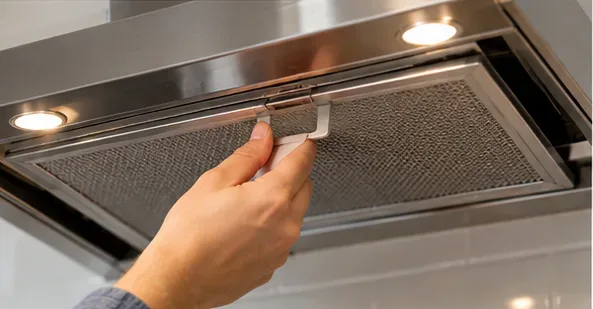
1. Turn the hood off, let it cool, and release the filter
Before handling the filter, switch the hood controls off and allow nearby lamps and cooking surfaces to cool. Whirlpool explicitly instructs users to make sure controls are off and the hood is cool before cleaning. If the hood is hardwired, follow the service precautions in the manual if the task requires more than routine filter removal.
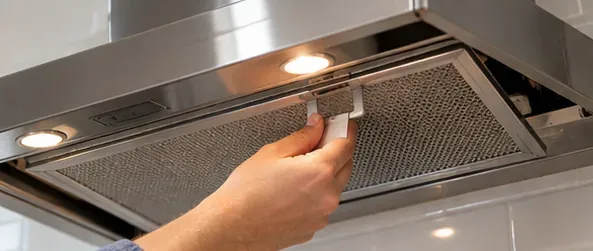
In Jordan's hypothetical kitchen, the hood has a spring-release latch. Other hoods use tabs, clips, screws, or a frame that slides into channels. Support the filter with one hand while releasing it so it does not drop onto the cooktop.
A removable metal mesh filter being released from its latch; the exact latch or tab design varies by hood model.
2. Inspect the filter before soaking it
Look for a metal mesh or baffle construction, a separate charcoal pad, broken latches, bent frames, or damage that could affect fit. If a charcoal layer is attached to the metal grease filter, remove it only as the manual directs. Do not automatically submerge the entire assembly.
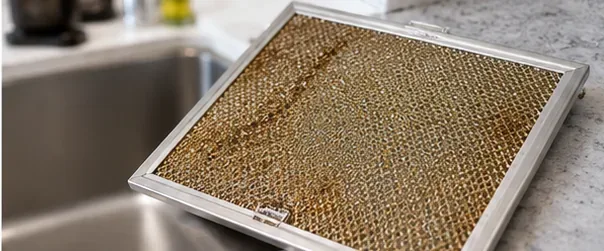
In our example, Jordan confirms that the visible filter is a washable metal grease filter. The brown film across the mesh is grease buildup, but the frame and latch are intact.
A visibly grease-coated metal mesh filter ready for cleaning; inspect the frame and any attached carbon layer before soaking.
3. Soak the washable metal filter in soapy water
Fill a sink or basin with hot or warm water and detergent. Bosch's current support instructions tell users to soak grease filters in hot, soapy water for 10 minutes before brushing. Other manufacturers may not specify a time, so treat 10 minutes as an example rather than a universal rule.
The goal is to soften grease enough that it releases with light brushing. There is no benefit in leaving the filter submerged indefinitely if the manual does not call for it.
The metal filter soaking flat in warm, soapy water so grease can soften before gentle brushing.
4. Brush gently instead of attacking the mesh
Use a soft brush or nonabrasive sponge to work detergent through greasy areas. Bosch specifically recommends scrubbing after the soak. Light pressure is usually more appropriate than stiff wire brushes or abrasive pads, which can deform mesh or damage finishes.
Jordan focuses on the dirtiest sections and the perimeter, where grease can collect around the frame. If grease remains, another short soak is preferable to bending the mesh with excessive force.
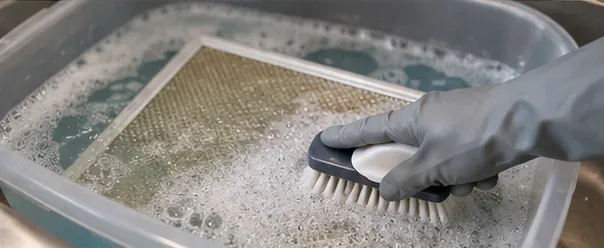
A soft brush working through the mesh without crushing or bending the filter layers.
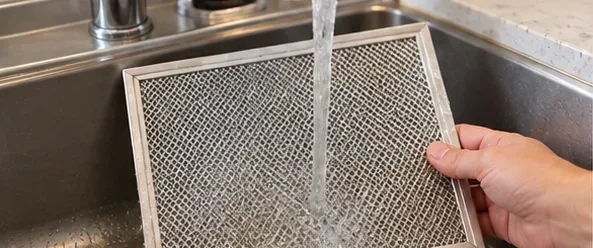
5. Rinse away loosened grease and detergent
Rinse the filter with clean water until visible suds and loosened residue are gone. Bosch's instructions explicitly include a clean-water rinse after brushing.
Check both sides and the frame. If water still carries obvious grease from the filter, repeat the detergent wash rather than reinstalling it immediately.
Clean water rinses detergent and loosened grease from both sides of the metal filter.
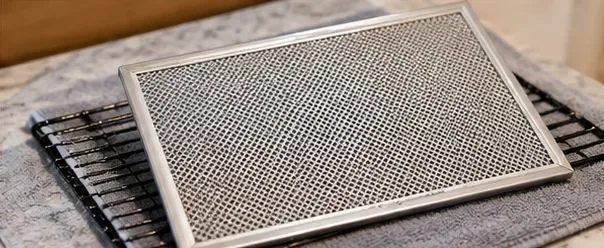
6. Let the filter dry completely
Do not reinstall a dripping filter. Bosch, Whirlpool, Zephyr, and other manufacturers tell users to dry grease filters before putting them back. Set the filter on a towel or rack and allow trapped water to drain from the mesh and frame.
In Jordan's example, the filter stays out until it is dry to the touch and no water is emerging from the edges when it is tilted.
The cleaned filter resting flat while water drains from the mesh and frame before reinstallation.
7. Reinstall the dry filter securely
Return the filter in the reverse order of removal. Make sure the tabs enter their channels and the latch fully engages. Whirlpool and GE both emphasize correct seating when the filter is reinstalled. Do not operate the hood with a grease filter left out; Wolf's ventilation guidance explicitly warns against operating without the grease filters.
The dry grease filter being seated back into its track and secured with the latch.
8. Check operation and reset a filter reminder if your hood has one
Once the filter is secure, run the hood briefly and confirm that it sits firmly without rattling. Some hoods also have a filter indicator that must be reset after cleaning; the reset procedure varies by model.
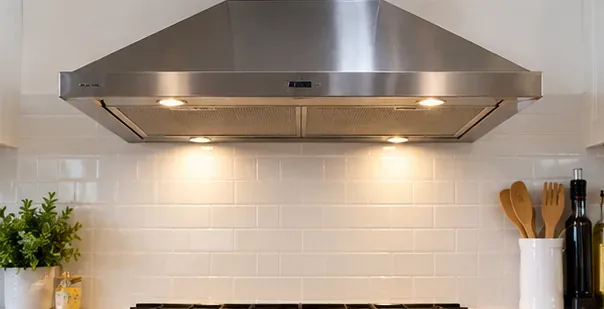
This last check closes our hypothetical Jordan example. The useful outcome is not a claimed percentage improvement in airflow or odor removal—those results would require measurement. The goal is simply to restore the filter to a clean, correctly installed condition and verify that the hood operates normally.
The range hood after the dry metal filter has been reinstalled and the system is ready for an operational check.
Can you put a range hood filter in the dishwasher?
Often, yes—but only if the manufacturer says the particular filter is dishwasher safe. Whirlpool says many removable metal grease filters can be cleaned in a sink or dishwasher. Broan-NuTone sells multiple aluminum mesh and hybrid baffle filters that it explicitly describes as dishwasher safe. Wolf also lists dishwasher cleaning for several hood filters.
However, dishwasher-safe does not mean appearance-safe. GE notes that dishwasher cleaning may discolor metal filters. Zephyr says discoloration can occur because of detergent chemistry or local water conditions and recommends a low-heat or short cycle with non-phosphate detergent for many of its filters.
Action: use the dishwasher only when the manual allows it. If keeping the original metal appearance matters, hand washing offers more control.
How often should you clean a range hood filter?
There is no single interval that applies to every kitchen. Manufacturer recommendations vary substantially. Wolf tells owners of some aluminum mesh hood filters to clean them monthly and more often with greasy cooking, frying, or wok use. GE says common metal grease filters may need cleaning about every six months under normal day-to-day use. Some hoods use operating-hour reminders instead of a calendar schedule.
The difference is not a contradiction; it reflects different products, operating assumptions, and cooking patterns. A household that deep-fries frequently will load a filter faster than one that mostly boils and bakes.
Action: use your manual's interval as the baseline, then shorten it if the filter becomes visibly greasy sooner or if your filter indicator activates.
What about charcoal or carbon filters?
Do not put a charcoal filter into the same cleaning bath just because it sits behind a washable metal filter. Bosch says its ventilation charcoal/carbon filters should generally be replaced every three to four months depending on use. Whirlpool's general guidance says the standard non-vented charcoal filter is not washable and may last up to six months with normal use.
But model-specific exceptions exist. Whirlpool also documents certain hoods with washable charcoal filters that are cleaned in a dishwasher and then heat-reactivated under specific temperature and time limits. That is why the model manual overrides generic internet advice.
Action: if the filter is black, fibrous, carbon-filled, or labeled charcoal, stop and check the exact model instructions before adding water.
Common mistakes that make the job harder
Washing the wrong filter: a replace-only carbon filter can be ruined by soaking.
Using aggressive chemistry without checking: some manufacturers prohibit ammonia or recommend specific detergent types.
Scrubbing hard enough to deform the mesh: use light brushing and repeat the soak instead.
Reinstalling while wet: let trapped water drain fully first.
Forcing the filter into place: tabs and latches should engage in the orientation shown in the manual.
Assuming dishwasher discoloration means the filter failed: some manufacturers state that cosmetic discoloration can occur without affecting performance.
When cleaning is not enough
Replace the filter if the frame is badly bent, the mesh is torn or separating, the latch no longer holds it securely, or the manufacturer identifies the media as replace-only. If airflow remains poor after a correctly cleaned and installed filter, the issue may be elsewhere in the hood, ducting, blower, or installation. At that point, consult the troubleshooting section for the exact model rather than repeatedly washing the filter.