How to Use Google Lens on Chromebook

How to Use Google Lens on Chromebook lets you scan objects, translate text, and solve problems directly from your device. Follow these steps to get started quickly.
You pull a pizza from your Ooni and see the familiar aftermath: a patch of burned cheese, flour turned black, a few sticky-looking spots, and a stone that no longer looks beige. The instinct is often to carry the stone to the sink and scrub it clean. For an Ooni pizza stone, that is the wrong direction. The stone is porous, and Ooni specifically advises against washing it with soap or water.
The better approach is mostly dry and heat-based: burn off food residue, let the oven cool completely, brush or scrape away the carbonized debris, and flip the stone when stubborn material remains. Dark stains are usually cosmetic. The goal is not to restore a factory-new color; it is to leave a dry, stable, relatively smooth cooking surface without loose ash or thick food buildup.
This guide was checked against Ooni's current U.S. care guidance on September 12, 2026, including its official pizza stone cleaning guide and official oven cleaning guidance. If your oven model's manual gives more specific instructions, use the model-specific manual.
Pizza stones collect residue because the cooking surface is exposed to flour, semolina, cheese, sauce, oil, and bits of dough at very high heat. Loose flour can scorch quickly. A torn pizza may spill cheese or sauce directly onto the stone, where it burns and hardens. Oils can leave darker patches. With repeated cooks, ordinary discoloration also builds up.
Ooni's replacement stones are made from cordierite, a heat-retaining ceramic material. The company notes that brown and black discoloration is normal with use. What matters more is texture and debris: a flat stain is usually far less important than a raised lump of carbonized food that can smoke, smell, or interfere with the next pizza.
You do not need dish soap, oven cleaner, a soaking tub, or a dishwasher. Ooni explicitly says not to use soap or water on the stone.
If there is burned flour, cheese, sauce, or other food debris on the stone, start with heat rather than scrubbing. Ooni's current pizza-stone FAQ recommends heating the oven to about 450–500°C (850–900°F) for 20–30 minutes so residue turns to ash. Its dedicated cleaning guide describes running the oven at top temperature for 30 minutes. Because Ooni models differ, use the operating limits in your own oven manual rather than forcing a model beyond its specified range.
This high-heat cycle is especially useful after a failed launch or a pizza that leaked toppings onto the stone. Do not try to pick molten cheese from a hot stone. Let the heat carbonize the spill instead.
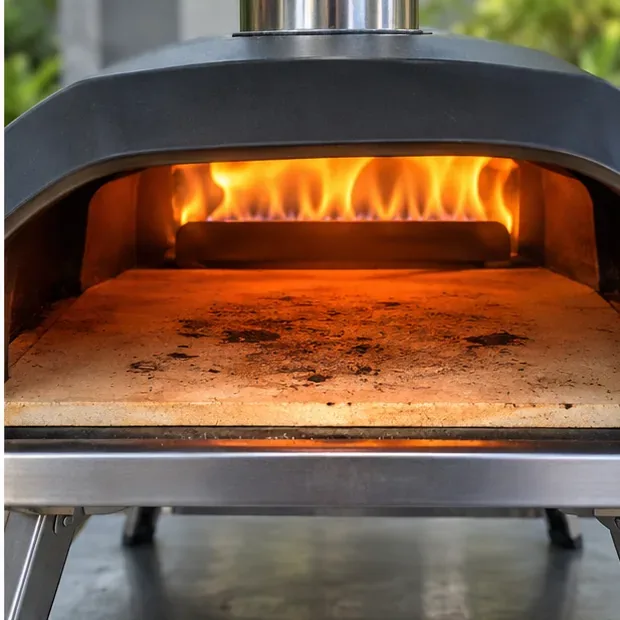
Turn the oven off and wait until the stone is completely cool before brushing aggressively, wiping, lifting, or flipping it. A hot stone can cause serious burns, and rapid temperature changes are a known risk for ceramic baking stones. Ooni also advises using protective gloves when handling and cleaning the oven.
Do not speed cooling with water. Pouring water onto a hot or warm stone creates the exact combination you want to avoid: moisture entering a porous material plus a sudden temperature change.
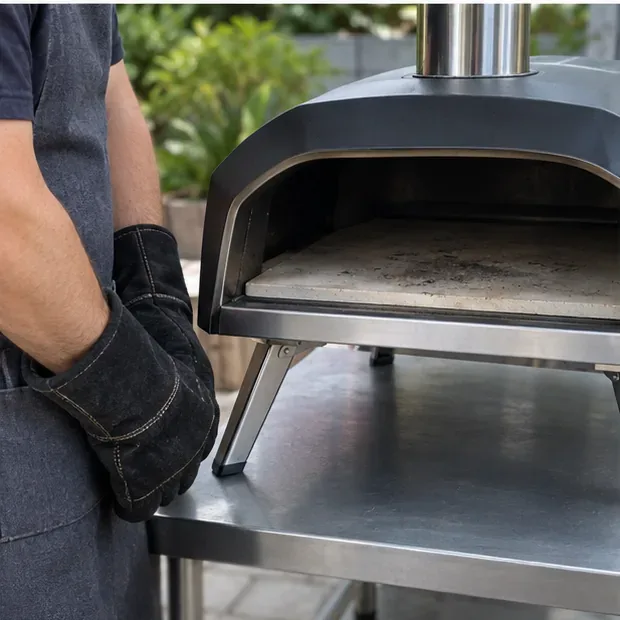
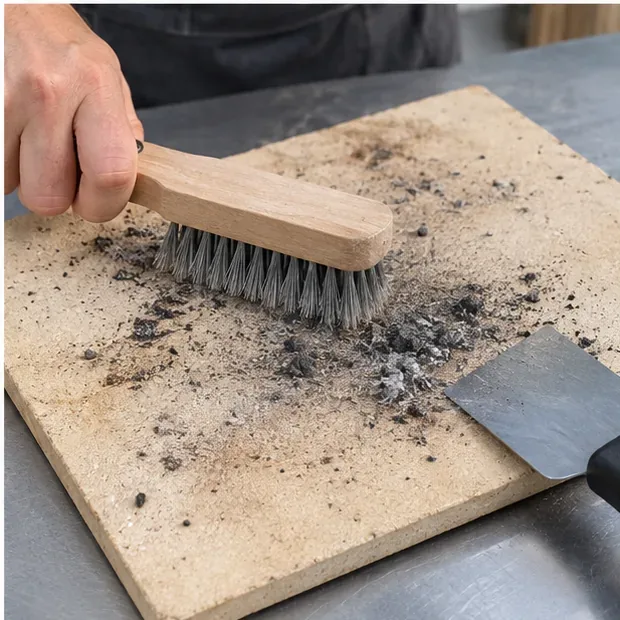
Once everything is cool, use a stiff brush to loosen the ash and carbonized material. Ooni recommends a sideways motion as well as back-and-forth brushing for hardened bits, then sweeping debris toward the front of the oven. A scraper can help with a raised patch, but use controlled pressure and keep the tool from digging grooves into the stone.
Finish by removing loose debris with a dry cloth or paper towel. The surface does not need to look uniformly pale. Stop when the loose ash is gone and the cooking surface feels reasonably smooth. Ooni specifically warns against harsh metal scourers that can damage the stone and create grooves where food is more likely to catch.
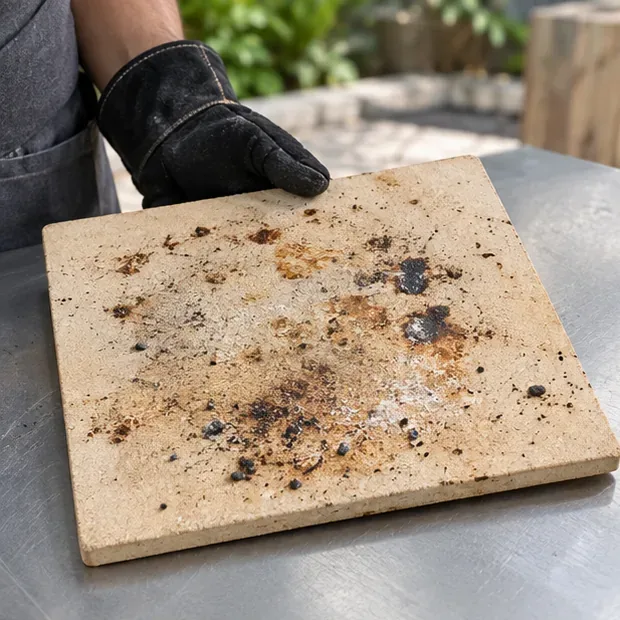
If brushing does not remove a stubborn area, Ooni's guidance says to carefully remove the stone once it has completely cooled, flip it over, and return it to the oven. During the next cook, high heat on the underside helps burn away residue from the side now facing down.
Handle the stone with both hands and follow your model's instructions for removal and orientation. Do not force a stone out of an assembly that is not designed to be removed in the same way. For Ooni's Rotating Pizza Stone, the company gives model-specific care instructions, including brushing debris between pieces and wiping the sensor with a dry cloth or paper towel.
Repeat the same sequence rather than escalating to water or chemicals: high heat, full cooling, then dry brushing or careful scraping. Thick cheese deposits may need more than one burn-off cycle. The practical sign of progress is that the material becomes dry, brittle, and easier to brush away.
If a greasy spot produces an odor when the oven heats, Ooni's cleaning guide recommends another high-heat burn-off. Avoid trying to dissolve the grease with dish detergent because the porous stone can absorb cleaning chemicals and later transfer unwanted flavors or odors.
Usually, no. Ooni describes discoloration as normal and advises owners not to force the stone back to a brand-new appearance. Brown, gray, and black marks can remain even after the surface is clean enough to cook on. A stain that is flat and dry is different from a crust of burned food sitting above the surface.
That distinction prevents over-cleaning. If you keep scraping simply because a dark mark remains, you can roughen the stone without improving how it cooks. Clean for function, not color.
| Method | Why to avoid it |
|---|---|
| Soap or detergent | The porous stone can absorb cleaning chemicals and unwanted flavors. |
| Running water or soaking | Ooni warns that absorbed moisture can contribute to cracking when the stone is heated. |
| Dishwasher | It exposes the stone to both water and detergent; Ooni explicitly advises against it. |
| Harsh metal scourers | Aggressive abrasion can groove or damage the stone surface. |
| Trying to erase every dark mark | Normal discoloration does not need to be removed if the surface is otherwise usable. |
Ooni's official pizza stone page summarizes the same core care rule: brush the cooled stone, flip it before the next use to burn off excess flour, and do not use soap or water.
Do not immediately put a wet stone into a hot oven. Ooni's public care guidance focuses on prevention and does not provide one universal drying time for every model and level of saturation. If the stone was only lightly splashed, let it dry thoroughly before considering another cook. If it was soaked, put through a dishwasher, or you are unsure whether moisture remains inside, consult your model documentation or Ooni support before reheating it. Avoid guessing at a fixed number of hours, because stone thickness, humidity, and how much water was absorbed can vary.
A hairline mark and a structurally unstable stone are not the same thing. Ooni's current cleaning guide says a small hairline crack may not affect performance, but a stone that is unstable should be replaced. Stop using a stone if pieces move, the cooking surface no longer sits securely, or a crack has developed into a separation that makes handling unsafe. For replacement compatibility, check the exact oven model rather than choosing a stone by size alone.
Before the next pizza, use this simple self-check. The goal is a functional surface, not a spotless one.
If those checks pass, the stone is generally ready for another cook. The most useful maintenance habit is also the simplest: after messy cooks, let heat do the heavy cleaning, then remove the dry residue after the oven cools. That approach follows Ooni's care guidance and avoids the two things most likely to create avoidable problems for a porous pizza stone—water and detergent.
How to Use Google Lens on Chromebook lets you scan objects, translate text, and solve problems directly from your device. Follow these steps to get started quickly.
Learn how to clean a lululemon yoga mat using current care guidance: wipe gently, avoid soaking and bleach, dry fully, and store out of sunlight.
Learn how to remove hot glue from fabric using cooling, gentle scraping, and cautious alcohol treatment, with fabric-safety checks for delicate materials.
Learn how to clean a freezer ice maker safely, remove stale ice and residue, wash and dry the bin, and know when deeper cleaning or service is needed.
Learn how to season gas grill grates safely, when seasoning is actually needed, and how cast iron, stainless, and porcelain grates differ.
Learn how to clean fabric blinds safely: identify the material, remove dust, spot-clean stains, avoid damage, air-dry correctly, and know when to call a pro.
Learn how to clean an Ooni pizza stone safely with dry brushing, high-heat burn-off, and flipping—plus what to avoid and how to know it is clean enough.
Learn how to clean a mechanical keyboard safely, from removing keycaps and dust to washing compatible caps, drying, reassembly, and testing.
Learn how to remove hardened wax from clothes safely: harden, scrape, transfer with low heat, pretreat residue, wash by the care label, and air-dry.
Clean a removable retainer at least daily, rinse it whenever you remove it, and use a deeper manufacturer-approved clean about weekly. Learn what changes the schedule.