Home
» How to
»
How to Convert Three-Phase Voltage, Current, kW, kVA, and Power Factor
How to Convert Three-Phase Voltage, Current, kW, kVA, and Power Factor
Need to move between volts, amps, kW, kVA, and power factor? For a balanced three-phase AC load, use line-to-line RMS voltage, line current, and power factor in one consistent set of formulas. The central relationships are S (kVA) = √3 × VL × I ÷ 1,000 and P (kW) = √3 × VL × I × PF ÷ 1,000. This guide explains how to choose the right inputs, solve for a missing value, and check when the simple calculation is not enough.
The Three-Phase Power Calculator follows this workflow. Its page was reviewed on October 13, 2026. The calculator states that it assumes a balanced load and sinusoidal voltage and current; that limitation matters when a real installation is unbalanced or has significant harmonics.
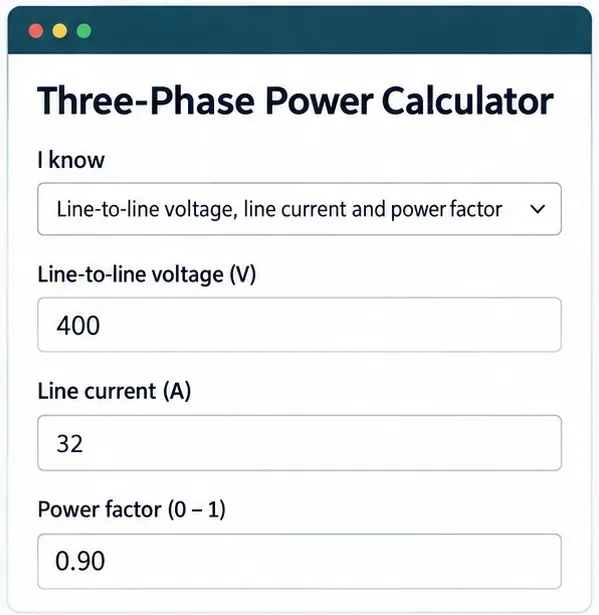
Figure 1. Enter the measured or specified line-to-line voltage, line current, and power factor in the matching fields.
Know which quantity you have
Symbol
Meaning
Unit
Use this in the formula
VL
Line-to-line RMS voltage, measured between two phase conductors
V
Voltage input
I
Line current on a phase conductor
A
Current input
P
Real or active power
kW
Useful electrical power
S
Apparent power
kVA
Voltage-current capacity
PF
Power factor, P divided by S
Unitless, typically expressed from 0 to 1 here
Relationship between kW and kVA
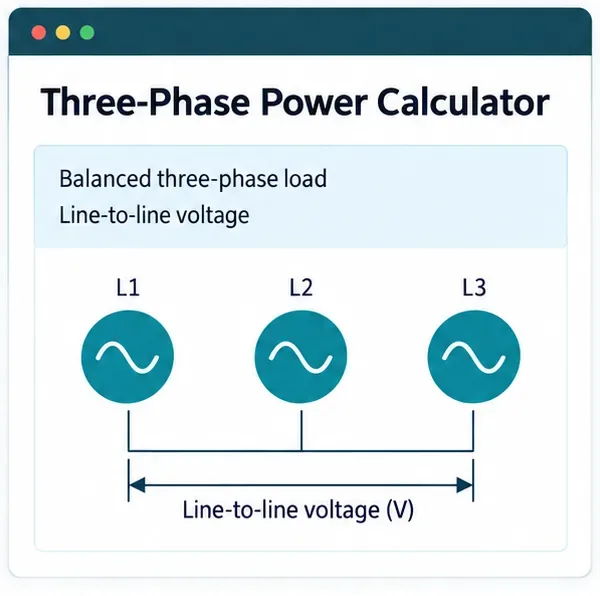
Verified: For a balanced three-phase system, the three phase voltages have equal magnitudes and are separated by 120 electrical degrees. The line-quantity formulas below are standard for that balanced case. Action: Check the nameplate, meter, or measurement record to see whether a voltage is line-to-line or line-to-neutral before entering it.
The formulas to convert between values
Figure 2. The balanced three-phase formulas use line voltage and line current; power factor is included when solving real power.
Use VL in volts and I in amps. Divide by 1,000 to express the result in kilo-units:
Apparent power: S (kVA) = √3 × VL × I ÷ 1,000
Real power: P (kW) = √3 × VL × I × PF ÷ 1,000
Power factor: PF = P (kW) ÷ S (kVA)
Current from real power: I (A) = P (kW) × 1,000 ÷ (√3 × VL × PF)
Current from apparent power: I (A) = S (kVA) × 1,000 ÷ (√3 × VL)
Voltage from real power: VL (V) = P (kW) × 1,000 ÷ (√3 × I × PF)
Apparent power from real power: S (kVA) = P (kW) ÷ PF
The √3 factor belongs with line-to-line voltage and line current for a balanced system. If you instead use per-phase voltage and current, total power is three times the per-phase value. Do not mix line voltage with phase current or phase voltage with line current in a formula meant for the other set of quantities. Schneider Electric’s three-phase power reference defines the line quantities and the corresponding √3 relationship.
Step-by-step: calculate and check one example
Step 1: Select the values you already know
Start with values measured or given for the same load and operating condition. The example uses 400 V line-to-line, 32 A line current, and PF 0.90. If you know kW rather than current, use the calculator’s input selection to solve for amps. Do not assume a motor’s nameplate current is its actual running current at every load.
Step 2: Confirm the voltage is line-to-line
Enter the RMS voltage between two phase conductors—not a line-to-neutral value—in VL. The calculator page describes this as the voltage measured between any two phases. For a nominal 400/230 V supply, 400 V is line-to-line and about 230 V is line-to-neutral; these values are not interchangeable. Action: If the source only says “230 V” or “400 V,” verify which pair of terminals the rating refers to before continuing.
Step 3: Enter the line current and power factor
Enter 32 A and PF 0.90 for the example. Power factor must be a decimal between 0 and 1 for this calculator, so 90% becomes 0.90. If the meter gives a percentage, convert it; if it gives a leading or lagging value, use the magnitude for this basic calculation and retain the lead/lag information separately where it matters.
Step 4: Calculate, then compare with the equations
For 400 V, 32 A, and PF 0.90:
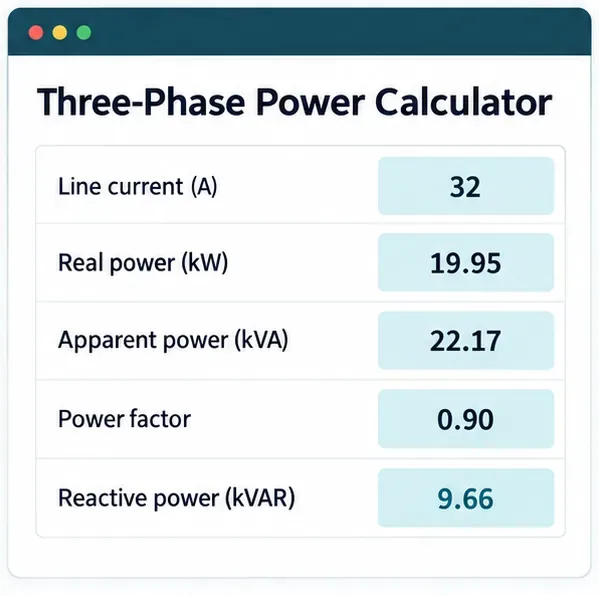
S = √3 × 400 × 32 ÷ 1,000 = approximately 22.17 kVA.
P = √3 × 400 × 32 × 0.90 ÷ 1,000 = approximately 19.95 kW.
PF = 19.95 ÷ 22.17 = approximately 0.90.
Rounding explains small differences in the final decimal. If using the conventional sinusoidal power triangle, reactive power magnitude is Q = √(S² − P²), which is about 9.66 kVAR in this example. That magnitude alone does not tell you whether the load is leading or lagging.
Figure 3. The worked example reports approximately 19.95 kW real power and 22.17 kVA apparent power.
To reverse-check the result, substitute 19.95 kW, 400 V, and 0.90 into the current equation: I ≈ 19.95 × 1,000 ÷ (√3 × 400 × 0.90) ≈ 32 A. The result should return close to the original current, subject to rounding. If it does not, check the units and inputs before trusting the output.
Common misunderstandings—and what to do
“kW and kVA are the same.” They are equal only when PF is 1. Otherwise, kW = kVA × PF, so apparent power is greater than real power for a positive PF below 1. Action: Keep the PF value with any kW-to-kVA conversion.
“Power factor always equals cos φ.” This is true for sinusoidal voltage and current, but distorted current can make total PF differ from displacement PF. Schneider Electric distinguishes total PF (P/S) from cos φ and notes that harmonics affect the ratio. Action: For a nonlinear load such as a drive or electronic power supply, use a power-quality meter’s true PF when accuracy matters.
“Any three-phase system can use this one formula.” The calculator explicitly assumes balance and sinusoidal waveforms. Unequal phase currents, distorted waveforms, or system-specific measurement methods may require per-phase readings or a power analyzer. Action: Compare phase voltages and currents; if they differ materially, stop treating the result as a definitive total.
“The calculator tells me what cable, breaker, or transformer to install.” It converts electrical quantities; it does not establish conductor ampacity, protective-device ratings, temperature correction, fault protection, or local code compliance. Action: Use applicable electrical codes, equipment data, and a qualified electrical professional for design and installation decisions.
Figure 4. Before relying on a single balanced-load calculation, confirm that the three phases are reasonably balanced.
When the result is dependable—and when to change approach
Good fit: a balanced three-phase load with known RMS line-to-line voltage, line current, and a suitable power factor, under the sinusoidal assumption stated by the tool. Use it for a quick conversion, a plausibility check, or a worked example.
Depends on the installation: whether a reported PF is true PF or displacement PF, whether currents are balanced, and whether the figures are nameplate ratings or measured operating values. Action: Record the source and operating point for each input instead of combining values from different conditions.
Not determined by this calculation: energy consumption over time (kWh), motor shaft output, efficiency, conductor sizing, or safe protection settings. A kW result is power at that operating point; energy requires power over time, and motor output also depends on efficiency. Action: Choose the calculation that matches the actual question and consult manufacturer data or a qualified professional for equipment selection.
Live electrical measurements can expose workers to shock and other hazards. OSHA’s electrical training rules distinguish qualified persons permitted to work on or near exposed energized parts and require relevant skills and training. Do not open energized equipment or take live measurements unless you are trained and authorized for that work; use a qualified electrician or technician where needed.
Final check
Did you use line-to-line RMS voltage and line current?
Did you enter PF as a decimal and use values from the same load and operating condition?
Does kVA × PF return approximately the calculated kW?
Do phase balance and waveform assumptions fit the actual system?
Are you using the result only for conversion, rather than as a substitute for electrical design or code review?