Home
» How to
»
How to Get Ink Out of a Pen: Restore Smooth Ink Flow Without Damaging It
How to Get Ink Out of a Pen: Restore Smooth Ink Flow Without Damaging It
If a pen has ink but barely writes, the goal is not simply to make one mark appear. A good recovery should give you a continuous, predictable line at normal writing pressure without repeated skipping, blobs, or leaks. The safest way to get ink flowing again depends on the pen type: a refillable ballpoint or gel pen is usually better served by checking or replacing its refill, while a clogged fountain pen can often be flushed with water according to the manufacturer’s instructions.
That distinction matters because pen inks are not all the same. Zebra explains that ballpoint pens commonly use higher-viscosity oil-based ink, while gel pens use lower-viscosity water-based ink. Rollerballs and fountain pens have different feed systems again. A trick that is harmless for one design can be ineffective or damaging for another.
What Counts as a Successful Fix?
Use the writing result, not the number of tricks you tried, as the measure of success. After any intervention, the pen should:
start writing without unusually heavy pressure;
produce an unbroken line through several words, loops, or strokes;
keep the same ink density instead of fading after a few inches;
avoid sudden blobs, leakage around the tip, or ink on the barrel;
continue writing after a short pause rather than needing to be restarted every time.
If the pen writes only while you press hard, works for a few seconds and stops again, or leaks after you “revive” it, the result is not stable. Change tactics rather than escalating force, heat, or chemicals.
Choose the Method by Pen Type
Pen type
Best first approach
When to change approach
Ballpoint
Check that the refill is installed correctly, then test the tip on clean paper with normal pressure.
If flow stays intermittent or the refill is spent, replace the correct refill.
Gel pen
Confirm the refill is seated and capped/retracted correctly, then test briefly on clean paper.
If the sealed refill still skips consistently, replacement is lower risk than heating or adding solvent.
Rollerball
Keep the cap on when stored and test the installed refill.
If a refill does not perform, replace it with the compatible rollerball refill for that pen.
Fountain pen
Check that the cartridge or converter is seated and that ink can reach the feed.
If dried ink is blocking the feed, follow the maker’s water-flushing procedure.
Step 1: Identify the Pen and Open It Only as Designed
Before trying to force ink through the tip, determine whether the pen is disposable or refillable and what refill family it uses. Many refillable ballpoints and rollerballs open by unscrewing the barrel or grip section. Do not assume that every refill with a similar shape is interchangeable.
Cross states that its ballpoint and rollerball refills are generally not interchangeable because their mechanisms and housings differ. Parker’s ballpoint and gel care guide likewise directs users toward the appropriate refill rather than modifying the existing one.
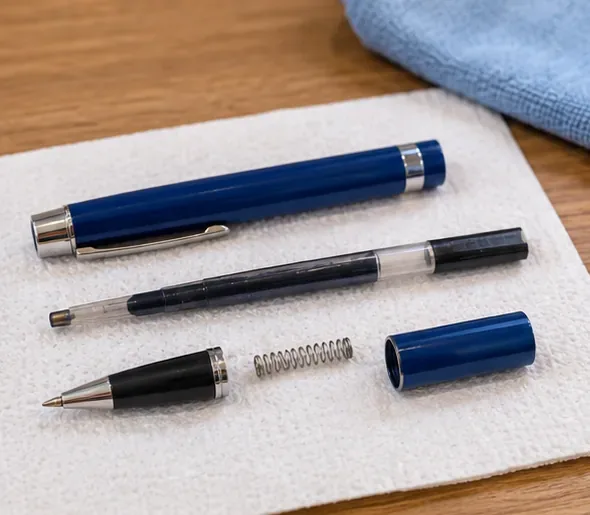
A refillable pen opened into its main parts. Keep the spring and refill orientation in order so the pen can be reassembled correctly.
If the pen is a disposable ballpoint or gel pen with a sealed body, there may be no serviceable internal part. In that case, avoid prying the barrel open merely to reach the ink. The most useful test is whether the tip can produce a stable line; if not, replacing the pen may be the practical endpoint.
Step 2: Check the Refill, Seating, and Tip
Look for an obvious empty refill, a cracked tube, a damaged writing tip, or a refill that is not fully seated in the pen. If the pen uses a spring, confirm that the spring is in the same position it had before disassembly.
Correct seating matters most obviously in cartridge-fed pens. Zebra’s V-301 fountain pen guidance notes that the cartridge must engage far enough to puncture its seal; otherwise ink will not flow properly. That specific advice applies to that cartridge system, but the broader lesson is useful: before assuming dried ink, first confirm that the ink source is actually connected as designed.
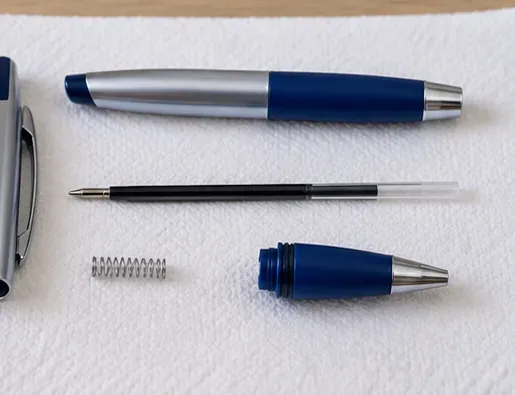
Inspect the refill and small hardware before reassembly. A wrong refill, damaged tip, or misplaced spring can prevent normal operation even when ink remains.
Do not puncture, cut, squeeze, or inject a sealed ballpoint, gel, or rollerball refill. The refill is designed as a controlled ink-delivery system. Opening it can create leaks without fixing a worn or clogged writing point.
Step 3: Try a Short, Controlled Writing Test
Reassemble the pen correctly and test it on clean, ordinary writing paper. Use normal handwriting pressure and make a few slow lines or loops. The purpose is to rotate or wet the writing point through normal use, not to grind it into the paper.
This is a practical checkpoint rather than a manufacturer-defined time limit: if a brief test produces a continuous line and the pen keeps writing after a pause, the recovery is probably sufficient. If the line repeatedly disappears, becomes extremely faint, or requires heavy pressure, stop. More force can damage the tip or paper without correcting a spent refill.
For a refillable ballpoint, gel pen, or rollerball, this is usually the point to switch from “restart” to “replace.” Cross and Parker both provide model-specific refill guidance, and using the correct refill preserves the geometry and mechanism the pen was designed around.
After the refill and internal parts are seated correctly, reassemble the pen before testing. Do not leave the mechanism loose while writing.
Step 4: Use the Correct Recovery Path if Ink Still Does Not Flow
For Ballpoint, Gel, and Rollerball Pens
If the refill still will not produce a stable line, replacement is usually the lowest-risk next step. Cross’s refill guide separates ballpoint, rollerball, porous-point, and fountain-pen ink systems, while Parker’s support pages similarly treat ballpoint/gel and rollerball refills as distinct components.
Storage also affects future reliability. Parker recommends storing rollerball pens capped to help protect the refill from drying out. For retractable ballpoint and gel models, retract the tip when the pen is not in use and follow the maker’s storage guidance.
For Fountain Pens
Fountain pens are the important exception because their nib and feed are designed to be cleaned. Parker’s fountain pen care guide instructs users to remove the cartridge or converter, flush the nib and gripping section with cool water, and dry the parts with a soft lint-free cloth. For a clog, Parker says the nib and gripping section can be soaked in cool water for up to 24 hours because its fountain-pen ink is water-soluble.
Kaweco’s official nib service instructions describe pumping lukewarm water through the nib with a converter until the water runs clear, and specifically say to avoid cleaning solutions or detergents. These instructions are for fountain-pen feed systems, not sealed ballpoint or gel refills.
Methods to Avoid Unless Your Pen Maker Specifically Recommends Them
Internet fixes often suggest heating the tip with a lighter, dipping a refill in boiling water, soaking it in alcohol, spinning the pen to force ink toward the point, or injecting solvent into the ink tube. The manufacturer guidance reviewed for this article does not recommend those as general-purpose fixes for ballpoint, gel, or rollerball refills.
That matters because ink chemistry, plastics, seals, adhesives, and tip construction differ among products. Heat may deform parts, solvents may attack materials or alter ink, and forced pressure can create leaks. If the maker of your exact pen does not prescribe one of these methods, replacing the refill is the more predictable route.
How to Judge the Final Result
After the pen writes again, test it with a short sentence and several continuous lines. The best sign is consistency, not simply that ink appears once.
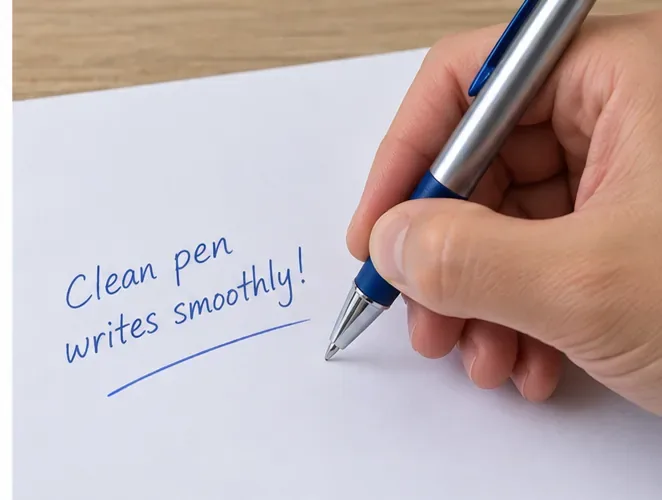
Judge the repair by a continuous line at normal pressure. A pen that still skips, fades, or needs heavy pressure is not fully recovered.
If the line is continuous and stays consistent after a brief pause, you can return the pen to normal use. If it skips at the same spots, immediately fades, or leaves blobs around the tip, change approach. For refillable ballpoints, gel pens, and rollerballs, install a compatible replacement refill. For fountain pens, repeat only the cleaning process allowed by the manufacturer and seek service if flow remains poor.
When the Pen Is Probably Beyond a Simple Fix
The writing tip is bent, cracked, or visibly damaged.
The refill leaks around the tip or tube.
The ink supply is exhausted.
A compatible new refill also does not extend or sit correctly, suggesting a mechanical pen problem.
A fountain pen remains clogged or leaks after the maker’s approved cleaning process.
At that point, further home treatment is less likely to improve writing quality. For a valuable or warrantied pen, use the manufacturer’s repair or support channel. Parker, for example, directs users to support when a refill does not perform or when maintenance beyond regular cleaning is required.
Bottom Line
To get ink flowing from a pen, start with the least invasive fix that matches the pen’s design. Identify the pen and refill, confirm the ink source is seated correctly, test with normal writing pressure, and judge success by a stable line. Replace sealed ballpoint, gel, or rollerball refills when they continue to skip rather than escalating to heat or solvents.
For fountain pens, water flushing is different because the nib and feed are serviceable parts, but even there the water temperature, soaking time, and use of cleaning solutions should follow the manufacturer’s instructions. A reliable result is a pen that writes smoothly and predictably—not a pen that produces ink only after increasingly aggressive tricks.