Home
» Technology
»
Navigating Global Supply Chain Disruptions with Digital Twin Technology
Navigating Global Supply Chain Disruptions with Digital Twin Technology
Global supply chains rarely fail in one neat, isolated place. A port delay can interact with a supplier shortage, a production bottleneck, an inventory imbalance, and a sudden change in demand. The practical challenge is not simply detecting that something went wrong. It is understanding how the disruption will propagate, which customers and products are exposed, and which response creates the best trade-off among service, cost, risk, and recovery time.
That is the role a well-designed supply chain digital twin can play. A digital twin is a synchronized virtual representation of a real system. In supply chain work, that system may include suppliers, factories, ports, warehouses, transportation lanes, inventory positions, orders, capacities, lead times, and business rules. Unlike a static network diagram or a dashboard that only reports the past, a useful twin combines current data with models that can test what may happen next.
Recent disruptions make that distinction important. In its September 2025 maritime review, UN Trade and Development reported that maritime shipping carries more than 80% of world trade and described continuing pressure from rerouting, volatile freight costs, and port disruption. The point is not that every company needs a complex global model. It is that disruption often travels through connected networks, so decisions made at one node can create effects elsewhere. See the UNCTAD 2025 maritime trade update.
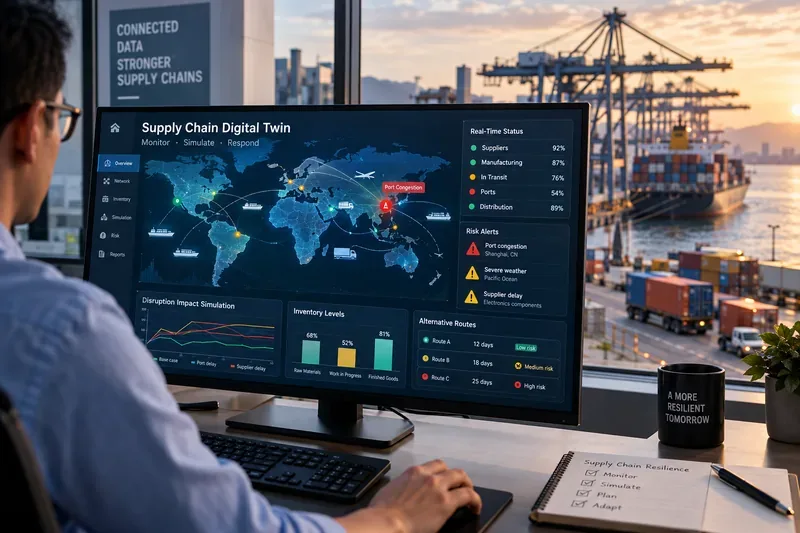
Example of a logistics control-room view: a network map, risk alerts, inventory levels, and route scenarios are shown together so planners can compare disruption responses in context.
Start with the right definition: a digital twin is more than a dashboard
For a beginner, the easiest mistake is to call any real-time visualization a digital twin. A dashboard can show shipment status, stock levels, or supplier performance. A digital twin goes further by connecting those observations to a model of how the system behaves.
The U.S. National Institute of Standards and Technology (NIST) describes digital twins as synchronized virtual models that can help users observe, diagnose, predict, and optimize real systems. NIST also emphasizes verification, validation, interoperability, and uncertainty rather than treating the model as automatically trustworthy. Its Digital Twins for Advanced Manufacturing project, updated in July 2026, is a useful reference for these principles.
In a supply chain context, that means the twin should answer questions such as: What is happening now? What is likely to happen if nothing changes? What alternatives are feasible? What is the expected effect of each alternative? And how confident should the planner be in the answer?
What you need before building anything
A digital twin project should begin with a business decision, not a technology purchase. Choose a disruption problem that is frequent enough, costly enough, and measurable enough to justify modeling. Examples include inbound material shortages, port closures, constrained production capacity, cold-chain excursions, late supplier deliveries, or inventory allocation across distribution centers.
1. Define the decision the twin must improve
A narrow question is easier to validate than a vague goal such as “make the supply chain resilient.” A stronger starting point is: “When a critical supplier slips by more than three days, identify affected orders and compare feasible recovery options within 30 minutes.” The exact threshold will vary by business, but the structure is important: event, affected scope, decision, and expected response time.
2. Map the minimum viable network
List only the entities and relationships needed for that decision. Typical entities include suppliers, parts, bills of material, plants, ports, lanes, carriers, warehouses, customers, and orders. Relationships explain dependency: a part feeds a plant, a plant serves a distribution center, a lane connects two nodes, or an order consumes a specific component.
This network is often represented as a graph. Microsoft’s official Azure Digital Twins overview is one concrete example of an architecture that models real environments as connected entities and relationships, then updates them from IoT and business-system data. A supply chain twin does not have to use Azure, but the graph concept is useful regardless of platform.
3. Inventory the data you can actually maintain
Do not design around data that exists only in a slide deck. Identify authoritative sources, owners, update frequency, latency, and expected quality. Common sources include ERP, transportation management systems, warehouse management systems, supplier portals, IoT sensors, carrier feeds, purchase orders, inventory records, production schedules, and master data.
Business question
Minimum useful data
Typical model output
Quality signal
Which orders are at risk?
Orders, inventory, bill of material, supplier status
Exposure by customer or product
Exposure matches known operations cases
Should freight be rerouted?
Routes, lead times, capacity, costs, port or carrier events
Alternative route scenarios
Feasible routes and realistic transit assumptions
Where should scarce inventory go?
Inventory, demand, service priorities, replenishment times
Allocation recommendations
Service and inventory trade-offs are visible
Will a plant outage create a shortage?
Capacity, production plan, dependencies, buffers
Projected shortage window
Prediction error is tracked over time
Build the twin in stages instead of trying to model the world
Stage 1: Create a visibility twin
The first version should establish a reliable current state. It should know which nodes exist, what inventory is available, which orders are moving, where delays are occurring, and which dependencies matter. At this stage, the twin may not predict much. That is acceptable if it replaces fragmented spreadsheets and inconsistent status reports with a trusted operational picture.
Success is visible when planners spend less time reconciling contradictory data and can trace an exception back to its source. If teams still debate basic quantities or node identities, adding machine learning will usually make the problem harder rather than better.
Stage 2: Add scenario simulation
Simulation turns visibility into decision support. The model can ask “what if?” questions: What if a port is unavailable for five days? What if transit time on a lane doubles? What if a supplier can only fulfill 60% of an order? What if demand shifts from one region to another?
The key is to model the operational consequences, not just the event. A port disruption matters because it changes lead time, inventory arrival, plant material availability, customer service, and potentially freight cost. A useful twin propagates those dependencies through the network.
Stage 3: Add optimization only after simulation is credible
Once the model can reproduce known operational behavior within an acceptable error range, optimization can compare recovery actions. Depending on the use case, it might recommend rerouting freight, changing a production sequence, reallocating inventory, using a secondary supplier, or prioritizing selected customers.
The recommendation should include constraints and trade-offs. “Use Route B” is weak advice. “Route B avoids the blocked port, adds two days to transit, consumes available capacity, protects the priority customer order, and increases landed cost” gives a planner enough context to make a decision.
Stage 4: Automate cautiously
Closed-loop automation means the system can trigger actions with limited human intervention. This is appropriate only where inputs are dependable, business rules are clear, and failure modes are understood. Many organizations should keep high-impact actions advisory, especially those affecting supplier commitments, regulated products, customer allocation, or expensive premium freight.
A simple disruption example
Consider a hypothetical electronics company whose primary inbound route uses a congested port. The visibility layer detects the delay and identifies three purchase orders carrying a component needed by two factories. The simulation layer estimates when each factory will run below safety stock if no action is taken. The scenario engine then compares alternatives such as waiting, diverting through another port, using air freight for a partial quantity, or reallocating inventory between factories.
The important output is not a single “best” answer. The useful output is a ranked set of feasible options with assumptions, expected service impact, cost impact, capacity requirements, and uncertainty. That gives the planner a structured choice rather than a false sense of certainty.
How to judge whether the twin is producing good results
A polished 3D model is not evidence of a useful digital twin. Quality should be measured against the decisions the system is supposed to support.
State accuracy: Do inventory, order, shipment, and capacity values reconcile with operational systems?
Event latency: How long does it take for a real-world change to appear in the twin?
Network coverage: Are the critical suppliers, lanes, and dependencies represented, or are important blind spots hidden?
Prediction calibration: When the twin predicts lead time, shortage risk, or recovery date, how large is the error?
Scenario feasibility: Do proposed alternatives respect actual capacity, contracts, geography, compliance, and operating constraints?
Decision lead time: Does the twin help teams act earlier than the current process?
Business outcome: Over time, does it improve service levels, reduce disruption cost, lower emergency freight, or shorten recovery time?
NIST’s 2026 research on supply chain digital twins is especially useful here because it highlights both potential and unresolved gaps. The study identifies real-time monitoring, simulation, and optimization as valuable functions, while also pointing to data quality and accessibility, privacy and security, and return-on-investment assessment as important barriers. See the NIST supply chain digital twin study published March 16, 2026.
When to change your approach
Not every supply chain problem needs a full digital twin. If data arrives only once per week, a complex real-time architecture may add cost without changing decisions. If the network is small and stable, a conventional planning model or discrete-event simulation may be enough. If the organization lacks consistent master data, start with data governance and integration before expanding the model.
Change course when you see one of these signals:
The model is detailed, but planners do not trust its basic state.
Simulation takes longer than the decision window.
Most effort goes into maintaining custom integrations rather than improving decisions.
Recommendations repeatedly violate real operating constraints.
The twin requires data partners are unwilling or unable to share.
The cost of updating the model exceeds the value of the disruptions it addresses.
A smaller twin focused on one product family, region, or disruption type can be more useful than an ambitious enterprise model that is never validated.
Common mistakes beginners should avoid
Trying to twin the entire supply chain on day one
Global networks contain thousands of entities and relationships. Modeling all of them before proving a use case increases integration cost and validation difficulty. Start with the decisions that matter most, then expand coverage as evidence of value grows.
Confusing more data with better decisions
A twin needs relevant, governed data, not every available field. High-volume sensor streams do not compensate for missing supplier lead times, incorrect part mappings, or inconsistent location IDs.
Treating model output as fact
Every simulation depends on assumptions. Lead times vary. Supplier capacity may be uncertain. Weather forecasts change. Demand can shift. Good twins expose uncertainty rather than hiding it behind a single precise number. NIST’s digital twin work explicitly emphasizes verification, validation, and uncertainty quantification.
Optimizing locally
An action that protects one warehouse may starve another. Expediting one customer order may consume capacity needed for a larger commitment. The purpose of a network twin is to make these interactions visible so that local fixes do not create larger downstream problems.
Assuming resilience means bringing everything home
Resilience is about managing dependencies, alternatives, buffers, and response options, not automatically eliminating global trade. The OECD Supply Chain Resilience Review published June 2, 2025 found that broad relocalization scenarios could reduce global trade by more than 18% and global real GDP by more than 5%, while not consistently improving resilience. Digital twins are useful partly because they let companies test targeted changes before committing to costly structural moves.
What digital twins cannot solve
A digital twin cannot create visibility where no data is available. It cannot force suppliers to share accurate capacity information, guarantee that a carrier will accept an alternative route, or predict rare events with certainty. It also cannot remove the need for contracts, safety stock, supplier development, cybersecurity, business continuity planning, or human judgment.
Cross-company twins create additional governance questions: who owns shared data, how frequently it is updated, which party can correct it, how confidential information is protected, and what happens when two sources disagree. These issues are often harder than the simulation itself.
A practical starting roadmap
For a first project, select one disruption class and one decision. Map the minimum network required, identify authoritative data sources, establish baseline metrics, and build a current-state model. Validate that state with planners before adding predictions. Then simulate a small set of known historical disruptions and compare modeled outcomes with what actually happened. Only after the model behaves credibly should you add optimization or automation.
Keep the objective simple: the digital twin should help the organization see a disruption earlier, understand its likely consequences, compare feasible responses, and make a better decision within the time available. If it cannot do those things reliably, adding more graphics, data feeds, or algorithms will not fix the core problem.
For readers who want the standards perspective, NIST’s Manufacturing Digital Twin Standards overview discusses ISO 23247 and the broader challenge of making twins interoperable and trustworthy. Those concerns matter beyond manufacturing because supply chain twins often need to connect many systems, organizations, and lifecycle stages.
Bottom line
Digital twin technology can make supply chain disruption management more disciplined by connecting live operational data with network models, simulation, and optimization. Its value is highest when it is tied to a specific decision, fed by dependable data, validated against real outcomes, and transparent about uncertainty.
For beginners, the best path is not to build the largest possible twin. Build the smallest model that can answer an important disruption question credibly, prove that it improves decisions, and expand only when the evidence supports the next step.