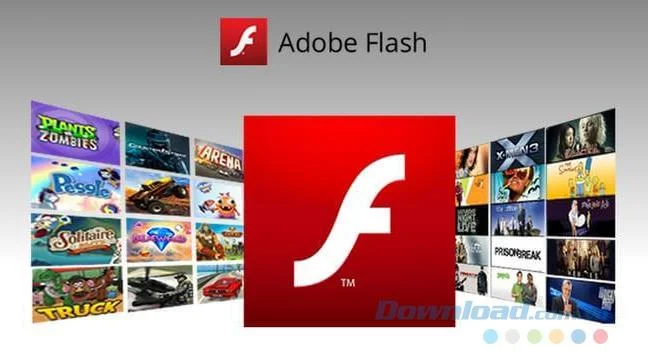
For those who already use computers, Adobe Flash Player (or Flash for short) is probably a familiar word. Every time the browser reports Flash, Youtube gets a black screen , the error of not installing Flash or a lot of other errors related to this "troublemaker" makes the computer unable to operate smoothly and as desired.
So in fact, Flash is software or what utility? What is the effect and how is it installed? What if there is no Flash? Does it really matter to the computer? We will explore all of that in today's article.
Adobe Flash Player is a product of the US computer software group - Adobe Systems . At first, Flash was called FutureSplash and later, when Adobe Systems made the decision to acquire Macromedia, the program was renamed to Macromedia Flash (or Flash for short).
In essence, Flash is a computer program that uses vector graphics techniques and point graphics used primarily on web browsers. By using its own "language" ActionScript, Flash is capable of transmitting and downloading visual or audio data.
In a nutshell, Flash is a program that supports web browsers as well as the interaction between these browsers and computers so that users can watch videos directly, or listen to audio directly from the web without software.
A tool to create applications for designing simulation software and animations.
The video is played with the best quality thanks to Flash
Videos on most websites are mostly Flash Videos. Therefore, in order to view these videos, you must have Adobe Flash Player installed . And thanks to the advanced technology built in, low bandwidth, these videos will be presented with the best quality without any difficulties.
Flash helps you view high-quality images with GIF, Progressive JPEG, PNG ... and many other formats.
In addition, this tool also supports many different compression methods to help you experience 2D and 3D graphics of videos and images easily without losing quality.
Speed up mobile web surfing
Flash has supporting software called Adobe Flash Player. This tool can be installed for use on mobile devices such as smartphones, iPads, tablets, Smartbooks, Netbooks, etc., increasing the browsing speed of these devices as well as helping us view them. get better online videos.
Increase sharpness for text files
Adobe Flash Player has a built-in Rendering tool. This tool is used for text files, helping data of this format to be viewed with high definition, font size, font as well as the most perfect display mode.
Speed up hardware operations
Not only does it support the display of videos on any website, Flash also allows us to watch these videos on popular computers or mobile devices (such as smartphones) with the best quality, high definition, or even the HD standard, but the cost is minimal.
Integrated effects with real time
Flash has many different effects in real time, and it comes with filters like Blur, DropShadow, Glow, Bevel, Gradient Glow, Gradient Bevel ...

Of the most commonly used web browsers today, only Google Chrome has built-in Adobe Flash Player and is available by default. Updated versions of Adobe Flash Player are included with the Google Chrome system update. And other browsers such as Firefox, Opera , Safari , Internet Explorer ... must have Adobe Flash Player installed to view videos and images in the best way.
Support online gaming
Online games today have really become an industry, a real industry. And web games are one of the most popular and popular game genres. Because we do not need to download or install any software, just open the browser and play, Adobe Flash Player will help you play games on the browser.
Advantages of Flash
- Flash can embed audio and animation files. Because the ability to support very well for the presentation of multimedia files or animation effects, this is also the "darling" of any website designer.
- With vector graphics - very small file size, Flash is extremely convenient for data transmission over the Internet and this is also the biggest advantage of this multimedia creation program.
Cons of Flash
- Over the past few years, Flash has been constantly exposed (or has) serious security holes. Therefore, websites and products that were created from this tool are at great risk of being attacked by hackers.
- It is for this reason that a large number of giants such as Facebook , Youtube , Firefox ... all simultaneously "boycott" Flash and call Adobe to "kill" this program.
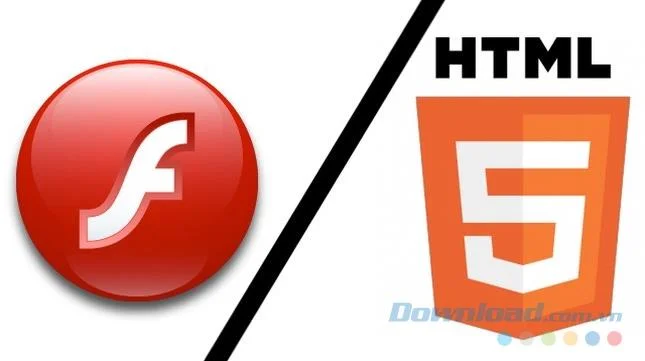
- According to technology experts, leading security companies in the world, Flash is now obsolete and no longer appropriate, nor can it be advanced and secure using HTML5 or WebGL standards .
Flash file format
One noticeable point is that Flash files almost always have the .swf extension (Shockwave Flash) and can be displayed by Web browsers such as ( Chrome , Mozilla Firefox, Internet Explorer , Coc Coc ... ) or the Flash Player application.
Flash files are also often animations, advertisements or other decorative elements of a Web page. Recently Flash has also been used to create richer Internet applications. If you have to compare the dimensions and features, then at the same size, a Flash file can contain more information than an image file in GIF or JPEG format.

Practical application of Flash
- Flash is a tool for designing, developing and creating simulation software design applications. At the same time, the ActionScript "language" used by Flash can also be used to create interactions, animations in movies.
- The strength of Flash is that it is possible to embed audio and animation files. Any programmer can take the initiative in setting out the navigation for the program.
- In fact, Flash can also be exported into different file formats such as HTML, EXE, JPG, JPEG ... to best suit the applications of their users on different media and tools. .
According to many, " Macromedia Flash " should be used to invoke the program to create Flash files. The " Flash Player " should be reserved only for applications that execute or display those Flash files. However, since both terms have the word "Flash", by default, it is used to call and talk about both programs. Specifically:
Website
- Flash can be a whole website or it can be just a part of that website. We can see the easiest is the flash video player of the world famous video sharing site - Youtube. Although only encapsulated within a player to watch videos, what this site brings is not small and we all know.
- Banners, advertisements, intros, are so common and can be found on many websites (gamevui).
Animation
- Animation sites, or websites for learning online, learning English through songs, images ... and many other difficult and complex applications but also a very nice interface.
Conclude:
Science and technology are constantly changing day by day, "development spiral" will produce new things, deny and "overshadow" the old. Therefore, "regress Flash" is an inevitable inevitable.
However, it is also undeniable that Flash has done very well, perfect the role of a "predecessor". It is a very important historical premise, while HTML5 and WebGL are still just "ideas", definitions being tested or lying on a desk.