
Pop Culture Costume Ideas That Will Dominate Halloween 2026

Plan a recognizable Halloween 2026 look with pop culture costumes inspired by Spider-Man, Supergirl, Toy Story 5, Moana, Mario, and Wednesday.
There are different ways in Excel to remove decimals and shorten numeric values. In this article, Quantrimang.com will explain how to use the TRUNC function and point out what makes it different from other techniques.
What is the TRUNC function?
The TRUNC function is a Mathematical and Trigonometric function in Excel, which helps to remove the fractional part of a number, or in other words, round the decimal number to an integer. It was first introduced in MS Excel 2007.
How to use the TRUNC function
Let's look at some TRUNC function examples with some sample data. The example below uses the following TRUNC function.
=TRUNC(A2)
If you do not specify how many digits to truncate, all decimal places will be discarded.
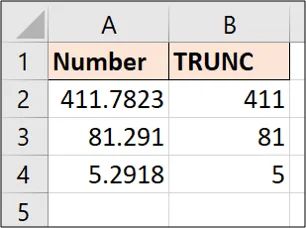
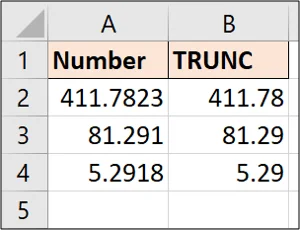
You can see with the value in cell A2 that the TRUNC function does not apply any rounding. It simply truncates to 411.
Let's look at another example. This time the example will reduce the values to two decimal places.
=TRUNC(A2,2)
The TRUNC function will not display extra decimals if you ask it to display more than you have.
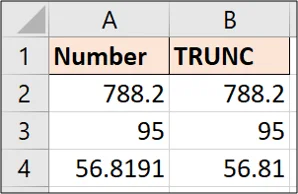
Take the following example and truncate it to 2 decimal places.
=TRUNC(A2,2)
The value in cell A4 is reduced to 2 decimal places, but the values in A2 and A3 remain the same because they have less than two decimal places.
If you want to display two decimals, the cells will need to be formatted to force them to display.
Remove time of day and timestamp
A useful example of TRUNC is removing the time portion from dates and timestamps in Excel.
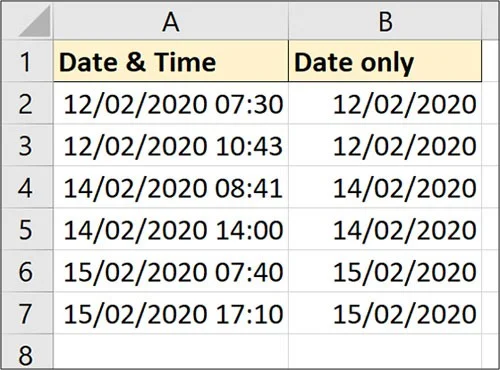
Imagine you have the following date and timestamp, but you only want the date part in the column for analysis.
The following formula will remove the time part.
=TRUNC(A2)
Even though the time portion has been removed, the resulting cells will still need to be formatted as dates.
Use TRUNC to shorten numbers
This is a rare technique. When you use a negative number, the function will truncate the numbers to the left of the decimal point. However, it does not change the number of digits, but replaces them with zeros.
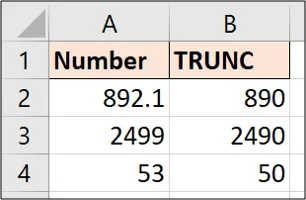
Look at the following example.
=TRUNC(A2,-1)
You can see in each example that a 0 is used to replace the number removed to the left of the decimal point.
There are many ways to remove decimal places, however, most of these will round the number in Excel . The beauty of the TRUNC function is that it does not round the values and simply shortens them to the specified number of decimal places.
Refer to more articles about good Excel functions here .
Plan a recognizable Halloween 2026 look with pop culture costumes inspired by Spider-Man, Supergirl, Toy Story 5, Moana, Mario, and Wednesday.
Sort leftover Halloween candy safely, share or repurpose sealed treats, and choose food use or compost for pumpkins based on their condition.
Compare workplace Halloween costume choices by respect, dress code, mobility, and safety—and learn when a subtle accessory or a policy check is the better option.
Find a couples costume that fits your style, budget, and comfort level, from Addams Family classics to original inside-joke duos.
Need a last-minute high school Halloween costume? Compare 10 easy closet-based ideas by prep time, comfort, school-day practicality, and simple safety checks.
Use a simple 2026 Halloween decorating timeline for indoor décor, outdoor displays, and fresh pumpkins, with practical adjustments for weather and events.
Mix five vivid, approachable Halloween cocktails with measured recipes, simple prep tips, and an alcohol-free option for your party guests.
Find 15 office-friendly Halloween costume ideas for 2026, with practical checks for dress codes, respectful themes, comfort, and workplace safety.
Plan a fun elementary school Halloween party with easy crafts, games, inclusive treats, costume tips, and a sample 75-minute classroom schedule.
Compare realistic side hustles for 2026 by startup cost, fees, flexibility, and income control, with current tax and scam guidance from official sources.