
Would Europe Be Drawn into a Hypothetical U.S.-Israel-Iran Nuclear War? NATO Rules Explained

A guide to NATO Articles 4 and 5, UN self-defense rules, and why consultation does not mean automatic European entry into war.
Sketch is a graphic design software, interface design, making great websites on computers. To master this program, you first need to learn about its interface. The following article will go into detail Sketch interface with features from basic to complex.
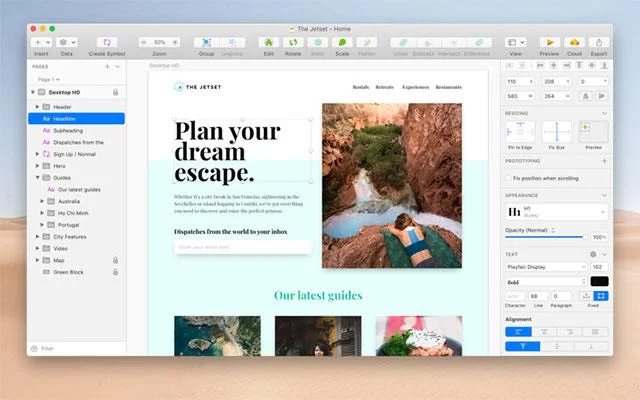
Sketch's interface is minimalist design but still full of features. The top vertical toolbar contains all the important tools and features. The Inspector on the right allows to adjust the properties of the selected layers. The Layer List is in the left pane, which lists all layers and Artboards in the document. Last but not least, Canvas is in the middle, where you'll see your entire design there.
There are no floating boards. Instead, the Inspector bar will display the current tools needed and hide other tools. Therefore, you can view the entire canvas without any hindrance.
If you use macOS 10.14 or higher, you can experience Sketch on a bright or dark interface.
Canvas on Sketch is not limited in size, you can scroll as far as you want and in any direction. If you want to create a fixed frame inside the Canvas, users only need to insert one or more Artboards.
The Inspector bar on the right allows you to adjust the settings of the current layer or options for the tool you are using. Once you've selected the layer, you'll see that the Inspector bar is divided into sections.
Not all sections are visible, depending on the selected layer type or whether it is in a group or an Artboard. The sections below the layer properties can be narrowed or expanded, allowing users to hide or display the content within.
Here, you can explore layering options, layer properties, text fields, up and down, increase and decrease values, perform calculations, resize, display and style, export layers or group ...
Layer List includes all the layers on the current page. Here you can view the properties of each layer, such as whether it is hidden or locked, as well as organize the document by renaming and rearranging the layer order.
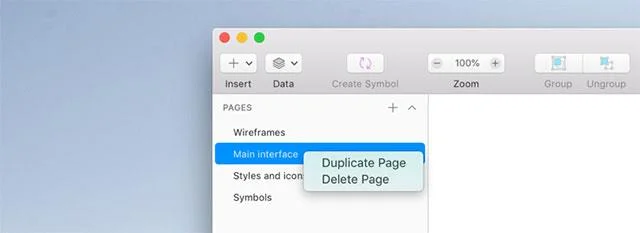
Sketch allows you to use multiple pages in your design and switch between them through the pop-up menu on the Layer List (or use the up / down function arrows). Layer List will display the layer of the current page only.
The artboard in the layer list is displayed along with the formatted content and the Artboard icon. These layers are on the top and cannot include other Artboards.
The title of the Artboard associated with the selected layer will appear above the Layer List, even if you have a large number of layers displayed on the interface.
Also in this layer list, users can learn more about masks, Boolean rules, icons and sharing styles, hide and lock layers, filter layers ...
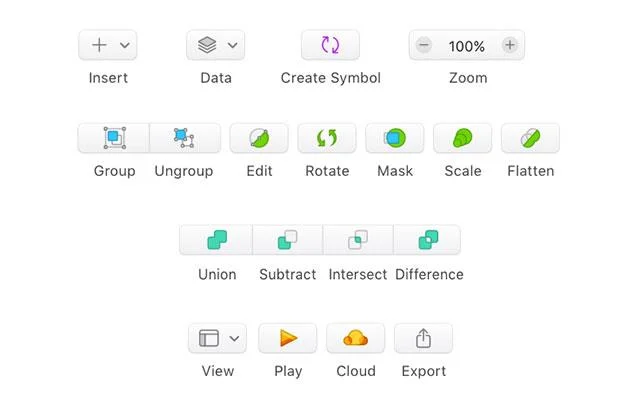
The Toolbar in Sketch provides all the tools needed for graphic design. The default settings include tools to insert layers, edit shapes and organize documents.
The toolbar includes the Insert menu, Data menu, Create Symbol, Zoom button, Group items and Ungroup to organize the list of layers.
Next are 4 editing tools that allow you to process the selected shape: Mask and Scale, Flatten, View and Preview.
Easily hide the toolbar by selecting View > Hide Toolbar from the menu bar. To show the toolbar when it is hidden, simply select View > Show Toolbar and you 're done.
For MacBook Pro users, the Touch Bar acts as an auxiliary panel in any app, and Sketch is no exception. Depending on your actions on the app, the Touch Bar will display the controls and shortcuts corresponding to that context.
With Touch Bar, we can insert layers, select layers, select multiple objects, edit shapes ...
Above, Download.com.vn took you 1 round to explore the main interface of Sketch graphics software. Hopefully the article will help you get an overview of the software and get to know the basic features of the program!
A guide to NATO Articles 4 and 5, UN self-defense rules, and why consultation does not mean automatic European entry into war.
Assess claims about Iran in six steps, distinguishing uranium enrichment, weapons development and verified possession.
Understand nuclear decision authority in six steps, including US civilian control and the limits of public information about Israel.
A guide to official 2026 evidence on Hormuz shipping disruption, Iran-related claims, confirmed incidents, and what remains uncertain.
A source-based guide to nuclear escalation risks, UN Charter rules and NATO Article 5 in a strictly hypothetical Iran scenario.
Use five steps to prepare for an outage; nuclear and EMP scenarios are hypothetical, and official shelter instructions come first.
Use 5 defensive steps to verify a cyber disruption, protect household accounts, and avoid mistaking an outage for war.
Use these 5 steps to assess climate effects from a hypothetical Iran strike, compare model assumptions, and avoid unsupported predictions.
Explore six steps for reading research on climate, food and ecosystem recovery after a hypothetical nuclear conflict.
Build a practical fallout preparedness kit in six steps, with sealed food and water, a radio, medical supplies and shelter guidance.