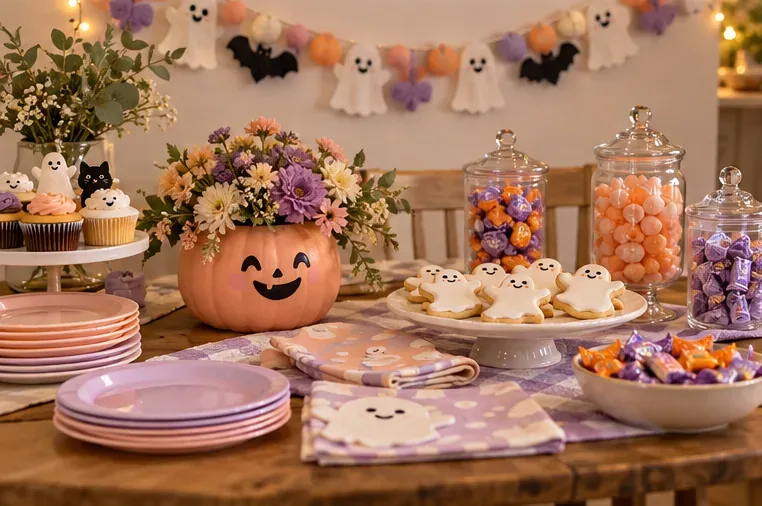
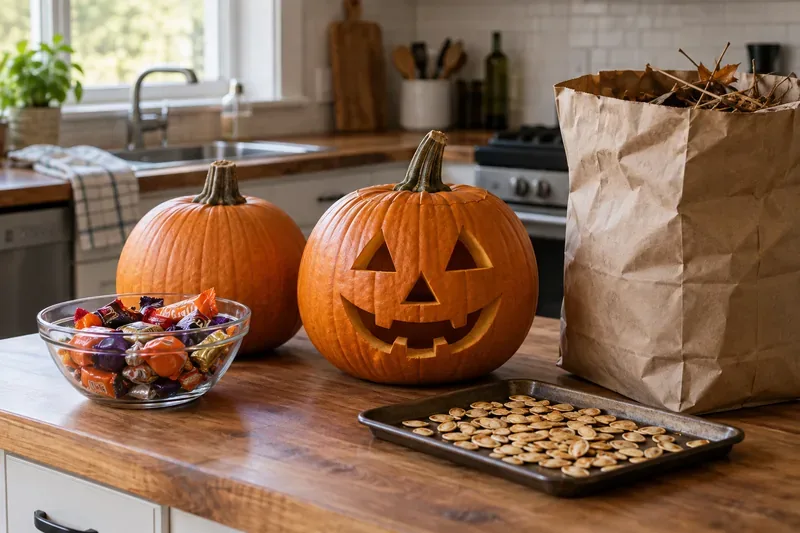
Summerween Explained: What It Is and How to Celebrate
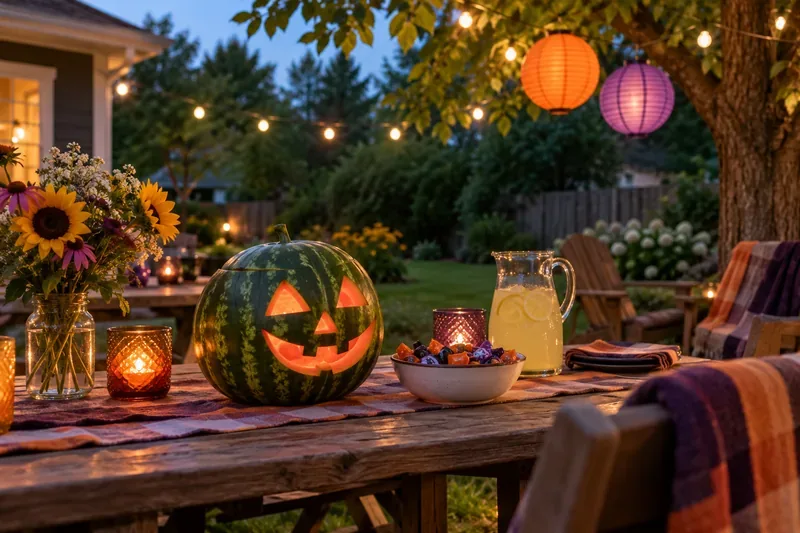
Learn how the Gravity Falls-inspired summer Halloween works, choose a date and celebration style, and plan a low-stress Summerween party.
The IF and IFS functions in Microsoft Excel are two of the logical functions used quite commonly for Microsoft Office users . In simplest terms, the IF / IFS function will return results based on one or several input comparison data.
Note :For examples and syntaxes of the IF and IFS functions below, we use a semicolon ( ; ) to separate, if in case the function reports an error or no output, please replace the semicolon ( ; ) with a comma ( , ).
With the IF function in Excel, you can perform a lot of different calculations including conditional formatting. For example, you can use it as an IF to classify students based on GPA, use the IF function to calculate numbers ...
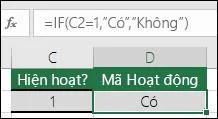
An IF statement will return two results including the first one if the condition is TRUE, and the second one will be executed for the remaining conditions (FALSE).
= IF ( Condition ; Do something if condition is true ; Do something with the other case )
If the above formula makes you confusing, please refer to the usage and the IF function examples in the content below.
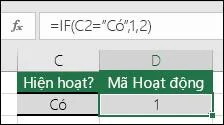
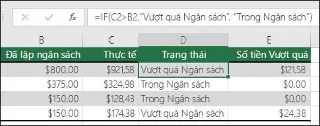
The formula in cell D2 will be: = IF (C2> B2; "Over Budget"; "In Budget")
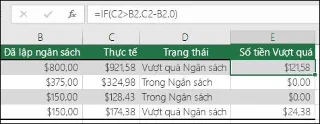
The formula in cell D2 will be: = IF (C2> B2; C2-B2; 0)
Sometimes you need to check if a cell is empty or not, usually because you don't want a formula to display the result without input. In this case, we will use the IF function together with the ISBLANK function :
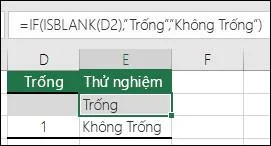
The formula in cell D2 will be: = IF (ISBLANK (D2); "Blank"; "Not Blank")
In the next example, we will use "" instead of the ISBLANK function. The "" sign essentially means "nothing".
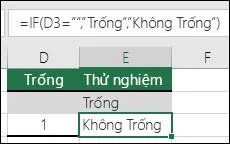
The formula in cell E2 is = IF (D3 = ""; "Blank"; "Not Blank")
In addition, the following is an example of a common method using "" to prevent a formula from performing calculations if an independent cell is empty:
= IF (D3 = ""; ""; Formula)
Explanation : IF (D3 has nothing, it returns no results, otherwise calculates your formula).
While the simple IF function only has two results ( True or False ), the nested IF function can have 3 to 64 results.
= IF (D2 = 1; "YES"; IF (D2 = 2; "No"; "Maybe")
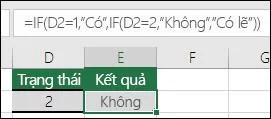
Explain the formula in cell E2: IF (D2 = 1 then return "Yes", otherwise IF (D2 = 2 then return "No", otherwise return "Perhaps") . Note that there are two closing parentheses at the end of the formula to complete both IF functions. If you try to enter a formula without both parentheses, Excel automatically adds the last closing parenthesis for you.
If the IF function alone is enough to use the basic conditions, IFS will make you feel better because IFS will combine multiple IF functions in a single IFS. In other words, instead of using multiple nested IFs, you only need to use IFS.
= IFS ( Condition 1 ; Value if DK1 is correct ; Condition 2 ; Value if DK2 is correct ; Condition 3 ; Value if DK3 is true ; .............)
The IFS function can test up to 127 different conditions, but you should not nest too many conditions because it will be difficult to check if errors or data conflicts occur.
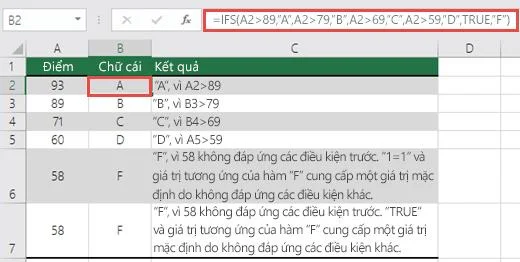
The formula for the cells in column B is: = IFS (A2> 89; "A"; A2> 79; "B"; A2> 69; "C"; A2> 59; "D"; TRUE; "F" )
Does that mean:
Learn how the Gravity Falls-inspired summer Halloween works, choose a date and celebration style, and plan a low-stress Summerween party.
Plan an inclusive virtual Halloween party for remote teams with time-zone-friendly scheduling, simple games, accessible options, and a practical hosting checklist.
Explore seven Halloween team building games for the workplace, with quick rules, hybrid-friendly options, accessibility tips, and practical safety guidance.
Mix a glossy prop-only fake blood batch, choose safer products for skin and costumes, and test cleanup before Halloween night.
Create a gentle Halloween look with pastel colors, friendly ghosts, easy no-carve accents, and practical safety tips for your home.
Create a spooky office cubicle with Halloween desk decor ideas that keep your workspace usable, tidy, and mindful of workplace safety.
Plan a recognizable Halloween 2026 look with pop culture costumes inspired by Spider-Man, Supergirl, Toy Story 5, Moana, Mario, and Wednesday.
Sort leftover Halloween candy safely, share or repurpose sealed treats, and choose food use or compost for pumpkins based on their condition.
Compare workplace Halloween costume choices by respect, dress code, mobility, and safety—and learn when a subtle accessory or a policy check is the better option.
Find a couples costume that fits your style, budget, and comfort level, from Addams Family classics to original inside-joke duos.